


Smartwatch vs connected ring: Why screens and sensors matter

Founder & CEO, Smartlet - CentraleSupelec engineer - Concours Lepine 2025, Awarded - CES 2026
Table of Contents
- The role of screens: visibility and daily data access
- Sensor technology: tracking accuracy and workout performance
- The daily reality: standalone features and practical limitations
- Edge cases: when a connected ring makes sense
- Smartwatch and mechanical timepiece: proven workflow for performance and prestige
- How Smartlet bridges mechanical and connected watch worlds
- Frequently asked questions
Key takeaways
| Point | Details |
|---|---|
| Screen visibility advantage | Smartwatches give real-time data and app access on your wrist for seamless daily use. |
| Superior sensor tech | Advanced sensors in smartwatches provide more accurate and actionable feedback for workouts and health. |
| Standalone independence | Smartwatches function independently for payments, music, and navigation, unlike phone-dependent rings. |
| Edge case: ring comfort | Connected rings excel in overnight wear and provide reliable passive sleep tracking. |
| Mechanical and smart combined | A mechanical watch paired with a smartwatch via Smartlet covers every use case a ring cannot. |
For watch collectors who also care about performance data, the choice between a connected ring and a smartwatch feels deceptively simple. It is not. Both devices track your health, but they operate in fundamentally different ways, with real consequences for daily usability, athletic performance, and professional image. Screens, sensor arrays, and standalone capabilities separate these two categories more than most reviews admit. And for collectors who refuse to sacrifice mechanical prestige for connected functionality, understanding these differences is the first step toward a smarter setup.
The role of screens: visibility and daily data access
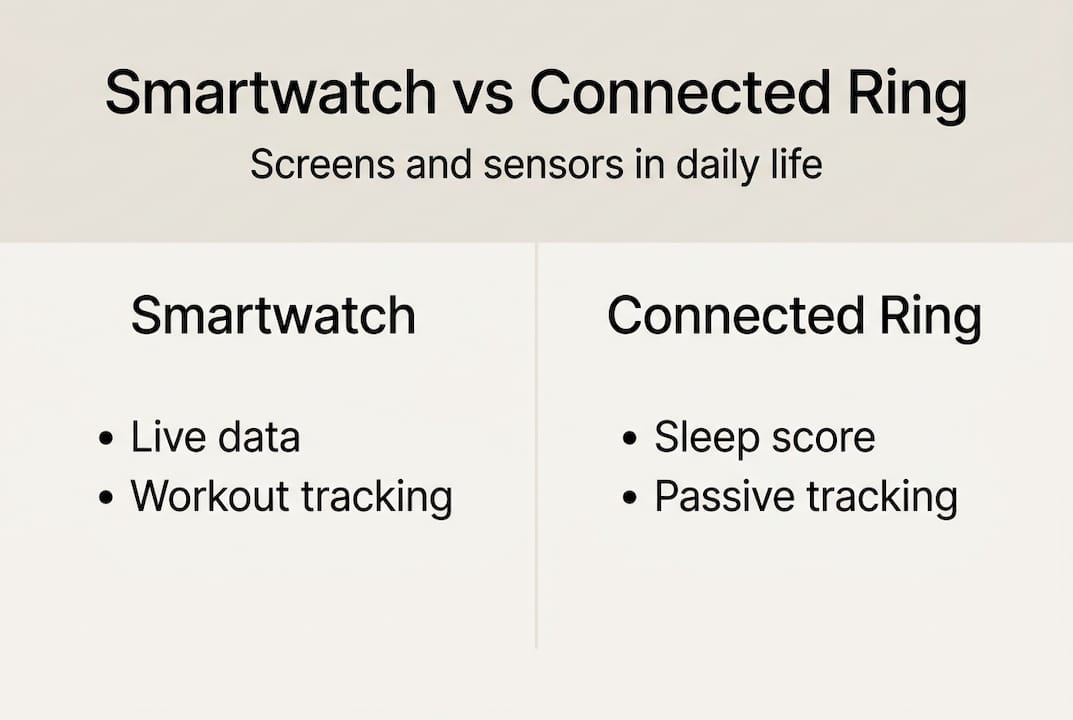
The screen is not just a feature. It is the entire interaction model. Smartwatches provide real-time data access, notifications, and on-device apps in a way that screenless rings simply cannot match. A ring sends data to your phone. A smartwatch puts it on your wrist, instantly, without unlocking anything. Smartwatches provide real-time data access
For watch collectors, this distinction matters more than it might seem. A mechanical watch already occupies the wrist with intention and presence. Adding a smartwatch on the same wrist keeps data visible without forcing you to pull out your phone mid-meeting. The smartwatch ecosystem has expanded to support this kind of modular approach, making the screen argument even stronger for discerning users. smartwatch compatibility
Here is what a smartwatch screen enables that a ring cannot:
- Instant notification previews without touching your phone
- Turn-by-turn navigation on your wrist during travel or runs
- Contactless payments via NFC, no wallet or phone required
- Music control and playback directly from the device
- On-device apps for weather, calendars, and fitness coaching
"The screen transforms a passive sensor into an active tool. Without it, you are always one step removed from your data."
| Feature | Oura Ring / Galaxy Ring | Apple Watch / Garmin |
|---|---|---|
| Sensor surface | Finger PPG (strong HRV) | Wrist optical + ECG |
| Screen | None | Full touchscreen |
| Battery life | 5 to 7 days | 1 to 14 days (model varies) |
| Interactions | Phone app only | On-wrist, standalone |
| Price range | $299 to $399 | $249 to $799+ |
The smart ring vs smartwatch debate often focuses on comfort and battery life, but the screen gap is where daily usability diverges most sharply. smart ring vs smartwatch
Sensor technology: tracking accuracy and workout performance
Beyond screens, sensors define what a wearable actually knows about your body. And here, the gap between rings and smartwatches is significant for active users.
Smartwatches feature GPS, ECG, and higher resolution sampling, with devices like Garmin recording data at one-minute intervals or better. Rings, by contrast, rely on finger-based PPG, which is excellent for resting HRV but limited during movement. Sweat, finger position, and activity intensity all reduce ring accuracy during workouts. Smartwatches feature GPS, ECG, and higher resolution sampling

Garmin smartwatches match or exceed rings in sleep and vitals accuracy, and they detect GPS events that rings miss entirely. For a collector who also trains seriously, this is not a minor footnote. Garmin smartwatches match or exceed rings
The practical performance sequence for active monitoring:
- Pre-workout: smartwatch locks GPS signal and sets baseline heart rate zones. Pre-workout:
- During activity: live pace, cadence, and heart rate displayed on screen in real time. During activity:
- Peak effort: ECG-capable watches flag arrhythmias or anomalies instantly. Peak effort:
- Recovery: both devices track HRV, but watches offer immediate post-session summaries. Recovery:
- Sleep: rings regain ground here, with stable finger contact through the night. Sleep:
For those curious about the medical side of wrist-based monitoring, the Apple Watch ECG feature is a real consideration for collectors. The broader story of smartwatch heart monitoring saving lives globally adds weight to the sensor argument. Apple Watch ECG and mechanical prestigesmartwatch heart monitoring
Real-world comparisons between Apple Watch and smart ring confirm what benchmarks suggest: for active tracking, smartwatches win. For passive overnight use, rings hold their own. real-world Apple Watch and smart ring comparisons
Use your smartwatch for live workout tracking and your ring, if you own one, for passive overnight HRV monitoring. They are not rivals. They are complements, if your setup allows it.
The daily reality: standalone features and practical limitations
Sensor accuracy and screen visibility matter most when you are moving through a real day. And in real life, rings create friction that smartwatches eliminate.
Smartwatches enable standalone use for payments, music, and navigation, even when your phone is left behind. A ring, by design, requires phone sync for all of its data. Leave your phone at the hotel gym locker and your ring becomes a passive sensor with no output you can actually use.
For collectors who travel frequently, this matters. Navigating an unfamiliar city, paying for a coffee, and checking your heart rate, all without reaching into your pocket: a smartwatch handles all three. A ring handles none of them independently.
Smartwatch standalone capabilities:
- LTE calls and messages without a phone
- Apple Pay or Google Pay for contactless transactions
- Offline maps and GPS navigation
- Spotify or Apple Music playback directly from the device
- Emergency SOS and fall detection
Connected ring limitations:
- All data requires phone app to view
- No payment functionality
- No GPS (relies on phone location)
- No notifications or alerts on the device itself
- Data gaps occur whenever phone is out of range
For collectors who want to maximize smartwatch utility, modular strap systems are a key part of the answer. And for those who want connected tech without compromise, the modular approach resolves the daily friction entirely. tips to maximize smartwatch utilityconnected tech without compromise
Smart ring limitations confirmed by independent reviewers: rings are best understood as supplementary devices, not primary wearables. smart ring limitations
Edge cases: when a connected ring makes sense
Fairness demands acknowledging where rings genuinely excel. There are real scenarios where a ring outperforms a smartwatch.
Finger PPG provides superior HRV data for passive sleep monitoring, because the finger has less motion artifact and better arterial contact during rest. For users who find wrist-worn devices uncomfortable overnight, a ring solves that problem cleanly.
Where rings hold a genuine advantage:
- Overnight comfort: lighter, smaller, and less intrusive than any smartwatch. Overnight comfort:
- HRV precision at rest: finger PPG captures cleaner signals during sleep. HRV precision at rest:
- Battery endurance: five to seven days versus one to two for most smartwatches. Battery endurance:
- Discretion: no screen means no social friction in formal or minimalist settings. Discretion:
- Some users find ring data more consistent for establishing resting baselines. Finger-based data:
Where smartwatches are clearly superior:
- Real-time workout feedback with live metrics on screen
- GPS tracking without a phone
- ECG and arrhythmia detection
- Standalone communication and payments
- Professional image with a visible, premium device
One benchmark worth noting: the Circular Ring showed an 11-minute sleep duration difference compared to Garmin, which highlights that rings lack the real-time feedback loop that performance athletes need.
For the collector athlete, the most rational approach is a hybrid setup. Wear your mechanical watch during the day for prestige and presence. Switch to your smartwatch for training and travel. Use a ring overnight if sleep data is a priority. connecting mechanical and smart watches
Smartwatch and mechanical timepiece: proven workflow for performance and prestige
Most mainstream advice tells collectors to pick one world: classic or connected. That advice is outdated and unnecessary.
Combining a mechanical watch with a smartwatch using a modular connector system covers every use case that a ring cannot. Live workout data. Standalone navigation. ECG monitoring. Contactless payments. Professional image at the boardroom table. A ring covers none of these.
"Combining a mechanical masterpiece with a connected watch is not a compromise. It is an advantage."
For collectors mixing mechanical and smart watches, the modular approach resolves the false dilemma entirely. You do not have to choose between the craftsmanship of a Rolex Submariner and the sensor depth of an Apple Watch. You wear both, each in its moment, each at its best. collectors mixing mechanical and smart watches
How Smartlet bridges mechanical and connected watch worlds
Smartlet was built by a watch collector who refused to choose. The patented modular strap adapter is engineered in brushed SS316L steel and Grade 2 titanium, compatible with any watch from 18 to 24mm lug width. No modification. No permanent alteration. Both watches, same wrist, same moment. Smartlet modular strap adapter
Three versions are available: Classic at 299 EUR, Shadow at 399 EUR, and Titanium at 549 EUR. Bronze Medal, Concours Lepine 2025. Presented at CES 2026. watch brand compatibilityClassic version
Featured Articles
No people found
We couldn’t find anything with that term. Please try again.


