


Mechanical watch vs smartwatch: Wear both without compromise

Founder & CEO, Smartlet - CentraleSupelec engineer - Concours Lepine 2025, Awarded - CES 2026
Table of contents
Key takeaways
| Point | Details |
|---|---|
| You can wear both | Collectors and professionals do not have to choose - multiple solutions let you enjoy mechanical and smartwatches simultaneously |
| Double-wristing is established | One mechanical, one smartwatch, two wrists - fashionable, practical, and embraced by notable personalities worldwide |
| Modular straps simplify integration | Smartlet modular bands combine both watch types on one wrist without modifying either timepiece |
| Hybrid watches are a compromise | Hybrid models mix analog hands with smart features but sacrifice depth on both ends |
| Choose based on your needs | Performance, style, and legacy priorities determine whether double-wristing, modular straps, or hybrids serve you best |
Every morning you stand at the dresser, your Submariner on the left, your Apple Watch Ultra 3 on the right, and you feel the weight of a false choice. One represents decades of craft, a movement that breathes without a battery. The other tracks your sleep, your heart rate, your next meeting. Choosing between them feels like choosing between who you are and how you live.
Why the either/or mindset no longer holds
The mechanical watch and the smartwatch are not rivals. A Speedmaster on your wrist carries the weight of history - a movement built by human hands, an object that no firmware update can replicate. A Garmin Fenix 8 Pro is a performance computer: VO2 max, trail mapping, irregular heartbeat alerts. Neither does the other's job. That is the point.
Neither does the other's job. That is the point.
For years, collectors on WatchUSeek and r/Watches debated dual wear. The consensus is shifting. More members openly discuss wearing a mechanical piece alongside a connected watch - not as a compromise but as a deliberate choice.
While in the past many saw incorporating a smartwatch as "downgrading," it is now common for serious collectors to openly discuss wearing connected watches alongside - and at times simultaneously with - their high-end mechanical pieces.
Hybrid watches blend analog aesthetics with smart features, but ask you to accept trade-offs on both sides. You get neither the full mechanical soul nor the complete sensor suite of a dedicated smartwatch. That gap is exactly where Smartlet was born.
- Mechanical watches carry emotional and historical value that no algorithm can replicate
- Smartwatches deliver real-time health data, GPS, notifications, and payment capabilities that mechanical movements cannot provide
- Hybrid watches offer a middle ground but sacrifice depth on both ends: you get neither the full mechanical soul nor the complete sensor suite
- Collectors and professionals Collectors and professionals increasingly need both - not a diluted version of each
- Apple Watch and Samsung Galaxy Watch pairing are now central questions in collector communities
Smartlet was created by David Ohayon, a French inventor and watch collector who refused to choose. The patented modular strap holds your smartwatch beneath your mechanical piece on a single wrist: no permanent modification, no sensor compromise.
Double-wristing: one watch per wrist
Double-wristing is exactly what it sounds like. One mechanical watch on one wrist, one smartwatch on the other. Simple in theory. The most accessible entry point for collectors who want full functionality from both pieces without any hardware changes.
Celebrities and collectors embrace double-wristing as a way to honor tradition while staying connected. The practice has moved from niche forums to mainstream watch media. Searches for "double-wristing" have grown steadily, and dual wear content consistently ranks among the most-read in collector publications.
Pros of double-wristing:
- Full features from both watches, zero compromise
- No modifications to either piece
- Maximum flexibility to swap watches independently
- Works with Withings ScanWatch or any other smartwatch combination
Cons of double-wristing:
- Can feel physically awkward, especially during workouts
- Style coordination becomes more complex
- Some sensor redundancy between wrists
- Not ideal for formal settings where one watch is already pushing convention.
Double-wristing works. But for many collectors, wearing both on a single wrist is the more elegant solution.
Smartlet modular straps: two watches, one wrist
The Smartlet modular system replaces your mechanical watch's strap and holds your smartwatch securely beneath it - preserving every sensor, every reading, every notification. No permanent changes required to either timepiece.
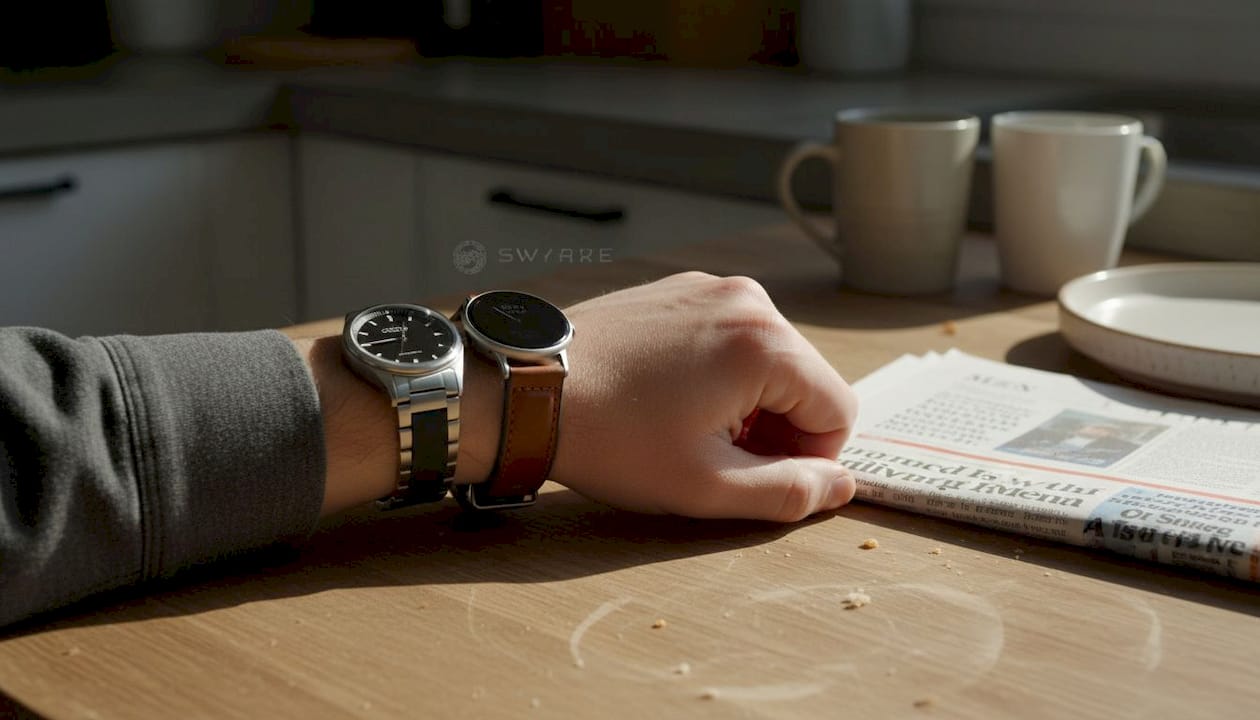
Smartlet does add some thickness and weight to the wrist, and that is an honest trade-off. But it is fully reversible. Remove the Smartlet, reinstall your original strap, and your Rolex or Omega is exactly as it was. No marks, no modifications, no regrets.
For performance professionals, this matters enormously. A surgeon who wears a Speedmaster for its precision and an Apple Watch for its ECG capability does not want to choose between them in the operating room corridor. A competitive cyclist who values a vintage Omega but needs Garmin training metrics on the road finds a real answer here.
| Feature | Smartlet modular | Double-wristing | Hybrid watch |
|---|---|---|---|
| Both watches on one wrist | Yes | No | N/A |
| Full smartwatch sensors | Yes | Yes | Partial |
| Mechanical movement preserved | Yes | Yes | Partial |
| Permanent modification required | No | No | No |
| Style flexibility | High | Medium | Low |
| Comfort during workouts | Good | Variable | Excellent |
| Suunto compatibility | Yes | Yes | N/A |
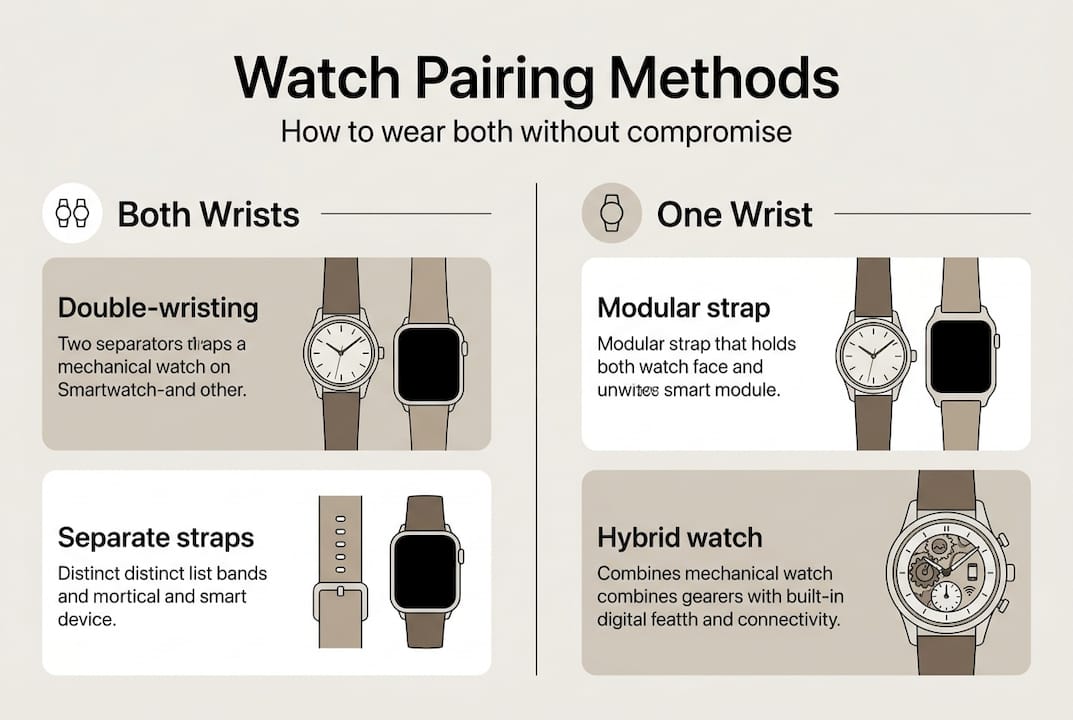
Three versions of the Smartlet bracelet address different collector priorities. Classic (299 EUR) in brushed SS316L. Shadow (399 EUR) with black PVD. Titanium (549 EUR) in Grade 2 titanium: at the same volume, titanium weighs about 4.5 g/cm3 against 7.9 g/cm3 for 316 steel. Patented in the EU, US, and Japan. Concours Lepine 2025 Bronze Medal, CES 2026.
Hybrid watches: best of both worlds?
Hybrid watches look like traditional watches - physical hands, traditional dials - but embed smart sensors beneath the surface. For collectors who want one watch that does most things adequately, they are worth considering.
The Withings ScanWatch 2 and Garmin Instinct Crossover are the strongest current options. The ScanWatch 2 offers medical-grade ECG and AFib detection with a 30-plus day battery. The Instinct Crossover adds GPS and military-grade durability. The Technik 4X TwinTimer takes a different approach, housing two independent movements in a single case.
Normal hands and arms present challenges to interaction with small displays, so focus on key features and interactions before selecting a hybrid form that can effectively present glanceable data.
| Model | Battery | Key sensors | Movement type | Style |
|---|---|---|---|---|
| Withings ScanWatch 2 | 30+ days | ECG, SpO2, AFib | Quartz + smart | Classic dress |
| Garmin Instinct Crossover | 70+ days | GPS, HR, stress | Quartz + smart | Sport/rugged |
| Technik 4X TwinTimer | Varies | Basic smart | Auto + quartz | Contemporary |
- Define your non-negotiables: GPS, ECG, or long battery life
- Check compatibility if you already own a connected health ecosystem before committing to a hybrid.
- Assess dial legibility - small displays behind analog hands can be frustrating in daily use.
- Consider Huawei Watch GT if you are already in that ecosystem
- Try the watch in person before committing - hybrid sizing often differs from pure smartwatches.
Hybrids are a good option for collectors because they look great and come with many of the core features of a smartwatch. However, if you are looking for the full smartwatch experience, hybrids are not the best choice.
Collector and professional scenarios
Your lifestyle determines your answer.
- The legacy collector: You own a Submariner or Speedmaster and refuse to compromise its integrity. You want full Apple Watch or Garmin functionality. Smartlet is purpose-built for this scenario
- The performance professional: You train seriously, track metrics obsessively, and still wear a mechanical piece to client meetings. Double-wristing works for casual days. Smartlet works when you need both on the same wrist
- The minimalist collector: You want one watch that handles most things. A hybrid like the ScanWatch 2 or Instinct Crossover fits your philosophy
- The brand mixer: You pair a vintage Omega with a modern Garmin Forerunner. The brand compatibility guide at Smartlet covers most major combinations and helps confirm fit before purchasing.
- The Whoop user: Whoop's screenless form factor makes it one of the cleanest pairings with a mechanical watch via Smartlet - minimal visual bulk, maximum data
The right solution fits your collection, your wrist, and your day. The better question is not which watch to wear - it is how to wear both.
Smartlet keeps both worlds on your wrist - same moment, no compromise.
Featured Articles
No people found
We couldn’t find anything with that term. Please try again.


