


How to wear a vintage watch and smartwatch together

Founder & CEO, Smartlet - CentraleSupelec engineer - Concours Lepine 2025, Awarded - CES 2026
Table of Contents
- Why collectors want both vintage and smartwatches
- Introducing modular bracelets: The Smartlet system
- Comparing stacking, double-wristing, and vintage adapters
- Practical tips, edge cases, and expert advice on wearing both
- Why hybrid watch solutions mark a new era
- Explore Smartlet solutions for collectors
- Frequently asked questions
Key Takeaways
| Point | Details |
|---|---|
| Stack both watches | Modular bracelets like Smartlet allow collectors to wear a vintage watch and a smartwatch on one wrist stylishly. |
| Understand compatibility | Smartlet fits most 18-24mm lug watches and major smartwatches, but check wrist size and model specifications. |
| Minimize risk | Stacking risks scratching and bulk; use practical tips to keep both watches secure and protected during daily wear. |
| Choose the right method | Double-wristing keeps watches pristine; modular stacking balances tradition, tech, and convenience. |
The Rolex 5513 Submariner sitting in a drawer three days a week is not a collection. It is storage. A lot of collectors know this feeling: you spent years tracking down the right dial, the right patina, the right provenance, and then you wear it twice a year because you are afraid to scratch it. Meanwhile, your Apple Watch stays on your wrist because you need the health data, the notifications, the GPS. The choice felt real and permanent. It is not. Modular bracelet technology, and specifically the Smartlet system, now makes it possible to wear both a mechanical vintage watch and a smartwatch on the same wrist, every single day, without compromising either.
Why collectors want both vintage and smartwatches
Vintage mechanical watches carry something no algorithm can replicate. A 1960s Omega Seamaster, a Heuer Carrera 2447, a Rolex 1680 with a red Submariner text dial: these objects hold history in their movements. Collectors do not buy them for timekeeping accuracy. They buy them for what they represent. double-wristing origins
But smartwatches have become genuinely useful in ways that are hard to ignore. Sleep tracking, heart rate monitoring, ECG readings, step counts, message alerts: these features affect daily quality of life in measurable ways. Skipping them to wear a vintage piece is a real trade-off, not a trivial one.
Here is what most collectors actually want:
- The craftsmanship and heritage of a mechanical watch on display
- The health and connectivity features of a smartwatch running in the background
- Zero modification to their vintage case or bracelet
- A solution that looks intentional, not improvised
The traditional options were limited. You could alternate watches day by day, which meant your vintage piece sat unused most of the time. You could try double-wristing, one watch per wrist, which works but feels awkward for many people and still forces a choice about which wrist gets which watch. double-wristing
Wearing both is common among collectors for full functionality, but it requires two wrists and still leaves one watch feeling secondary.
The real shift came when modular bracelet systems entered the picture.
Introducing modular bracelets: The Smartlet system
Smartlet is not a strap hack. It is a precision-engineered bracelet system built in brushed SS316L stainless steel or Grade 2 titanium, designed to hold two watches on one wrist simultaneously. The system positions your mechanical watch on top and your smartwatch underneath, secured by dual locking clasps that require no tools to operate. Smartlet bracelet system
The physics here matter. The smartwatch underneath the wrist, in the central part of the bracelet, balances the weight of the mechanical watch above it, which spreads the load more evenly than a single heavy watch.
Key specs worth knowing:
- Lug compatibility: 18mm to 24mm, fits via standard spring bar with no case modification. Lug compatibility:
- Materials: brushed SS316L steel for the Classic and Shadow versions, Grade 2 titanium for the Titanium version. Materials:
- Thickness added: 9 to 12mm total
- Smartwatch compatibility: Apple Watch, Garmin, and most major connected watch brands. Smartwatch compatibility:
- Pricing: Classic at 299 EUR, Shadow at 399 EUR, Titanium at 549 EUR. Pricing:
The Smartlet system includes dual security locks and tool-free swapping in seconds, compatible with Rolex, Omega, Apple Watch, and Garmin. The concept was presented at CES 2026 and won a Bronze Medal at Concours Lepine 2025. tool-free swapping in secondsinnovative watch bracelet
| Version | Material | Price (EUR) | Weight added |
|---|---|---|---|
| Classic | Brushed SS316L steel | 299 | ~80g |
| Shadow | Black PVD SS316L steel | 399 | ~80g |
| Titanium | Grade 2 titanium | 549 | ~60g |
When fitting Smartlet watch adapters to a vintage watch, use the spring bar tool included in the box and inspect the lug holes for wear before installation. Vintage cases from the 1960s and 1970s sometimes have softer lug metal than modern references. A snug fit matters.
The CNET review of Smartlet describes the experience as surprisingly comfortable. The system feels lighter on the wrist than most people expect. CNET review of Smartlet

Comparing stacking, double-wristing, and vintage adapters
Not every solution fits every collector. Understanding the real trade-offs helps you choose the right approach for your specific watches and lifestyle.
Legacy adapters, the kind that attach a smartwatch module to a traditional watch strap or case back, are mostly discontinued and not viable for vintage pieces. They often required case modifications, drilling, or adhesive attachment, none of which are acceptable for a collectible reference. mostly discontinued and not viable for vintage
Double-wristing is a common alternative among collectors who want full functionality from both watches. It keeps each piece pristine and untouched. The downside is that it can feel socially awkward, and many people find wearing a watch on their non-dominant wrist uncomfortable for daily tasks.
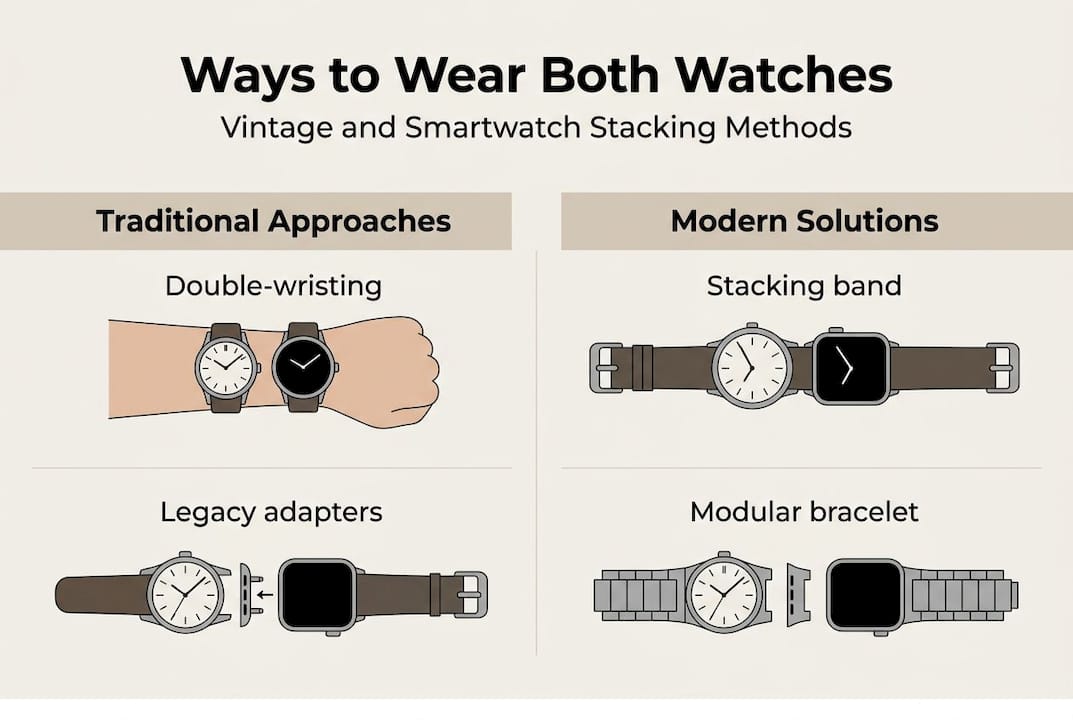
Here is how the three main approaches compare:
| Method | Pros | Cons | Price range | Risk to vintage |
|---|---|---|---|---|
| Modular bracelet (Smartlet) | Both watches, one wrist, daily wear | Adds 9-12mm thickness, 60-100g | 299-549 EUR | Low, no modification |
| Double-wristing | Zero bulk, both watches pristine | Two wrists needed, can feel awkward | Free | None |
| Legacy adapters | Low cost historically | Discontinued, modification risk | Varies | High |
- Smartlet requires a minimum wrist circumference of 16cm for a secure and comfortable fit.
- Double-wristing works best when both watches have similar lug widths and strap profiles.
- Legacy adapters should be avoided entirely for any watch with collector or resale value.
"Protect your vintage piece and your smartwatch by choosing a method that does not permanently modify either watch case." vintage and smartwatch safely
The Smartlet review on A Blog to Watch notes that the system is genuinely engineered for collectors who want both watches active simultaneously, not just displayed. connecting watches
Practical tips, edge cases, and expert advice on wearing both
Daily wear with two watches stacked requires a bit of attention, especially in the first week. The risks are real but manageable once you know what to watch for.
The most common issue is desk contact. When you rest your wrist on a hard surface, the underside watch can press against the desk edge. This is rarely a problem for the smartwatch itself, but checking the security locks before each wear is a sensible habit.
Sensor functionality is a common question. The system feels lighter than expected and sensors work correctly as long as the smartwatch is not inverted. ECG readings require skin contact on the correct side, so orientation matters.
Practical checklist for dual-watch daily wear:
- Check lug width compatibility before purchasing any modular system. Check lug width compatibility
- Inspect spring bars on vintage watches every 3 to 6 months
- Clean the bracelet and case backs regularly to prevent buildup under the smartwatch.
- Verify security locks are fully engaged before leaving the house. Verify security locks
- For high-impact activity, keep your Apple Watch on its standard strap for that session. For high-impact activity,
| Pitfall | Risk level | Prevention |
|---|---|---|
| Desk contact | Medium | Adjust wrist angle, use desk pad |
| Spring bar failure on vintage | Low with inspection | Regular checks, quality bars |
| Sensor inversion | Low | Keep smartwatch face toward wrist |
| Lug mismatch | Medium | Verify specs before purchase |
The Yanko Design review highlights that Smartlet's approach makes wearing both watches feel natural rather than forced. For specific guidance on Rolex and Apple Watch techniques, Smartlet's press coverage walks through real configurations in detail. Yanko Design reviewRolex and Apple Watch techniques
Why hybrid watch solutions mark a new era
There is a certain type of collector who views any adaptation as a betrayal of the craft. That position is understandable. Vintage watch culture has always valued purity: original dials, unpolished cases, untouched movements. But that framing misses a key point.
But collector etiquette is evolving. The Heuer Carrera 2447 on your wrist is not diminished by the health data running underneath it. If anything, wearing it daily honors it more than keeping it in a drawer.
Esquire called the Smartlet concept innovative but noted it reads as awkward or futuristic to some observers, positioning it as a niche solution for collectors who want to avoid double-wristing. That is a fair read. Not every collector will adopt it. But the ones who do are not compromising. They are composing.
Think of a modular system as functional fashion. It is a deliberate choice, not a workaround. The real shift is cultural: stacking reflects a new balance between tech and tradition, one that lets both coexist without either apologizing for the other.
Daily wear is the only true tribute to a mechanical watch. Smartlet makes that daily wear possible without sacrificing the health monitoring that modern life demands.
Explore Smartlet solutions for collectors
If you have been keeping a vintage Omega Seamaster or a Rolex in its box because daily wear felt too risky, the Smartlet modular strap changes that calculation. The system is engineered specifically for collectors who refuse to choose between craftsmanship and connectivity. Smartlet modular strap
The brand compatibility guide covers lug widths, case dimensions, and smartwatch pairings across dozens of references, so you can confirm fit before you commit. The accessories collection offers options designed for the same precision standards as the bracelet itself. brand compatibility guideaccessories for Smartlet
Featured Articles
No people found
We couldn’t find anything with that term. Please try again.


