


Guide complet des largeurs de cornes : de 18 mm à 24 mm pour les collectionneurs

Fondateur & PDG, Smartlet · Ingénieur CentraleSupélec · Concours Lépine 2025, Lauréat · CES 2026
Table des matières
- Comprendre les bases de la largeur de barrette et les techniques de mesure
- Largeurs de barrette standard et variations de conception : choisir le bon ajustement
- Matériau, conicité et compatibilité des bracelets : esthétique et durabilité
- Considérations spéciales pour les montres intelligentes et les montres d'outil
- Enrichissez votre collection avec les bracelets et connecteurs modulaires de Smartlet
- Le guide complet de la largeur de barrette : 18 mm à 24 mm pour les collectionneurs de montres FAQ
Points clés
| Point | Détails |
|---|---|
| Mesurez l'écart interne | Pas les bords extérieurs. Pas le diamètre du boîtier. La distance interne entre les barrettes où repose la barre de ressort. |
| 20 mm domine | La largeur de barrette la plus courante sur les montres contemporaines de Rolex, Omega, Tudor et la plupart des marques de milieu de gamme. |
| Arrondissez toujours vers le bas | Une mesure de 20,3 mm signifie un bracelet de 20 mm. Forcer un bracelet plus large plie la barre de ressort et endommage les canaux de barrette. |
| Les barrettes courbes nécessitent des bracelets courbes | Les bracelets droits sur des barrettes courbes créent des espaces visibles et un mauvais alignement. Vérifiez la géométrie de la barrette avant de commander. |
| Smartlet couvre 18-24 mm | Le kit d'ajustement universel couvre toute la gamme des montres de collection. Un système, n'importe quelle montre de votre rotation. |
Échec de la commande de bracelet de montre Cela vous est arrivé à un moment ou à un autre. Vous trouvez une image en ligne d'un bracelet qui correspond à la circonférence de votre montre, et vous êtes convaincu que les trous de 20 x 22 mm et la largeur du bracelet s'adapteront. Vous commandez et deux semaines plus tard, votre nouveau bracelet arrive.
Comment mesurer correctement
Vous prenez ensuite le moins de temps possible pour confirmer vos hypothèses et presque instantanément, alors que le bracelet est en route vers le vendeur en ligne, vous devez vous sentir un peu bête et légèrement contrarié par vous-même. Les choses importantes à retenir sont donc : 1. La largeur de barrette est la mesure la plus importante pour les bracelets de montre (vous pouvez deviner le reste de cette affirmation) 2. La largeur de barrette est impossible à déterminer avant de commander en ligne. Ce guide aurait dû être lu avant votre désastre.
Comprendre les bases de la largeur de barrette et les techniques de mesure
Pour mesurer votre poignet avec précision, vous aurez besoin d'un pied à coulisse numérique ou au moins d'une règle aussi précise que possible. Votre mesure doit être prise entre les barrettes ou les espaces entre les barrettes. Mesurez toujours de l'intérieur des barrettes, jamais du bord extérieur. Un pied à coulisse numérique peut mesurer jusqu'à 0,01 mm. Pour nos besoins, vous devez arrondir cette mesure au millimètre le plus proche. Une marge d'erreur de 1 mm peut causer des problèmes avec le bracelet et des dommages possibles à la barre de ressort.utilisez un pied à coulisse numérique ou une règle précisePositionné au point le plus étroit entre les barrettes. Placez l'outil de mesure à l'intérieur des barrettes, pas sur les bords extérieurs. Les pieds à coulisse numériques offrent une précision de 0,01 mm, bien que l'arrondi au millimètre le plus proche fonctionne pour la sélection de bracelet. Évitez d'estimer les mesures à l'œil nu, car une erreur de 1 mm crée des problèmes d'ajustement et des dommages potentiels à la barre de ressort.
Une marge d'erreur de 1 mm peut causer des problèmes avec le bracelet et des dommages possibles à la barre de ressort.utilisez un pied à coulisse numérique ou une règle précisePositionné au point le plus étroit entre les barrettes. Placez l'outil de mesure à l'intérieur des barrettes, pas sur les bords extérieurs. Les pieds à coulisse numériques offrent une précision de 0,01 mm, bien que l'arrondi au millimètre le plus proche fonctionne pour la sélection de bracelet. Évitez d'estimer les mesures à l'œil nu, car une erreur de 1 mm crée des problèmes d'ajustement et des dommages potentiels à la barre de ressort.
Il y a une erreur courante commise lors de la mesure de la longueur d'une montre qui consiste soit à mesurer à partir des bords extérieurs des barrettes de la montre, soit à estimer la mesure à partir du diamètre du boîtier de la montre. Ce qu'ils doivent vraiment mesurer, c'est l'écart interne de la montre. Certains collectionneurs mesureront une montre qui a encore son bracelet actuel, ce qui ne sera pas la mesure de l'ouverture de la barrette. Il est très préférable de retirer le bracelet pour obtenir une mesure précise. Un outil de mesure de largeur de barrette conçu pour les montres rend ce processus très facile.outil de mesure de largeur de barretteConçu spécifiquement pour les montres simplifie ce processus.
La largeur de barrette est la seule mesure qui détermine tout le reste. Obtenez-la correctement une fois et chaque changement de bracelet après cela prend trente secondes.
Certains collectionneurs mesureront une montre
Certains collectionneurs mesureront une montre qui a encore son bracelet actuel, ce qui ne sera pas la mesure de l'ouverture de la barrette. Il est très préférable de retirer le bracelet pour obtenir une mesure précise. Un outil de mesure de largeur de barrette conçu pour les montres rend ce processus très facile.outil de mesure de largeur de barretteConçu spécifiquement pour les montres simplifie ce processus.
Meilleures pratiques de mesure :
- Retirez les bracelets existants avant de mesurer pour accéder à la véritable ouverture de barrette
- Mesurez au point interne le plus étroit entre les barrettes, pas les bords extérieurs
- Utilisez des pieds à coulisse numériques pour la précision, en arrondissant au millimètre entier le plus proche
- Vérifiez les mesures deux fois pour détecter les erreurs avant de commander des bracelets
- Conservez un enregistrement des largeurs de barrette pour chaque montre de votre collection
Les barres de ressort sont rarement discutées dans les guides de largeur de barrette, mais elles sont directement liées à la mesure. Une barre trop courte pour l'écart de barrette s'assiéra mal et usera les trous de barrette plus rapidement. Une barre trop longue stressera les broches et comprimera de manière inégale. Les barres de qualité de Bergeon ou équivalent utilisent de l'acier trempé avec des tolérances contrôlées. La différence de prix entre une bonne barre et une bon marché est de quelques euros. La conséquence d'une chute de barre de ressort sur une montre de cinq mille euros ne l'est pas.
Largeurs de barrette standard et variations de conception : choisir le bon ajustement
La largeur de barrette de 21 mm est la mesure la plus révélatrice de l'horlogerie contemporaine. La transition de la Submariner de Rolex de 2020 de 20 mm à 21 mm a déplacé tout le marché intermédiaire.
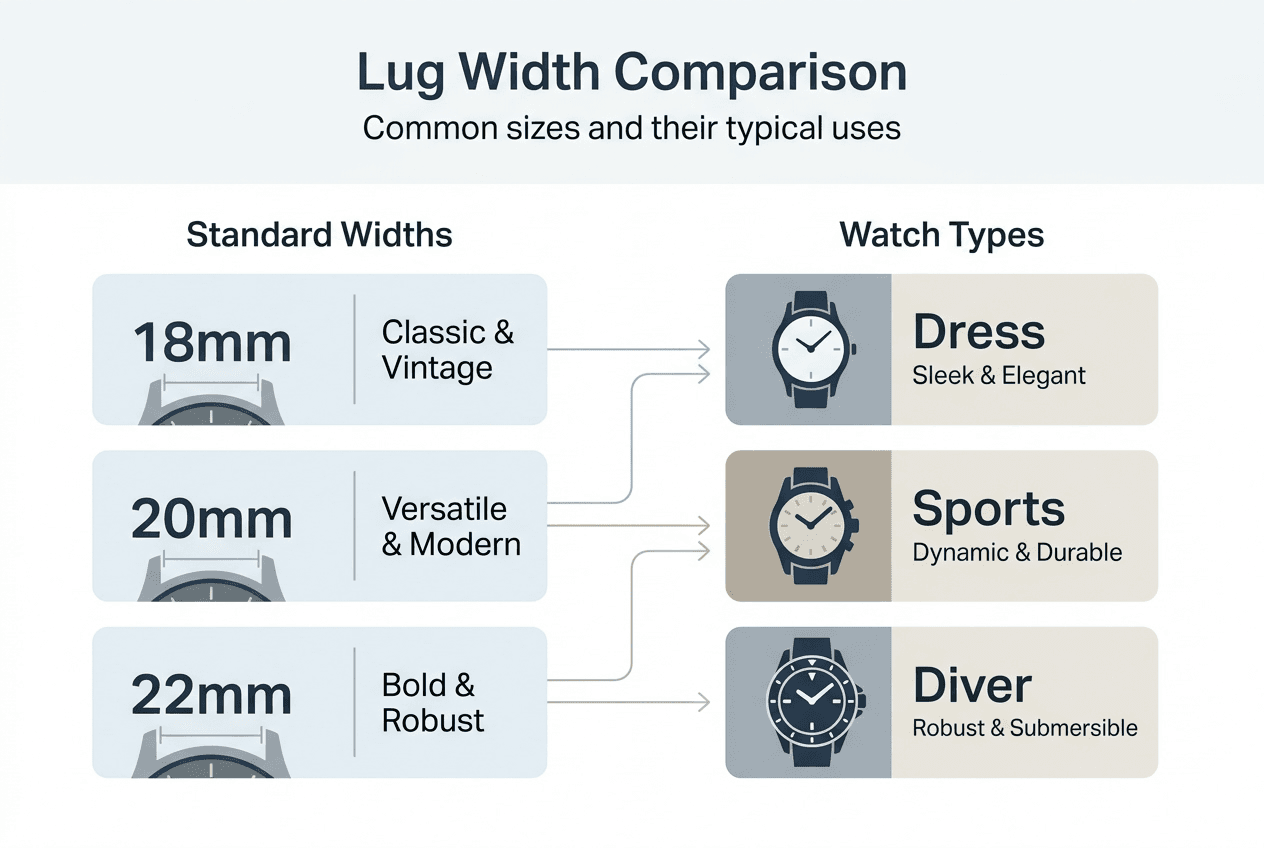
Les largeurs de barrette standard sont généralement des nombres pairsToutes les largeurs standard pour les barrettes sont des nombres pairs et font généralement 20 mm de large. Certaines montres vintage et montres habillées peuvent faire 16-18 mm de large, tandis que les montres de plongée et d'outil modernes font souvent 22 mm de large. Les plus grandes montres de sport peuvent faire 24 mm de large et plus. Ces normes de largeur proviennent d'années de pratique de fabrication et de la disponibilité de bracelets de diverses largeurs.
Bien qu'il soit possible de rencontrer occasionnellement une montre de 19 mm ou 21 mm de large ici et là, ce n'est pas courant et c'est généralement un choix de conception du fabricant pour forcer le client à acheter un bracelet OEM. Cela limite vraiment l'utilisation des bracelets du marché secondaire. Bien qu'il soit possible d'utiliser un adaptateur ou un bracelet personnalisé sur une montre de largeur impaire, ce n'est pas toujours le choix le plus pratique. Avoir une collection de montres avec des largeurs de barrette paires et standard est généralement la meilleure façon de rendre votre collection aussi fonctionnelle que possible.
La largeur de barrette est la seule mesure qui détermine tout le reste. Obtenez-la correctement une fois et chaque changement de bracelet après cela prend trente secondes.
Un poignet plus petit peut rendre plus difficile l'ajustement des barrettes courbes, mais les barrettes courbes sont de loin plus confortables et visuellement attrayantes que les alternatives de barrettes droites. L'inconvénient est que les extrémités du bracelet doivent correspondre à la forme des barrettes, ce qui est un ajustement difficile. Heureusement, il existe de nombreux bracelets du marché secondaire avec les bonnes extrémités de bracelet courbes. Il est important d'obtenir la forme correcte de la courbe lors de la commande d'un bracelet, car différents styles de bracelet ont des courbures légèrement différentes et peuvent varier d'un millimètre ou deux.

De nombreux fabricants de montres utiliseront un
De nombreux fabricants de montres utiliseront un système de barrette intégré similaire à la Royal Oak d'Audemars Piguet ou à la Nautilus de Patek Philippe. Cela signifie que la montre et le bracelet sont vendus comme une unité. Les montres à barrettes intégrées n'acceptent généralement pas les bracelets de montre standard. Bien que quelques fabricants de montres offrent parfois un bracelet en caoutchouc pour les montres à barrettes intégrées, ce n'est pas aussi courant qu'avec les montres à barrettes non intégrées. C'est quelque chose à garder à l'esprit lors de l'achat d'une montre, qui peut ne pas être facilement interchangeable avec différents bracelets.
Catégories courantes de largeur de barrette :
- 16-18 mm : montres vintage, montres habillées, diamètres de boîtier plus petits
- 20 mm : norme universelle, s'adapte à la plupart des montres contemporaines dans toutes les catégories
- 22 mm : montres de plongée modernes, montres de sport, plus grandes montres d'outil
- 24 mm+ : montres surdimensionnées, montres d'aviation, pièces de déclaration
Matériau, conicité et compatibilité des bracelets : esthétique et durabilité
Un bracelet qui s'adapte à la largeur de barrette mais qui lutte contre la géométrie du boîtier aura toujours l'air mal. La largeur est la première dimension. La conicité est celle qui détermine si la montre a l'air finie.
Le choix du matériau a un impact sur l'esthétique et la durabilitéLe choix des matériaux est un facteur essentiel pour l'esthétique et la durabilité d'un objet. Chacun des matériaux que nous utilisons - cuir, métal, caoutchouc et textile - présente des propriétés spécifiques. Avec le cuir, le métal, le caoutchouc et le textile, chaque matériau présente des caractéristiques uniques. Le bracelet en cuir sera parfaitement adapté aux besoins morphologiques du poignet : il sera possible d'ajuster la longueur pour s'adapter à la forme du poignet et s'étendra progressivement pour correspondre aux contours du poignet. Un bracelet en cuir est souvent utilisé pour les montres habillées classiques ou pour les montres vintage. Bien que plus d'entretien soit nécessaire qu'avec les matériaux synthétiques, le cuir nécessite plus de soin pour conserver sa beauté et nécessite une patine que tous les collectionneurs n'approuvent pas. L'alligator ou le veau offrent les finitions les plus attrayantes tandis que le cuir suédé est plus adapté aux montres décontractées.
Un bracelet en cuir est souvent utilisé pour les montres habillées classiques ou pour les montres vintage. Bien que plus d'entretien soit nécessaire qu'avec les matériaux synthétiques, le cuir nécessite plus de soin pour conserver sa beauté et nécessite une patine que tous les collectionneurs n'approuvent pas. L'alligator ou le veau offrent les finitions les plus attrayantes tandis que le cuir suédé est plus adapté aux montres décontractées.
Un bracelet de montre en métal peut être très durable et élégant. C'est particulièrement vrai pour de nombreuses montres de sport et d'outil. L'acier inoxydable est de loin le métal le plus couramment utilisé pour les bracelets de montre car il est généralement compatible avec le boîtier de la montre. Les avantages d'un bracelet de montre en titane sont qu'il est plus léger tout en conservant la dureté du métal.
Les bracelets de montre en cuir et caoutchouc sont
Les bracelets de montre en cuir et caoutchouc sont généralement moins chers qu'un bracelet de montre en métal, mais ils ne dureront pas plus de 2 à 3 ans. Après cela, le cuir commencera à se fissurer et à s'estomper tandis que le bracelet en caoutchouc commencera à se fissurer et à perdre sa couleur noire d'origine. Heureusement, la plupart des bracelets de montre en métal s'adapteront à une largeur de barrette de 20 mm ou 22 mm. Sachez simplement que sur les petites montres, les bracelets très lourds peuvent déséquilibrer la montre.
Les bracelets en caoutchouc sont idéaux pour les montres résistantes à l'eau, qui nécessitent un look très sportif, idéal pour les montres de plongée et les montres de sport. Les nouveaux matériaux en caoutchouc ont une meilleure résistance aux rayons UV causés par les rayons du soleil et le sel marin et nos bracelets sont disponibles en largeurs 22 mm et 24 mm pour s'adapter à la plupart des montres de sport. Ils sont très faciles à nettoyer et sèchent en quelques minutes. Bien que certains collectionneurs de montres puissent vouloir opter pour des alternatives plus élégantes comme le cuir ou le métal.
Considérations relatives au matériau et à la conicité
La conicité est l'amincissement du bracelet de la barrette à la boucle. Disons que nous avons commencé avec un bracelet de 22 mm de large, mais que nous voulions le réduire à 18 mm au fermoir pour obtenir une montre plus élancée et moins volumineuse. La conicité fonctionne en conjonction avec le boîtier pour obtenir la bonne proportion. Les bracelets sans conicité sont ceux qui conservent la largeur complète du bracelet. Certains collectionneurs pensent que les bracelets larges sur leurs montres sont la meilleure façon de montrer la beauté de la montre dans toute sa gloire. Lors de l'appairage d'un bracelet à une montre, il faut être très prudent quant aux grands écarts entre le bracelet et le boîtier.
Considérations relatives au matériau et à la conicité :
- Cuir : meilleur pour les montres habillées et vintage, nécessite un entretien, développe du caractère
- Métal : durable et premium, plus lourd, convient aux montres de sport et d'outil
- Caoutchouc : résistant à l'eau et sportif, facile d'entretien, idéal pour une utilisation active
- Conicité : réduit le volume, améliore le confort, améliore le flux visuel du boîtier à la boucle
- Épaisseur : assortissez à la largeur de barrette pour une apparence proportionnelle et un ajustement sécurisé
Considérations spéciales pour les montres intelligentes et les montres d'outil
Les Samsung Galaxy Watches utilisent 20 mm et 22 mmJ'ai quelques Samsung Galaxy Watch qui traînent, toutes équipées de largeurs de barrettes de 20 mm et 22 mm avec des pins à dégagement rapide. Alors quand j'ai reçu la Galaxy Watch 4 en tailles 40 mm et 44 mm avec des largeurs de barrettes de 20 mm et 22 mm respectivement, j'ai eu une idée. J'ai été surpris d'apprendre que l'on peut tout à fait utiliser des bracelets tiers avec la Samsung Galaxy Watch. Les pins à dégagement rapide qui maintiennent les bracelets en place devront être remplacés ou adaptés, mais au moins vous n'aurez pas besoin d'utiliser un outil à barrette ressort.
Largeurs de barrette courantes des montres intelligentes :
| Modèle | Largeur de barrette | Système de bracelet |
|---|---|---|
| Galaxy Watch 4 (40 mm) | 20 mm | Broches de libération rapide |
| Galaxy Watch 4 (44 mm) | 22 mm | Broches de libération rapide |
| Garmin Fenix 7S | 20 mm | Clip QuickFit |
| Garmin Fenix 7 | 22 mm | Clip QuickFit |
| Garmin Fenix 7X | 26 mm | Clip QuickFit |
Spécificités de la largeur de barrette des montres intelligentes
La majorité des montres intelligentes utilisent des largeurs de barrette standard pour s'assurer que les montres peuvent être appairées avec le plus grand nombre de bracelets possible et pour donner à l'utilisateur le plus de choix en matière de personnalisation. C'est le contraire exact d'une conception de barrette propriétaire, qui verrait une montre et un bracelet verrouillés dans une seule marque.
Avec tant de collectionneurs de montres intelligentes voulant pouvoir basculer entre le port de leur montre technologique et leur montre mécanique, il est également important de considérer que la façon dont une montre intelligente est sécurisée au poignet peut être différente de celle d'une montre avec des barres de ressort traditionnelles.
Beaucoup de nos clients sont des fans
Nous avons beaucoup de clients qui sont des fans à la fois de montres mécaniques et intelligentes. Pour vous aider, nous avons nos guides de compatibilité. Smartlet en est un excellent exemple, qui peut être associé à un certain nombre de modèles de montres différents en utilisant notre système de bracelet modulaire. Avant d'acheter, nous vous conseillons vivement de vérifier quelles montres sont compatibles avant d'acheter pour ne pas vous retrouver avec un bracelet que vous ne pourrez pas utiliser avec vos autres montres. De cette façon, vous pouvez tirer le meilleur parti de votre budget de bracelet. Les guides de compatibilité de Smartlet détaillent quels modèles fonctionnent avec les systèmes de bracelet modulaires. Cela élimine les conjectures lors de la constitution d'une collection de bracelets unifiée sur les types de montres. Comprendre ces nuances prévient l'achat de bracelets incompatibles et maximise la valeur de votre investissement en bracelets.
De cette façon, vous pouvez tirer le meilleur parti de votre budget de bracelet. Les guides de compatibilité de Smartlet détaillent quels modèles fonctionnent avec les systèmes de bracelet modulaires. Cela élimine les conjectures lors de la constitution d'une collection de bracelets unifiée sur les types de montres. Comprendre ces nuances prévient l'achat de bracelets incompatibles et maximise la valeur de votre investissement en bracelets.
Enrichissez votre collection avec les bracelets et connecteurs modulaires de Smartlet
Tout commence par la largeur de barrette. Et la largeur de barrette pour Smartlet est définie entre 18 et 24 mm, une plage qui couvre 99,9 % des montres de collection – non pas parce que c'était le plus facile à concevoir et développer, mais parce que c'est la bonne plage. Pourvu que votre Seamaster, votre Submariner ou votre Black Bay aient des largeurs de barrette dans cette bande, vous avez déjà déterminé quelle montre porter pour la journée. La modularité de Smartlet traite alors tous les problèmes de compatibilité de montre restants possibles. Construits en acier SS316L et titane, les connecteurs de la boucle de Smartlet peuvent recevoir par barre de ressort n'importe quelle montre avec des largeurs de barrette allant de 18 mm à 24 mm sans que la montre n'ait besoin d'être modifiée de quelque façon que ce soit. Le système breveté lauréat du Concours Lépine 2025 permettant le port simultané de montres mécaniques et de montres intelligentes.Black BayS'inscrit dans cette plage, la question de savoir quelle montre porter aujourd'hui a déjà été répondue.Système modulaire de SmartletRésout les défis de compatibilité dans toute votre collection. Conçus en acier SS316L et titane, les connecteurs Smartlet s'adaptent à n'importe quelle montre de 18 mm à 24 mm de largeur de barrette via barre de ressort standard. Aucune modification requise. Cette conception brevetée, lauréate du Concours Lépine 2025, vous permet de porter à la fois des montres mécaniques et des montres intelligentes sur un seul poignet.
La modularité de Smartlet traite alors tous les problèmes de compatibilité de montre restants possibles. Construits en acier SS316L et titane, les connecteurs de la boucle de Smartlet peuvent recevoir par barre de ressort n'importe quelle montre avec des largeurs de barrette allant de 18 mm à 24 mm sans que la montre n'ait besoin d'être modifiée de quelque façon que ce soit.
Le système breveté lauréat du Concours Lépine 2025 permettant le port simultané de montres mécaniques et de montres intelligentes. Black BayS'inscrit dans cette plage, la question de savoir quelle montre porter aujourd'hui a déjà été répondue. Système modulaire de SmartletRésout les défis de compatibilité dans toute votre collection.
Conçu en acier SS316L et titane Smartlet
Conçus en acier SS316L et titane, les connecteurs Smartlet s'adaptent à n'importe quelle montre de 18 mm à 24 mm de largeur de barrette via barre de ressort standard. Aucune modification requise. Cette conception brevetée, lauréate du Concours Lépine 2025, vous permet de porter à la fois des montres mécaniques et des montres intelligentes sur un seul poignet.
VérifiezGuide de compatibilité de SmartletVérifiézGuide de compatibilité de Smartlet Pour vous assurer que vous avez les bons modèles de montres Cliquez ici pour l'ensemble de connecteurs classiques Notre ensemble de connecteurs classiques s'adapte toujours à n'importe quelle largeur de barrette que vous avez mesurée à l'aide des techniques décrites dans ce guide. Nous nous assurons que toutes nos pièces s'adaptent à votre montre en toute sécurité et sans causer de dommages.Ensemble de connecteurs classiquesFonctionne proprement avec les largeurs de barrette que vous avez mesurées en utilisant les techniques de ce guide. L'ingénierie de précision garantit un ajustement sécurisé sans compromettre l'intégrité ou l'esthétique de votre montre.
Le guide complet de la largeur de barrette : 18 mm à 24 mm pour les collectionneurs de montres FAQ
Comment mesurer correctement la largeur de barrette de ma montre ?
1. Retirez l'ancien bracelet. 2. Mesurez la distance interne entre les barrettes à leur point le plus étroit à l'aide du pied à coulisse numérique. Arrondissez vers le haut ou vers le bas au millimètre le plus proche. Il est préférable de mesurer deux fois pour assurer la précision lors de la commande d'un nouveau bracelet.
Quelles sont les tailles de largeur de barrette les plus courantes pour les montres intelligentes ?
La plupart des montres intelligentes ont une largeur de barrette de bracelet de 20 mm ou 22 mm afin que vous puissiez les échanger contre des bracelets du marché secondaire fabriqués pour d'autres montres. Certains modèles de Samsung et Garmin tels que les montres Galaxy et les montres Fenix ont également une largeur de barrette de 20 mm, mais avec un type d'extrémité de bracelet différent.
Pourquoi la distance lug-to-lug est-elle plus importante que le diamètre du boîtier ?
La distance lug-to-lug fait référence à la mesure de la distance entre les barrettes de chaque côté du bracelet de la montre. Cette mesure est importante car elle a un impact non seulement sur le niveau de confort de la montre, mais aussi sur la relation entre la montre et le poignet du porteur.
Par exemple, une montre de 42 mm avec une mesure lug-to-lug de 52 mm peut pendre sur le poignet d'une personne de petite taille tandis qu'une montre de 40 mm avec une mesure lug-to-lug de 48 mm s'assiéra plus confortablement sur le poignet. La mesure lug-to-lug est bien plus importante pour le porteur en relation avec l'ajustement de la montre au poignet que le diamètre réel du boîtier.
Quels matériaux fonctionnent le mieux pour les bracelets avec différentes largeurs de barrette ?
La largeur de barrette détermine chaque décision de bracelet dans votre collection. Obtenez la mesure correctement une fois, et le reste est configuration. Smartlet couvre 18 mm à 24 mm dans toutes les versions.
Recommandé
- Guide de compatibilité des modèles de montres
- Rolex et Garmin Fenix : guide de port double pour les collectionneurs 2026
- Guide de compatibilité des marques de montres - Toutes les marques
- Pourquoi la modularité est importante dans les montres : guide 2026
- Lubiwood
- Portez une montre intelligente avec votre Tudor Black Bay 41
- Portez une montre intelligente avec votre Seiko Prospex
- Guide de confort des bracelets de montre
Articles stars
No people found
We couldn’t find anything with that term. Please try again.


