


Montre mécanique ou montre connectée : portez les deux sans faire de compromis

Fondateur & PDG, Smartlet - Ingénieur CentraleSupélec - Concours Lépine 2025, Lauréat - CES 2026
Table des matières
Points clés
| Point | Détails |
|---|---|
| Vous pouvez porter les deux | Les collectionneurs et les professionnels n'ont pas à choisir - plusieurs solutions vous permettent de profiter des montres mécaniques et intelligentes simultanément |
| Le double-wristing est établi | Une montre mécanique, une montre intelligente, deux poignets - à la mode, pratique et adopté par des personnalités notables dans le monde entier |
| Les bracelets modulables simplifient l'intégration | Les bracelets modulables Smartlet combinent les deux types de montres sur un seul poignet sans modifier aucune des deux montres |
| Les montres hybrides sont un compromis | Les modèles hybrides mélangent les aiguilles analogiques avec des fonctionnalités intelligentes mais sacrifient la profondeur des deux côtés |
| Choisissez en fonction de vos besoins | Les priorités en matière de performance, de style et d'héritage déterminent si le double-wristing, les bracelets modulables ou les hybrides vous conviennent le mieux |
Chaque matin, vous vous tenez devant la commode, votre Submariner à gauche, votre Apple Watch Ultra 3 à droite, et vous ressentez le poids d'un faux choix. L'une représente des décennies d'artisanat, un mouvement qui respire sans batterie. L'autre suit votre sommeil, votre fréquence cardiaque, votre prochain rendez-vous. Choisir entre les deux ressemble à choisir entre qui vous êtes et comment vous vivez.
Pourquoi la mentalité « soit l'un, soit l'autre » n'a plus lieu d'être
La montre mécanique et la montre intelligente ne sont pas des rivales. Une Speedmaster à votre poignet porte le poids de l'histoire - un mouvement construit par des mains humaines, un objet qu'aucune mise à jour logicielle ne peut reproduire. Une Garmin Fenix 8 Pro est un ordinateur de performance : VO2 max, cartographie des sentiers, alertes de battements cardiaques irréguliers. Aucune ne fait le travail de l'autre. C'est justement le point.
Aucune ne fait le travail de l'autre. C'est justement le point.
Pendant des années, les collectionneurs sur WatchUSeek et r/Watches ont débattu du port double. Le consensus évolue. De plus en plus de membres discutent ouvertement du port d'une pièce mécanique aux côtés d'une montre connectée - non pas comme un compromis, mais comme un choix délibéré.
Alors que par le passé beaucoup voyaient l'intégration d'une montre intelligente comme une « dégradation », il est maintenant courant que les collectionneurs sérieux discutent ouvertement du port de montres connectées aux côtés - et parfois simultanément avec - leurs pièces mécaniques haut de gamme.
Les montres hybrides mélangent l'esthétique analogique avec des fonctionnalités intelligentes, mais vous demandent d'accepter des compromis des deux côtés. Vous n'obtenez ni l'âme mécanique complète ni la suite de capteurs complète d'une montre intelligente dédiée. C'est exactement à cet écart que Smartlet est né.
- Montres mécaniques portent une valeur émotionnelle et historique qu'aucun algorithme ne peut reproduire
- Les montres connectées fournissent des données de santé en temps réel, le GPS, les notifications et le paiement, ce que les mouvements mécaniques ne peuvent pas offrir
- Les montres hybrides proposent un compromis mais sacrifient la profondeur des deux côtés : vous n'obtenez ni l'âme mécanique complète ni la panoplie complète de capteurs
- Collectionneurs et professionnels Les collectionneurs et les professionnels ont de plus en plus besoin des deux - pas d'une version diluée de chacun
- Apple Watch et Samsung Galaxy Watch l'appairage sont maintenant des questions centrales dans les communautés de collectionneurs
Smartlet a été créé par David Ohayon, inventeur français et collectionneur de montres qui refusait de choisir. Le bracelet modulaire breveté tient votre montre connectée sous votre pièce mécanique, au même poignet : aucune modification permanente, aucun compromis sur les capteurs.
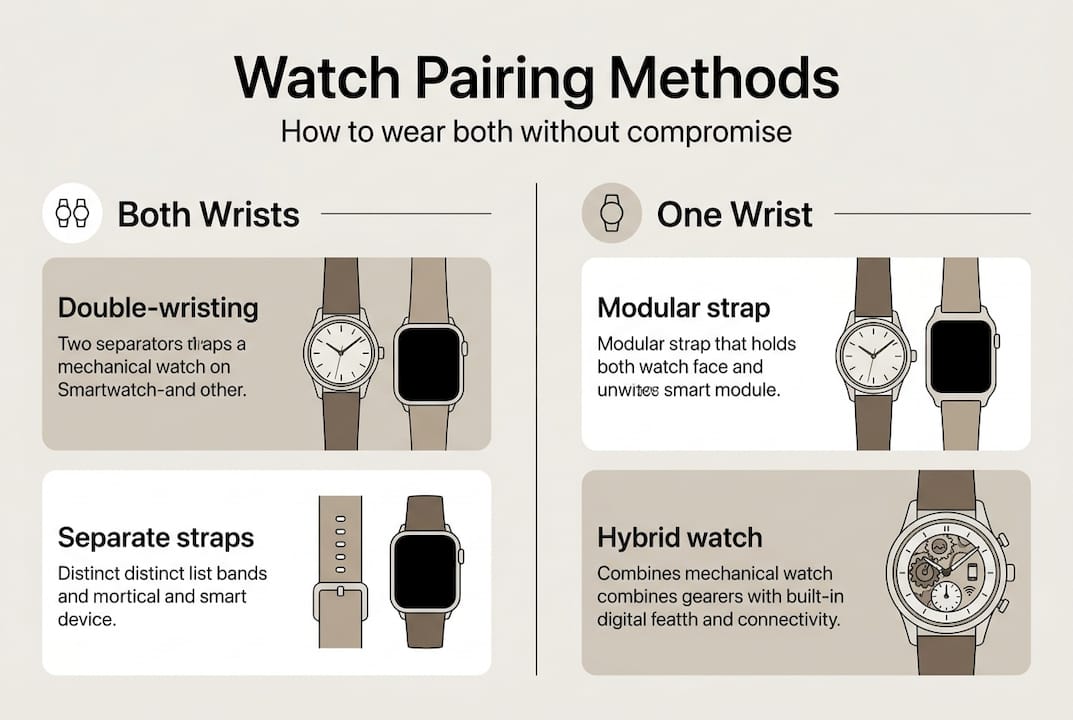
Double-wristing : une montre par poignet
Le double-wristing est exactement ce que cela semble être. Une montre mécanique sur un poignet, une montre intelligente sur l'autre. Simple en théorie. Le point d'entrée le plus accessible pour les collectionneurs qui veulent une fonctionnalité complète des deux pièces sans aucune modification matérielle.
Les célébrités et les collectionneurs adoptent le double-wristing comme un moyen d'honorer la tradition tout en restant connectés. La pratique est passée des forums de niche aux médias horlogers grand public. Les recherches pour « double-wristing » ont augmenté régulièrement, et le contenu de port double se classe régulièrement parmi les plus lus dans les publications de collectionneurs.
Avantages du double-wristing :
- Fonctionnalités complètes des deux montres, aucun compromis
- Aucune modification à l'une ou l'autre pièce
- Flexibilité maximale pour échanger les montres indépendamment
- Fonctionne avec Withings ScanWatch ou toute autre combinaison de montres intelligentes
Inconvénients du double-wristing :
- Peut sembler physiquement maladroit, surtout pendant les entraînements
- La coordination des styles devient plus complexe
- Une certaine redondance de capteurs entre les poignets
- Pas idéal pour les contextes formels où une montre repousse déjà les conventions.
Le double-wristing fonctionne. Mais pour de nombreux collectionneurs, porter les deux sur un seul poignet est la solution plus élégante.
Bracelets modulables Smartlet : deux montres, un poignet
Le système modulable Smartlet remplace le bracelet de votre montre mécanique et maintient votre montre intelligente fermement en dessous - préservant chaque capteur, chaque lecture, chaque notification. Aucune modification permanente requise pour l'une ou l'autre pièce.
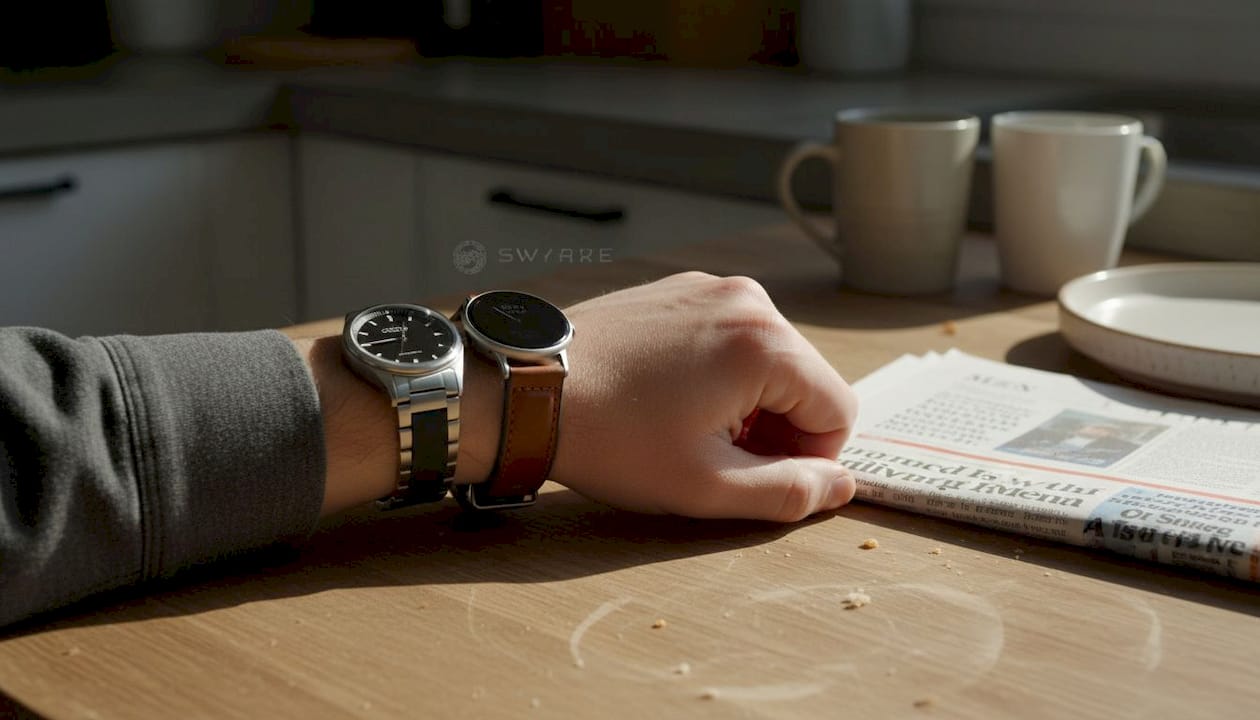
Smartlet ajoute un peu d'épaisseur et de poids au poignet, c'est un compromis honnête. Mais il est entièrement réversible. Retirez le Smartlet, remettez votre bracelet d'origine, et votre Rolex ou votre Omega est exactement comme avant. Aucune marque, aucune modification, aucun regret.
Pour les professionnels de la performance, cela compte énormément. Un chirurgien qui porte une Speedmaster pour sa précision et une Apple Watch pour sa capacité ECG ne veut pas choisir entre les deux dans le couloir de la salle d'opération. Un cycliste compétitif qui valorise une Omega vintage mais a besoin des métriques d'entraînement Garmin sur la route trouve une vraie réponse ici.
| Fonctionnalité | Smartlet modulable | Double-wristing | Montre hybride |
|---|---|---|---|
| Les deux montres sur un poignet | Oui | Non | N/A |
| Capteurs complets de montre intelligente | Oui | Oui | Partiel |
| Mouvement mécanique préservé | Oui | Oui | Partiel |
| Modification permanente requise | Non | Non | Non |
| Flexibilité de style | Élevée | Moyenne | Faible |
| Confort pendant les entraînements | Bon | Variable | Excellent |
| Compatibilité Suunto | Oui | Oui | N/A |
Trois versions du bracelet Smartlet répondent à différentes priorités de collectionneur. Classic (299 EUR) en SS316L brossé. Shadow (399 EUR) en PVD noir. Titanium (549 EUR) en titane grade 2 : à volume égal, le titane pèse environ 4,5 g/cm3 contre 7,9 g/cm3 pour l'acier 316. Breveté dans l'UE, aux États-Unis et au Japon. Médaille de bronze au Concours Lépine 2025, CES 2026.
Montres hybrides : le meilleur des deux mondes ?
Les montres hybrides ressemblent à des montres traditionnelles - aiguilles physiques, cadrans traditionnels - mais intègrent des capteurs intelligents sous la surface. Pour les collectionneurs qui veulent une montre qui fait la plupart des choses de manière adéquate, elles valent la peine d'être considérées.
La Withings ScanWatch 2 et la Garmin Instinct Crossover sont les options actuelles les plus solides. La ScanWatch 2 offre un ECG de qualité médicale et une détection de la fibrillation auriculaire avec une batterie de plus de 30 jours. L'Instinct Crossover ajoute le GPS et la durabilité de qualité militaire. La Technik 4X TwinTimer adopte une approche différente, logeant deux mouvements indépendants dans un seul boîtier.
Les mains et les bras normaux présentent des défis pour l'interaction avec de petits écrans, alors concentrez-vous sur les fonctionnalités et interactions clés avant de sélectionner une forme hybride qui peut présenter efficacement des données d'un coup d'œil.
| Modèle | Batterie | Capteurs clés | Type de mouvement | Style |
|---|---|---|---|---|
| Withings ScanWatch 2 | 30+ jours | ECG, SpO2, FA | Quartz + intelligent | Habillé classique |
| Garmin Instinct Crossover | 70+ jours | GPS, FC, stress | Quartz + intelligent | Sport/robuste |
| Technik 4X TwinTimer | Variable | Intelligent basique | Auto + quartz | Contemporain |
- Définissez vos éléments non négociables : GPS, ECG ou longue autonomie
- Vérifiez la compatibilité si vous possédez déjà un écosystème de santé connecté avant de vous engager dans un hybride.
- Évaluez la lisibilité du cadran - les petits écrans derrière les aiguilles analogiques peuvent être frustrants dans l'utilisation quotidienne.
- Considérez Huawei Watch GT si vous êtes déjà dans cet écosystème
- Essayez la montre en personne avant de vous engager - le dimensionnement hybride diffère souvent des montres intelligentes pures.
Les hybrides sont une bonne option pour les collectionneurs car elles ont fière allure et offrent de nombreuses fonctionnalités principales d'une montre intelligente. Cependant, si vous recherchez l'expérience complète de la montre intelligente, les hybrides ne sont pas le meilleur choix.
Scénarios pour collectionneurs et professionnels
Votre mode de vie détermine votre réponse.
- Le collectionneur de patrimoine : Vous possédez une Submariner ou une Speedmaster et refusez de compromettre son intégrité. Vous voulez une fonctionnalité Apple Watch ou Garmin complète. Smartlet est conçue spécifiquement pour ce scénario
- Le professionnel de la performance : Vous vous entraînez sérieusement, suivez les métriques de manière obsessionnelle et portez toujours une pièce mécanique aux réunions clients. Le double-wristing fonctionne pour les jours décontractés. Smartlet fonctionne quand vous avez besoin des deux sur le même poignet
- Le collectionneur minimaliste : Vous voulez une montre qui gère la plupart des choses. Un hybride comme la ScanWatch 2 ou l'Instinct Crossover correspond à votre philosophie
- Le mélangeur de marques : Vous associez une Omega vintage à une Garmin Forerunner moderne. Le guide de compatibilité des marques chez Smartlet couvre la plupart des combinaisons majeures et aide à confirmer l'ajustement avant l'achat.
- L'utilisateur Whoop : Le facteur de forme sans écran de Whoop en fait l'un des appairages les plus propres avec une montre mécanique via Smartlet - encombrement visuel minimal, données maximales
La bonne solution s'adapte à votre collection, à votre poignet et à votre journée. La meilleure question n'est pas quelle montre porter - c'est comment porter les deux.
Smartlet garde les deux mondes à votre poignet - au même moment, sans compromis.
Recommandé
- Comment porter une montre intelligente avec une montre de luxe en toute sécurité
- Comment la surveillance cardiaque des montres intelligentes sauve des vies
- Omega Seamaster et Apple Watch : port double 2026
- Porter l'Apple Watch avec votre montre mécanique
- Portez la Samsung Galaxy Watch avec votre montre mécanique
- Découvrez Smartlet One
Articles stars
No people found
We couldn’t find anything with that term. Please try again.


