


Why endurance athletes wear two watches every day

Founder & CEO, Smartlet - CentraleSupelec engineer - Concours Lepine 2025, Awarded - CES 2026
Table of Contents
- The race-day myth and the real problem
- Two watches, two completely different functions
- The 95% of the year that is not race day
- Why the mechanical watch matters more after the race than during it
- The pairings that actually make sense for endurance athletes
- The one rule for race day
- How Smartlet was built for this exact problem
- Frequently asked questions
Key takeaways
| Point | Details |
|---|---|
| The real problem | Endurance athletes do not need two watches during the race. They need them every other day of the year. |
| Recovery data is continuous | HRV, sleep, training load. The smartwatch only delivers value when worn 24/7, not just during effort. |
| Identity is non-negotiable | A serious athlete with a meaningful mechanical watch should not have to choose between data and identity. |
| Race day is the exception | For high-impact activity, keep your Apple Watch on its standard strap for that session. |
| What Smartlet solves | The dual-wear setup for the office, the boardroom, the recovery day, the trip, the dinner, the meeting. |
The marathon is on Sunday. The Ironman is once a year. The trail race takes 12 hours of your life. The other 360 days, the question is different. What do you wear when you are not racing? And how do you keep the recovery data flowing while you are doing the rest of your life?
The race-day myth and the real problem
Most articles about athletes wearing two watches start with race day. They show you the triathlete with a Garmin and a Rolex on the same wrist crossing the finish line. The image is compelling, but it is also misleading. No serious endurance athlete keeps a mechanical watch on their wrist during a 12-hour Ironman. The chip on the ankle handles official timing. The bike computer handles power. The smartwatch handles everything else. The mechanical watch comes off before the start gun and goes back on after the finish line photo.
The real problem is not what you wear during the race. The real problem is what you wear the rest of the week, the rest of the season, the rest of the year. A marathon runner trains 200 days a year and races maybe 4. A long-distance cyclist puts in 8,000 kilometers of base miles for one A-event in June. The race is the visible 5%. The other 95% is where the question of how to wear two watches actually matters.
This guide is about that 95%.
Two watches, two completely different functions
The reason an endurance athlete owns both a smartwatch and a mechanical watch is simple: they answer different questions. The smartwatch answers how is my body responding. The mechanical watch answers who am I. These are not competing functions. They are parallel ones. how is my body respondingwho am I
The smartwatch delivers data the athlete cannot live without:
- HRV: the morning baseline that tells you whether to push hard or back off today. HRV:
- Sleep score: the overnight metric that determines tomorrow's training quality. Sleep score:
- Training load: the rolling acute and chronic ratio that prevents overtraining injuries. Training load:
- Resting heart rate: the long-term trend that signals fitness gains or accumulating fatigue. Resting heart rate:
- Recovery time: the platform-specific recommendation for when to schedule the next hard session. Recovery time:
None of these metrics are useful for 30 minutes of measurement. They are useful for 23 hours of measurement, every day, for months. That is what the smartwatch does well. That is what it cannot do if you take it off when you change into a suit at 8am and put it back on when you change out at 7pm.
"The smartwatch is not a stopwatch. It is a continuous biometric record. The moment you take it off, the record breaks. And a broken record is worse than no record at all, because it gives you false trends."
The mechanical watch delivers something the smartwatch cannot: continuity of self. The Submariner inherited from your father. The Speedmaster you bought after your first marathon under three hours. The Black Bay you wear when you sign contracts. These watches are not interchangeable with a piece of consumer electronics. They are part of your identity, and they belong on your wrist on the days that matter, which is most days. continuity of self
The 95% of the year that is not race day
Picture the week of a serious endurance athlete who is also a working professional. Monday morning meeting. Tuesday client lunch. Wednesday board call. Thursday dinner. Friday wedding. Saturday long run. Sunday recovery. The mechanical watch belongs on the wrist for at least five of those seven days. The smartwatch needs to be there for all seven, especially the recovery days, because that is when the data is most valuable.
The conventional solution is to take off the mechanical watch when the smartwatch goes on, or to wear the smartwatch on the opposite wrist. Both are compromises. The first one means the smartwatch comes off whenever the suit goes on, breaking the data continuity. The second one means committing to a permanent dual-wrist asymmetry that does not work for everyone, especially in formal contexts where two visible watches read as ostentatious.
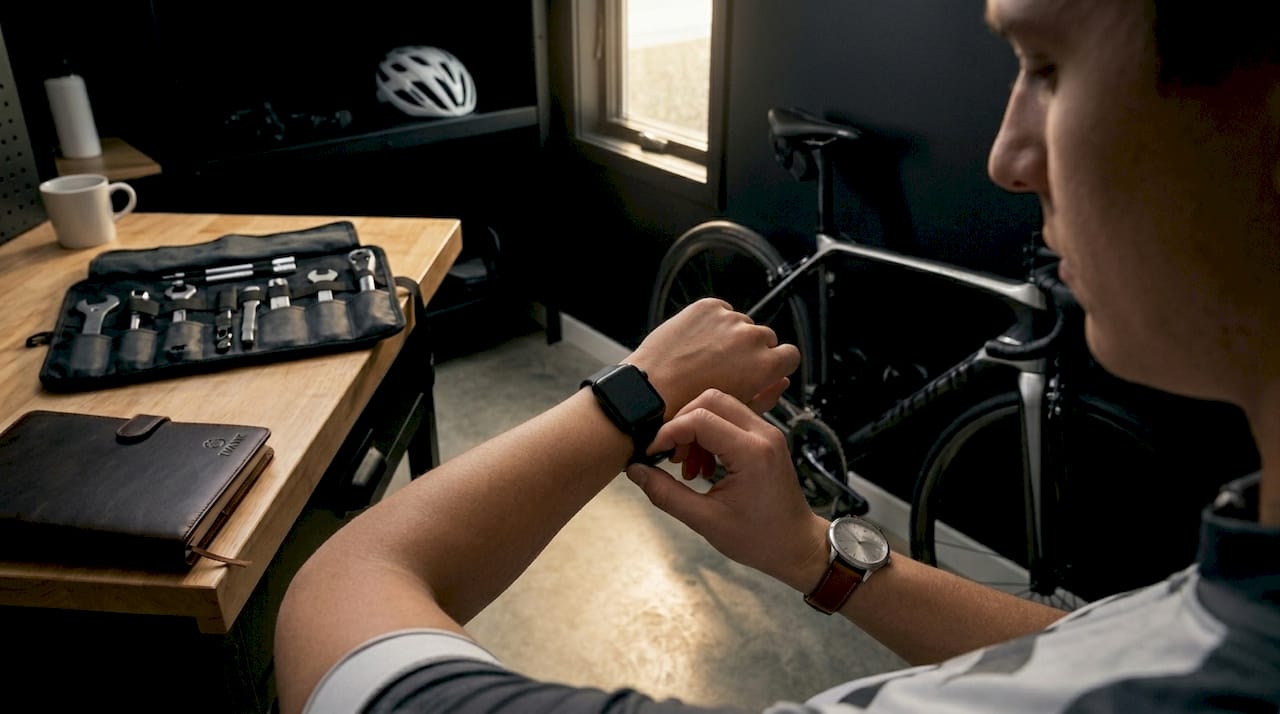
The dual-wear approach via a modular adapter changes the equation. The mechanical watch sits on the dial side, visible at the wrist position. The smartwatch sits toward the forearm, under the cuff in formal contexts and exposed in casual ones. Both watches stay on the wrist throughout the day. The recovery data continues to record. The identity continues to be expressed. Neither watch compromises the other.
This is the actual job Smartlet does. It is not a race-day instrument. It is a daily-life enabler.
Why the mechanical watch matters more after the race than during it
There is a moment after every meaningful race where the athlete looks at their wrist. The smartwatch shows the data. The mechanical watch tells the story. The data fades into the training log within a week. The story stays.
This is why the mechanical watch matters more in the days after the race than in the hours during it. The Submariner you wear to dinner the night you finished your first sub-three marathon. The Speedmaster on your wrist the Monday after the Ironman, sitting in the meeting where everyone congratulates you. The Black Bay on your trip back home from the trail race. These are the moments the watch was made for.
If the smartwatch has to come off for those moments because the mechanical watch is taking the wrist, the recovery data goes blind exactly when it would be most informative. The post-race week is when HRV crashes, sleep degrades, and training load needs to be managed carefully. Losing data continuity in that window is a real cost. Smartlet eliminates that cost without asking the athlete to choose.
HRV typically drops 15 to 25% in the 72 hours after a marathon, and full recovery often takes 7 to 14 days depending on training age. The smartwatch on your wrist during this window tells you when to start training again. Losing that data because you switched to a mechanical watch for client dinners is a coaching mistake.
The pairings that actually make sense for endurance athletes
Not every smartwatch and mechanical pairing is realistic for daily wear. The variables are case thickness, lug width, and the formal register of the mechanical watch. Here are the combinations that work in practice for the working endurance athlete.
| Smartwatch | Mechanical pairing | Daily-wear context |
|---|---|---|
| Apple Watch Series | Rolex Submariner, Tudor Black Bay, Omega Seamaster | Office, dinners, weekends. The Apple Watch slim profile sits well under a cuff. |
| Apple Watch Ultra | Tudor Pelagos, Omega Seamaster Planet Ocean | Casual professional. The Ultra case is heavy. Pair with a sport mechanical, not a dress watch. |
| Garmin Forerunner 965 | Hamilton Khaki Field, Tudor Ranger, IWC Pilot | Marathon and trail runners. Field watches pair naturally with running smartwatches. |
| Garmin Fenix 8 | Bremont, Sinn, Damasko | Adventure professionals. Tool watches at both wrist positions. Visual coherence. |
| Polar Vantage V3 | Omega Speedmaster, Longines HydroConquest | Multisport athletes. The Polar discrete profile pairs with chronograph dial watches. |
For specific configurations, see the Hamilton Khaki Field and Garmin Forerunner 965 dual-wear guide and the Garmin Forerunner 965 with a mechanical watch deep dive. Both detail the lug width, strap, and positioning choices that make these pairings work in formal and casual contexts. Hamilton Khaki Field and Garmin Forerunner 965 dual-wear guideGarmin Forerunner 965 with a mechanical watch
"The wrist is not a manifesto. It is a tool. The athlete who uses it as a tool wears the smartwatch for what the smartwatch does and the mechanical watch for what the mechanical watch is."
The one rule for race day
This guide is not about race day. But there is one rule worth stating clearly.
For high-impact activity, keep your Apple Watch on its standard strap for that session. The same applies to your Garmin, your Polar, your Coros. The Smartlet adapter is engineered for daily wear and recovery contexts, not for the impact and water exposure of a 4-hour open water swim followed by a 180-kilometer bike leg followed by a marathon. On race day, your smartwatch goes solo on its standard strap. Your mechanical watch stays in the transition bag, ready to go back on the wrist after the finish line.
Smartlet enables the rest. The morning of the race, when you arrive at the venue with your Sub on the dual-wear setup. The afternoon after the finish line, when you put the mechanical back on for dinner and want your sleep tracking to keep recording. The Monday meeting where everyone wants to hear about your race and you wear both because that is who you are now.
How Smartlet was built for this exact problem
Smartlet was not designed as a race-day tool. It was designed for the working endurance athlete who refuses to choose between identity and data. The patented modular adapter sits between the mechanical watch and the smartwatch, allowing both to be worn on a single wrist throughout the day.
Three versions are available. The Classic at 299 EUR in brushed SS316L is the natural choice for steel sport mechanical watches. The Shadow at 399 EUR in matte black PVD is the right choice for athletes who prefer contrast or own a darker mechanical reference. The Titanium at 549 EUR in Grade 2 titanium is the lightest option, valuable when wrist weight matters during long days.
All three versions fit any watch from 18 to 24mm lug width via standard spring bar, with no modification to either timepiece. Use the brand compatibility guide to confirm your specific watches are supported. ClassicShadowTitaniumbrand compatibility guide
Recommended
- Hamilton Khaki Field and Garmin Forerunner 965: dual-wear guide
- Garmin Forerunner 965 VO2 Max with a mechanical watch
- A. Lange and Sohne with Apple Watch: collector's dual-wear guide
- Smartwatch strategies for bankers and traders
- All compatible watch brands


