


Des montres à assortir : alliez tradition et style technologique

Fondateur & PDG, Smartlet - Ingénieur CentraleSupélec - Concours Lépine 2025, Lauréat - CES 2026
Dans cet article
- Qu'est-ce que la montre mixte ?
- Comment fonctionne la montre mixte : bracelets, compatibilité et installation
- Avantages et compromis : fonctionnalité, confort et valeur de collection
- Conseils de style et de port pour le look parfait à deux montres
- La montre mixte est-elle plus qu'une tendance ?
- Questions fréquemment posées
Points clés
| Point | Détails |
|---|---|
| Port dual défini | La montre mixte vous permet de porter une montre mécanique et une montre intelligente ensemble pour le style et les fonctionnalités intelligentes. |
| Les bracelets modulaires sont essentiels | L'adaptateur breveté Smartlet facilite l'installation et est compatible avec la plupart des grandes marques de montres. |
| Avantages et défis | Vous gagnez en commodité et en options de style tout en gardant votre montre mécanique inmodifiée et sa valeur intacte. |
| Les conseils de style comptent | Privilégiez la proportion, l'harmonie des finitions et un placement soigné pour le meilleur look et un plaisir durable. |
De nombreux collectionneurs portent désormais une montre mécanique et une montre intelligente sur un seul poignet, non pas pour l'apparence, mais pour capturer le meilleur des deux mondes. La question n'est plus « quelle montre je porte aujourd'hui ? » mais « comment je porte les deux sans compromis ? » Ce guide répond exactement à cela.
« Pourquoi un collectionneur devrait-il choisir entre sa montre mécanique et sa montre intelligente ? » Cette question, posée par David Ohayon, est celle à laquelle la montre mixte répond chaque jour.
Qu'est-ce que la montre mixte ?
Imaginez un opérateur en position de tir, fusil à l'épaule, regard vers l'avant. Il consulte sa montre sans changer de posture. Le cadran est à l'intérieur du poignet, lisible d'un simple coup d'œil vers le bas. Cette habitude, née dans les tranchées de la Première Guerre mondiale où les cadrans au radium révélaient les positions la nuit, n'a jamais quitté la culture des forces spéciales. Aujourd'hui, elle est le fondement d'un mouvement croissant parmi les collectionneurs.
La montre mixte signifie porter une montre mécanique et une montre intelligente sur le même poignet simultanément. Pas une sur chaque poignet. Pas une montre hybride qui essaie de tout faire dans un seul boîtier. Deux montres distinctes, chacune faisant ce qu'elle fait le mieux, portées ensemble via un système de bracelet modulaire.
C'est là que Smartlet entre en jeu. Fondée par David Ohayon, un inventeur français et collectionneur de montres, Smartlet a conçu la montre intelligente pour la position intérieure du poignet. La montre intelligente se situe exactement où les opérateurs ont toujours lu leurs montres : intérieur du poignet, protégée, discrète, instantanément lisible. La montre mécanique reste sur le dessus, visible au monde.
Motivations classiques des amateurs de montres :
- Préserver l'artisanat et la valeur d'investissement d'une pièce mécanique
- Maintenir une esthétique traditionnelle sans compromis
- Porter une montre avec une véritable importance horlogère
- Garder une pièce de collection en rotation quotidienne
Motivations des utilisateurs axés sur la technologie :
- Suivi de la santé, surveillance de la fréquence cardiaque et données de fitness
- Notifications, navigation et fonctionnalités connectées
- Commodité d'un système d'exploitation moderne au poignet
- Compatibilité avec un mode de vie numérique
Pour ceux curieux de pairages spécifiques, le guide sur porter une Rolex et une Apple Watch ensemble est un excellent point de départ. Et pour la perspective d'un collectionneur japonais, la répartition du port dual pour les collectionneurs vaut le coup d'être lue.
Comment fonctionne la montre mixte : bracelets, compatibilité et installation
Le matériel est plus simple que la plupart des gens ne le pensent. La méthode principale utilise un bracelet dual-montre modulaire comme l'adaptateur breveté Smartlet : la montre mécanique se situe sur le dessus en position standard, et la montre intelligente s'attache dessous, reposant sur l'intérieur du poignet. Aucun perçage, aucune modification, aucun changement permanent pour l'une ou l'autre montre.
L'adaptateur Smartlet est conçu en acier SS316L et titane de grade 2. Trois versions existent : Classic (299 EUR), Shadow (399 EUR) et Titanium (549 EUR). Le système est compatible avec les montres de 18 à 24 mm de largeur de cornes et s'attache via des barrettes de ressort standard.
Aperçu de compatibilité :
| Montre mécanique | Largeur de cornes | Compatibilité montre intelligente |
|---|---|---|
| Rolex Submariner | 20 mm | Apple Watch, Samsung Galaxy Watch |
| Tudor Black Bay | 22 mm | Apple Watch, Samsung Galaxy Watch |
| Hamilton Khaki Field | 20 mm | Apple Watch, Garmin Forerunner |
| Seiko Prospex | 22 mm | Apple Watch, Google Pixel Watch |
| Omega Seamaster | 20 mm | Apple Watch, Samsung Galaxy Watch |
Pour les détails complets de compatibilité des montres intelligentes, la page compatibilité avec Apple Watch couvre tous les modèles supportés.
Assemblage étape par étape :
- Retirez le bracelet existant de votre montre mécanique à l'aide d'un outil de barrette de ressort.
- Attachez l'adaptateur modulaire Smartlet aux cornes de votre montre mécanique via des barrettes de ressort.
- Enfilez votre bracelet dans le canal central de l'adaptateur Smartlet.
- Connectez votre Apple Watch via l'adaptateur inclus avec votre Smartlet.
- Ajustez l'ajustement pour que la montre mécanique se situe sur l'extérieur du poignet et la montre intelligente repose sur l'intérieur du poignet vers l'avant-bras.
Harmonisez la finition de l'adaptateur Smartlet avec la finition du boîtier de votre montre mécanique. Une Submariner en acier brossé s'associe parfaitement à la version Classic. Une montre habillée polie bénéficie du ton plus sombre de Shadow. La cohérence visuelle compte.
Avantages et compromis : fonctionnalité, confort et valeur de collection
Le cas pour la montre mixte est solide. Mais il vaut la peine d'être clair sur les limitations aussi.
Avantages clés :
- Accès complet au suivi de santé de la montre intelligente, y compris la surveillance de l'oxygène sanguin et la fréquence cardiaque, sans retirer votre pièce mécanique
- Zéro risque de modification pour les montres précieuses. La valeur de revente reste intacte.
- Aucun compromis sur l'esthétique. La montre mécanique reste la pièce maîtresse visuelle.
- Notifications, GPS et données de fitness disponibles en un coup d'œil sur l'intérieur du poignet.
- Le système modulaire signifie que vous pouvez échanger l'une ou l'autre montre indépendamment.
| Critères | Montre mixte | Montre hybride | Port double |
|---|---|---|---|
| Artisanat mécanique préservé | Oui | Partiel | Oui |
| Fonctionnalités complètes de montre intelligente | Oui | Partiel | Oui |
| Port sur un seul poignet | Oui | Oui | Non |
| Modification de montre requise | Non | S/O | Non |
| Valeur de revente de collection | Inaffectée | S/O | Inaffectée |
| Équilibre visuel | Élevé (avec la bonne installation) | Élevé | Variable |
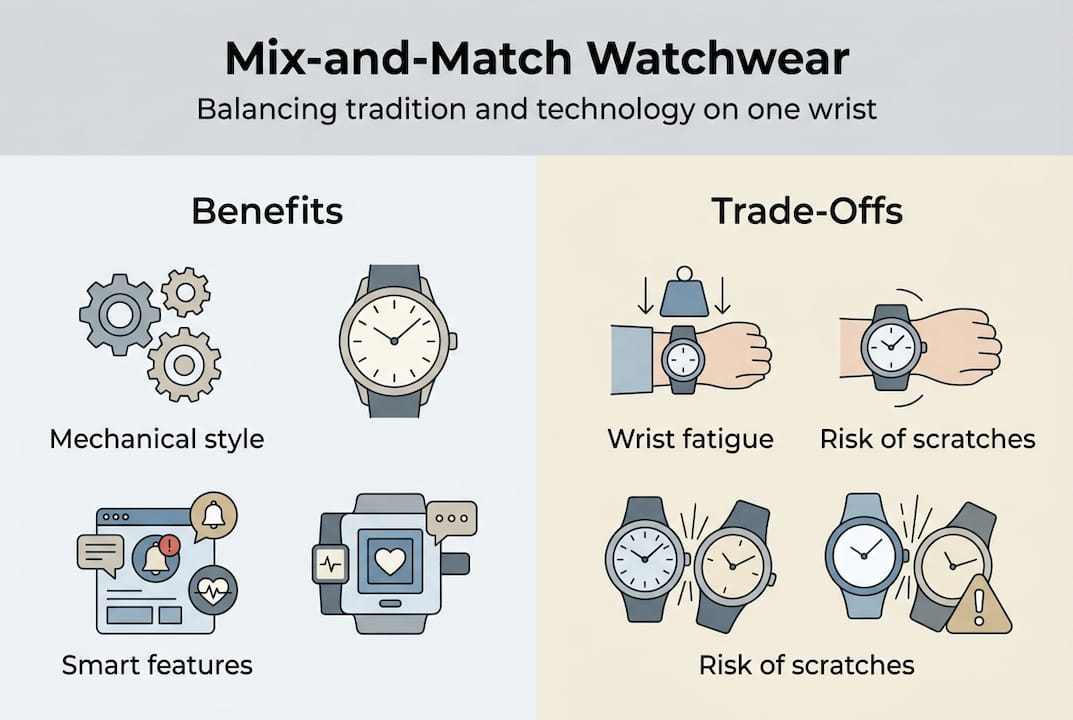
Les compromis sont réels. Les cas limites incluent le risque de rayer les mécaniques précieuses si le bracelet n'est pas bien sécurisé, la fatigue du poignet due au poids dual et la rotation si le bracelet est trop lâche. Ces éléments sont gérables avec le bon matériel et les bonnes habitudes. Une installation typique pèse environ 150 g pour la montre mécanique et 25 g pour la montre intelligente. La plupart des utilisateurs s'adaptent en un jour ou deux.
Pour des conseils d'appairage spécifiques, le guide Omega Seamaster et Apple Watch aborde le confort et l'équilibre pour les boîtiers mécaniques plus lourds.
Conseils de style et de port pour le look parfait à deux montres
La montre mécanique appartient au-dessus. Ce n'est pas seulement une préférence esthétique. C'est fonctionnel. Placer la mécanique en position standard sur l'extérieur du poignet la protège des impacts sur le bureau et de la submersion accidentelle. La montre intelligente sur l'intérieur du poignet gagne quatre avantages spécifiques : la discrétion dans les contextes formels, la protection du cristal contre les surfaces dures, la lisibilité avec une simple rotation de l'avant-bras et la compatibilité avec les manches longues et les poignets.

Bien styliser la combinaison se résume à trois principes : la proportion, la cohérence des finitions et la retenue.
Proportion : Le boîtier de la montre intelligente ne doit pas être significativement plus grand que la mécanique. Une Apple Watch 44 mm sous une montre habillée 40 mm crée un déséquilibre visuel. Visez des dimensions similaires ou plus petites pour la montre intelligente par rapport à la mécanique.
Cohérence des finitions : Gardez les tons de métal cohérents. Mélanger l'acier brossé avec l'or poli fonctionne rarement. La comparaison Classic vs Shadow vs Titanium couvre l'appairage des finitions en profondeur.
Retenue : La combinaison elle-même est déjà une déclaration. Gardez le reste de la tenue propre.
Erreurs à éviter :
- Bracelets de montre intelligente en caoutchouc de couleur vive associés à des mécaniques formelles
- Tailles de boîtier mal assorties qui créent un déséquilibre visuel
- Bracelets non sécurisés qui permettent la rotation pendant le port
- Appairage d'une montre outil avec un bracelet de montre intelligente avant-gardiste
- Négliger de vérifier la sécurité de la barrette de ressort avant une utilisation active
La règle de non-modification est non négociable. L'attachement par barrette de ressort de Smartlet ne laisse aucune trace sur votre montre. Votre Tudor Black Bay ou Hamilton Khaki Field conserve sa valeur de revente complète. Cela compte quand vous gérez une collection sérieuse.
La montre mixte est-elle plus qu'une tendance ?
Voici la réponse honnête : la montre mixte ne sera jamais grand public. Et c'est précisément pourquoi elle compte pour les collectionneurs.
Certains l'appellent la réponse définitive au dilemme style-versus-technologie. Les critiques la rejettent comme niche, inutile compte tenu de la qualité des montres hybrides d'aujourd'hui. Les deux côtés ont un point. Mais aucun ne comprend pleinement ce qui pousse un collectionneur sérieux.
Un collectionneur qui possède une Tudor Black Bay ou une Seiko Prospex ne veut pas d'hybride. Il veut cette montre, avec son mouvement spécifique, son histoire, son poids, son cadran. Une hybride vous donne une simulation de tradition. La montre mixte vous donne la vraie chose, plus tout ce que le monde connecté offre.
La pratique redéfinit la limite entre le style et la technologie sans effacer l'un ou l'autre. Elle signale quelque chose de spécifique sur le porteur : il comprend les deux mondes et refuse d'être limité par l'un ou l'autre. Ce n'est pas une tendance. C'est une position.
L'adoption à long terme sera déterminée par l'ingénierie du confort et la discrétion du design, non par la nouveauté. Le système breveté de Smartlet, reconnu avec une Médaille de Bronze au Concours Lépine 2025 et présenté au CES 2026, est construit pour exactement ce standard.
Le système Smartlet rend possible le port des deux montres simultanément, chaque jour, sans vous demander de choisir entre elles.


