


IWC Big Pilot strap guide: lug width, Apple Watch compatibility

Founder & CEO, Smartlet - CentraleSupelec engineer - Concours Lepine 2025, Awarded - CES 2026
Table of Contents
- Understanding lug widths: IWC Big Pilot vs Apple Watch
- Why direct strap compatibility is nearly impossible
- How dual wear works: style and practicality for collectors
- Creative solutions: custom straps, adapters, and modular systems
- The collector's perspective: why combining IWC and Apple Watch matters
- Find your seamless dual wear solution
- Frequently asked questions
Key Takeaways
| Point | Details |
|---|---|
| Lug widths differ | IWC Big Pilot uses 20mm spring bar lugs. Apple Watch uses proprietary sliding connectors. These are two different systems. |
| No direct strap sharing | Proprietary Apple connectors and standard spring bar systems are mechanically incompatible. |
| Dual wear on one wrist | Modular systems like Smartlet enable same-wrist dual wear without modifying either watch case. |
| Proportion matters | The 46mm Big Pilot pairs best with the Apple Watch Ultra 3 for visual balance on the wrist. |
| Modular solutions exist | Smartlet's patented modular strap seats in the Big Pilot's 20mm lug holes, in place of the spring bars, with no modification required. |
IWC Big Pilot has 20mm lugs, not 22mm. Learn how lug width, Apple Watch compatibility, and dual wear setups work for collectors who want both watches.
Lug width is not open to interpretation. It is a precise specification that determines which straps fit, which watch adapters seat, and which setups are even possible. Getting it right takes thirty seconds with a pair of calipers. Getting it wrong wastes time, money, and patience.The lug width on a watch is not a suggestion. It is a specification. Getting it wrong means buying straps that do not fit, watch adapters that will not seat, and setups that look wrong from across the room.
Measuring the lug width of an IWC Big Pilot with calipers confirms what the spec sheet already states: 20mm between the spring bar holes. Despite the 46mm case diameter that dominates the wrist, the lug width stays at a refined 20mm. That is the number that matters for every strap and Smartlet decision that follows.
The Big Pilot IW329301 runs a 46mm case diameter, 20mm between the spring bar slots, and a 57mm lug-to-lug distance. These three measurements together define every strap and modular pairing decision for this watch.
Understanding lug widths: IWC Big Pilot vs Apple Watch
Lug width and case diameter are not the same measurement. On the Big Pilot, the 46mm case creates a bold visual statement above the wrist, while the refined 20mm lug width tapering to 18mm at the buckle ensures the strap sits proportionally beneath it. That engineering balance is intentional.
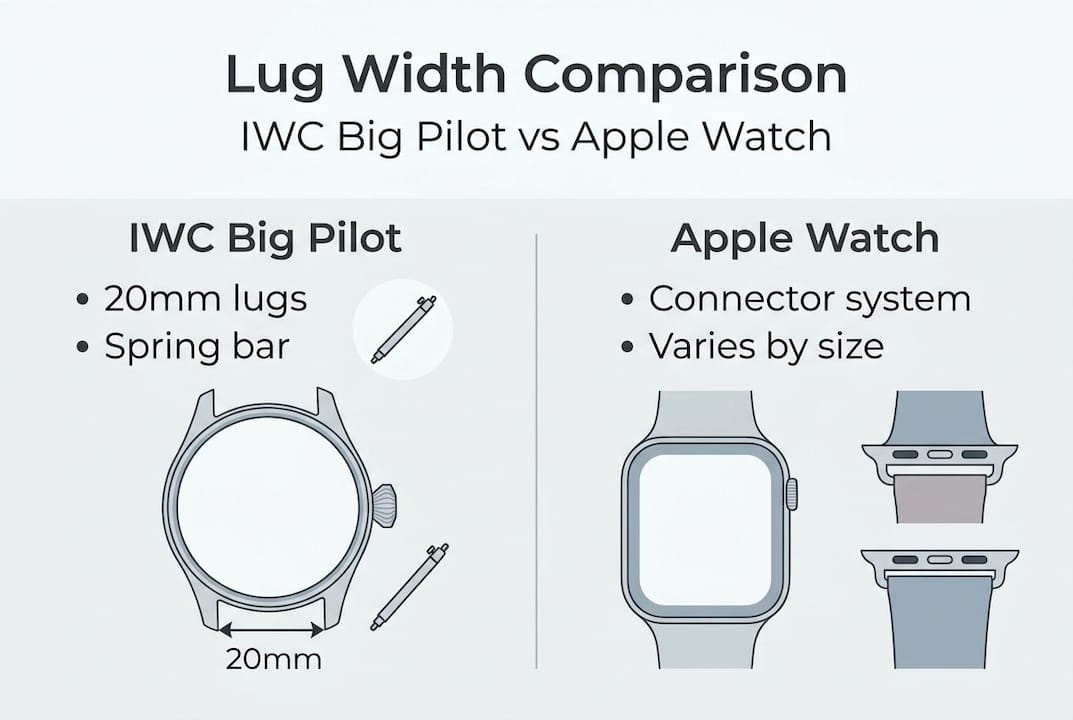
Apple Watch uses a proprietary sliding connector, not a spring bar system. Apple groups its models into two connector families: small (38/40/41/42mm) and large (42/44/45/46/49mm including Ultra 3). These dimensions look familiar to collectors, but the connection mechanism is entirely different from anything in mechanical watchmaking.
Here is a quick reference for the models most relevant to dual wear:
| Watch model | Case diameter | Connection system |
|---|---|---|
| IWC Big Pilot IW329301 | 46mm | 20mm spring bar (tapers to 18mm) |
| Apple Watch Series 10 (42mm) | 42mm | Small connector group (38/40/41/42mm) |
| Apple Watch Series 10 (46mm) | 46mm | Large connector group (42/44/45/46mm) |
| Apple Watch Ultra 3 | 49mm | Large connector group (49mm, same as 42/44/45/46mm) |
At 49mm, the Apple Watch Ultra 3 is the only Apple Watch large enough to visually hold its own alongside the 46mm Big Pilot. Smartlet Classic or Titanium version accommodates this pairing, and the result is a setup that looks balanced and considered. Smartlet Classic or Titanium version accommodates this pairing, and the result is a setup that looks considered rather than accidental.
Every current IWC Big Pilot in the main lineup uses a 20mm lug width. That consistency makes strap selection straightforward once you understand how the spring bar system works. The 20mm measurement falls directly within the Smartlet's 18-24mm compatibility range. spring bar system that IWC uses is the first step toward finding adapters and straps that actually fit. The complete lug width guide covers the full 18-24mm range for collectors.
Despite its 46mm case, the IWC Big Pilot uses a 20mm lug width, which falls squarely within the Smartlet's 18-24mm compatibility range. No modification to the watch case is required.
Why direct strap compatibility is nearly impossible
IWC uses a standard open spring bar system, the same architecture that watchmakers have used for decades. Any 20mm strap with the correct pin dimensions fits the Big Pilot's lugs directly. No proprietary hardware. No conversion required.
The Apple Watch band connects via a proprietary sliding connector with no spring bar, no lug holes, and no shared hardware with traditional watch straps. The IWC Big Pilot's leather strap is not transferable to an Apple Watch, and no Apple Watch band fits the Big Pilot's 20mm spring bar lugs.
Here is what that means in practice:
- You cannot take a Big Pilot strap and attach it to an Apple Watch case.
- You cannot take an Apple Watch band and fit it to the Big Pilot's 20mm lugs.
- Third-party adapters allow Apple Watch to use standard-width straps, but they work on the Apple side only.
- Lug width mismatch and proprietary connectors mean no universal swap system exists between these two watches.
The Smartlet modular strap resolves this directly. Its watch adapters seat in the Big Pilot's lug holes, in place of the spring bars, holding both watches together as a single unit on one wrist. No modifications to either case. No forced compatibility between two incompatible strap systems.
For a deeper look at why wearing both without compromise is possible despite these hurdles, the distinction between strap compatibility and modular pairing is key. One tries to share hardware. The other accepts that the hardware is different and builds a bridge.
How dual wear works: style and practicality for collectors
Smartlet approach accepts that the two strap systems are fundamentally different and builds a physical bridge between them. Both the Big Pilot and Apple Watch sit on the same wrist, each facing forward, each doing its job independently.
Best practices for dual wear comfort and style:
- Proportion matters. Proportion is the first consideration in any dual wear pairing. The 46mm Big Pilot combines best with the Apple Watch Ultra 3 for visual balance. Smaller Apple Watch models can appear mismatched next to a case of this size.
- One bracelet unifies the setup. The Smartlet replaces both straps with a single metal bracelet, so the two watches share one material. Choose the Classic, Shadow or Titanium finish to match the Big Pilot's case.
- Wear height matters. When wearing both watches simultaneously, the mechanical Big Pilot sits at the standard wrist position while the smartwatch sits underneath, against the skin. This keeps both watches comfortable and the sensors in consistent skin contact.
- Dominant wrist for the mechanical. The Big Pilot deserves the wrist that people see during a handshake. The Apple Watch stays functional, not visual.
The Big Pilot was engineered as a cockpit instrument: precision legibility under pressure, at a glance. Adding the Apple Watch to that wrist does not dilute that purpose. It extends it. The instrument panel on your wrist just gained a second display.The Big Pilot was designed to be read at a glance in a cockpit. Wearing it alongside an Apple Watch does not diminish that. It extends the instrument panel to your wrist.
For collectors who have explored dual wear setups with other watches or studied heart rate monitoring accuracy in dual wear, the principles translate directly to the Big Pilot configuration. The sensor orientation guide confirms that smartwatch sensors remain accurate when positioned on the underside of the wrist.
Creative solutions: custom straps, adapters, and modular systems
Third-party strap adapters for Apple Watch expand its strap options considerably, allowing leather, NATO, and rubber bands via a small proprietary connector adapter. This benefits Apple Watch owners exclusively. It does nothing for Big Pilot owners seeking a pairing solution.
Current solutions and their real scope:
- Custom leather straps (IWC side): Excellent quality, no tech integration, purely aesthetic.
- Apple Watch third-party adapters: Expand strap options for Apple Watch, no benefit to IWC pairing.
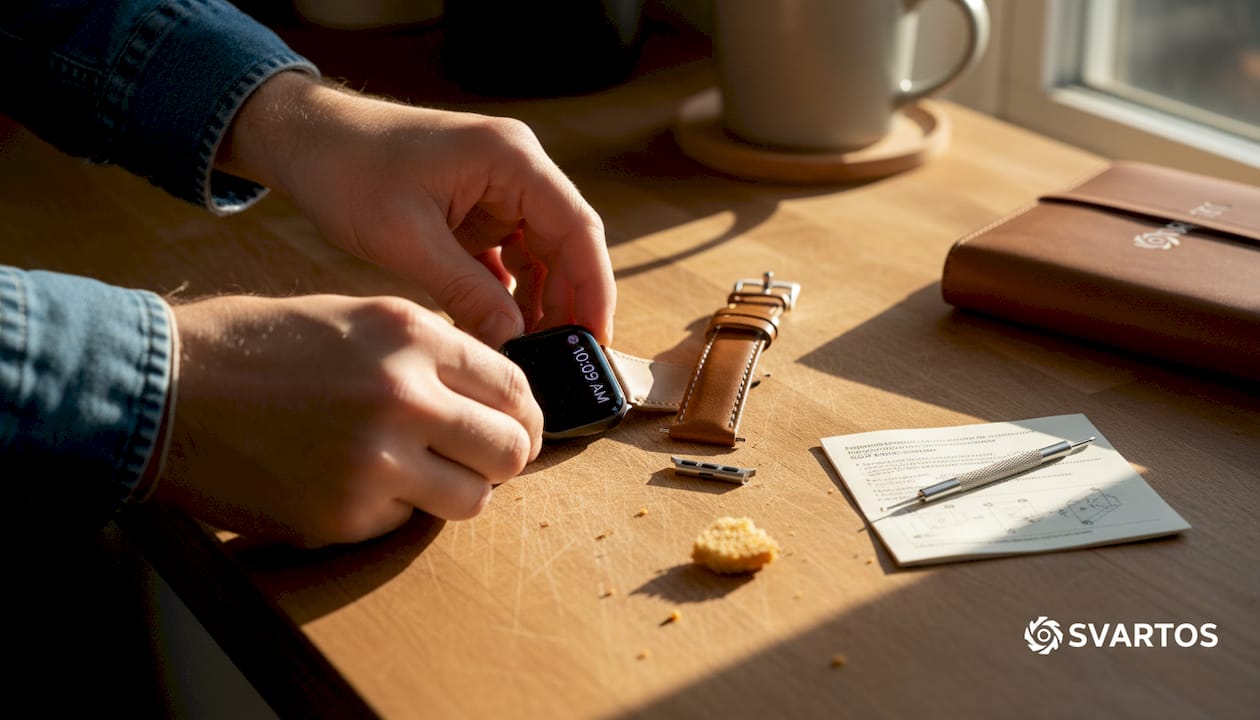
- Modular bracelet systems (Smartlet): The Smartlet bracelet attaches to the Big Pilot through watch adapters seated in its 20mm lug holes, enabling dual wear without any modification to the watch case. Both watches attach and detach in under two minutes with the spring bar tool included in the box.
Smartlet's watch adapters seat in the Big Pilot's 20mm lug holes, in place of the spring bars. For dual wear setups in practice with similar proportions, the modular approach is where the category is heading. The CES 2026 presentation of the Smartlet system confirmed this direction with independent editorial coverage.
The collector's perspective: why combining IWC and Apple Watch matters
Dual wear is not a fashion indecision. The mechanical watch delivers presence, craftsmanship, and identity. The Apple Watch delivers connectivity, health data, and convenience. Each does something the other cannot. Wearing both is a deliberate optimization, not a compromise.
The Big Pilot makes this point clearly. Engineered for pilots who needed extreme legibility under pressure, it shares a philosophy with the Apple Watch: both are instruments optimized for information access and performance. The Apple Watch simply added a second layer of capability to the same wrist.
Collectors who make the move to dual wear consistently report that the adjustment period is short and the satisfaction is lasting. What remains after the first days is confidence: the knowledge that nothing was compromised, and that the setup works as well in a boardroom as at an airport gate.
The collectors who get the most from dual wear are the ones who stop thinking about strap compatibility as the goal. The goal is wearing both watches well. Modular systems, the right proportions, and thoughtful strap selection get you there faster than any universal hardware solution ever could. strap selection get you there faster than any universal swap ever could.
Find your seamless dual wear solution
The Smartlet modular strap holds the Big Pilot on top and the Apple Watch underneath on the same wrist, seated in the Big Pilot's 20mm lug holes. No watch modifications. No strap alterations. Both watches active simultaneously. It was engineered for exactly this kind of setup: a 20mm watch paired with a connected device, on one wrist, without modifying either case.
Smartlet is available in Classic (299 EUR), Shadow (399 EUR), and Titanium (549 EUR): hand-brushed SS316L, black matte PVD, and Grade 2 titanium. All three versions share identical dimensions. The only differences are finish and material. dual wear accessories designed to complement the setup, and check the brand compatibility guide to confirm your exact Big Pilot model. Do not choose between the watch you love and the tech you need. Compose both.


