


Watch strap comfort: Smartlet fits within the butterfly clasp range

Founder & CEO, Smartlet · CentraleSupélec engineer · Concours Lépine 2025, Awarded · CES 2026
Why clasp design matters
A watch is comfortable for its size and strap thickness has no bearing whatsoever on this. What is important is whether a watch can genuinely be described as being “worn”. The goal of any watch strap is that by the end of the first week you no longer give it a second thought. A decent butterfly deployant clasp has long been the industry benchmark – by evenly dispersing pressure points along the length of the strap, they significantly reduce the amount of pressure on the wrist.
The NATO comparison
With this in mind, we specified that the Smartlet watch strap and buckle combination should be as comfortable as a decent butterfly deployant clasp and premium leather strap. The following table presents the data that proves it out: Premium leather strap with butterfly deployant clasp 10 – 13mm of strap material is compressed at the closure point NATO strap folded tail 4 – 6mm of dynamic fabric is sitting on top of the strap base – well within the defined parameters of the industry.
Table of contents
- Smartlet's official dimensions from the product page
- The butterfly clasp standard that nobody questions
- Strap thickness by the numbers
- The NATO strap tail problem nobody talks about
- What Smartlet adds in real millimeters
- Who actually removes their watch at the desk
- The comfort logic for snug-fit wearers
- Explore your compatible configuration
- Frequently asked questions
Key takeaways
| Point | Details |
|---|---|
| Smartlet height on wrist back | 9 to 12 mm including connected device. Source:Smartlet product page, Technical Specifications. Smartlet product page, Technical Specifications. |
| Smartlet width | 18.5 to 36 mm including connected device. Same official source. |
| Butterfly deployant clasp | Length when closed: 7 to 10 mm. Length when combined with leather: 10 to 13 mm. *Source: Strapcode hardware specifications* Strapcode hardware specifications. |
| NATO strap tail bundle | For the Smartwatch we are talking about 4 to 6 mm of folded, mobile nylon for the buckle point in addition to the 2.5 mm base layer under the watch face. This is more invasive and less stable than the fixed pod design of the Smartlet. |
| Premium leather strap (buckle end) | ~3 mm. Source: WatchUSeek community documentation (RIOS, Hirsch). |
| Skin contact variable | A new study, published in the open access PMC journal Bioinspiration & Biomimetics, has uncovered how the accuracy of a smartwatch’s bespoke sensor varies depending on where it is positioned on the skin. |
Smartlet's official dimensions from the product page
The numbers that can be compared against other designs are provided by Smartlet, scattered about in their Technical Specifications section on the product page:
Before comparing Smartlet to other strap configurations, it helps to anchor the discussion in the numbers Smartlet publishes directly. The Technical Specifications section of the product page states: height above the wrist between 9mm and 12mm including the connected device, width between 18.5mm and 36mm including the connected device, weight between 60g and 100g including the connected device. These are the numbers the comparison that follows is built on.
Source: smartlet.io/products/smartlet-one-classic
Stack height and wrist comfort
They also mentioned the typical dimensions of a standard steel watch band, being height from wrist to the back plate in the range of 4 to 8 mm and a band width of 18 to 22 mm. Our Smartlet’s width is a bit larger as it has to accommodate the connected device. Comparing the height of our watches to a standard height of an average steel watch band (4 to 8 mm) and we are left with a height difference on the wrist back of 9 to 12 mm. So unusual are these dimensions? No, absolutely not. The watch community wears more thicker watch profiles every day without hesitation.
The butterfly clasp standard that nobody questions
Walk into any Rolex, Omega, or BreitlingHead into a Rolex, Omega or Breitling Boutique and ask for a leather strap with a deployant clasp, and you won’t get any bother when you ask for a slim clasp. The butterfly clasp, or as it is known formally, the double-fold deployant (boucle déployante in French) has been the de rigueur material for premium watch straps for over a century. The concept of a deployant clasp itself was patented by Cartier in 1909. It was used on Cartier’s iconic Santos watch of 1911. Every day use of a deployant clasp for over a hundred years, without so much as an inkling of an issue, is what makes its poor design for watch strap use, so astonishing. boucle déployanteIn French - has been a premium strap standard since Cartier patented the single deployant concept in 1909 and first used it on the Santos in 1911. Over a century of unquestioned daily wear.
It was used on Cartier’s iconic Santos watch of 1911. Every day use of a deployant clasp for over a hundred years, without so much as an inkling of an issue, is what makes its poor design for watch strap use, so astonishing.boucle déployanteIn French - has been a premium strap standard since Cartier patented the single deployant concept in 1909 and first used it on the Santos in 1911. Over a century of unquestioned daily wear.
The dimensions of the hardware for the Smartlet are well-documented by Strapcode, a supplier of strap hardware often discussed by watch enthusiasts. The 316L stainless steel double-fold butterfly clasp is 7mm thick when closed and is approximately 40 mm x 22 mm in size. This clasp sits under the wrist. And that is exactly what the Smartlet pod does. Same design principle as the hardware – a hardware component under the wrist, creating a wrist profile unlike a simple strap. Strapcode, one of the most referenced strap hardware suppliers in the enthusiast community, document the dimensions precisely. A standard double-fold butterfly clasp in 316L stainless steel measures 7 mm thick when closed, with a footprint of approximately 40 mm x 22 mm. It sits on the underside of the wrist. That is exactly where the Smartlet pod sits. The design principle is the same: a structural element on the wrist underside creating a localized profile compared to a bare strap.
And that is exactly what the Smartlet pod does. Same design principle as the hardware – a hardware component under the wrist, creating a wrist profile unlike a simple strap. Strapcode, one of the most referenced strap hardware suppliers in the enthusiast community, document the dimensions precisely.
A standard double-fold butterfly clasp in 316L stainless steel measures7 mm thick when closed, with a footprint of approximately 40 mm x 22 mm. It sits on the underside of the wrist. That is exactly where the Smartlet pod sits. The design principle is the same: a structural element on the wrist underside creating a localized profile compared to a bare strap.
Lengths When referring to length, we are talking about the fit of the watch under the wrist. Butterfly clasp on a premium leather strap will add on anywhere from 10 to 13 mm, and on a Smartlet about 9 to 12 mm. Nobody ever complains about the butterfly clasp being uncomfortable and here is the comparison that answers any question.
Strap thickness by the numbers
Crown and BuckleThe strap widths listed below are based on our knowledge and have been obtained from the excellent website Crown and Buckle. This website contains a wealth of information about virtually every type of strap that exists. In addition, Crown and Buckle list the thickness of all their straps, which is a valuable piece of information when choosing a strap and considering the overall thickness of the strap to the watch. Our standard NATO straps are made from 1.25mm thick ballistic nylon. We have recently changed our premium seatbelt straps to 1.4mm thick nylon and our heavy duty straps are made from 1.6mm thick nylon. The pass-through NATO strap configuration adds up two thicknesses of strap between the watch case and your wrist. So you are left with about a 2.5mm spacing between the watch and your wrist.
Our standard NATO straps are made from 1.25mm thick ballistic nylon. We have recently changed our premium seatbelt straps to 1.4mm thick nylon and our heavy duty straps are made from 1.6mm thick nylon. The pass-through NATO strap configuration adds up two thicknesses of strap between the watch case and your wrist. So you are left with about a 2.5mm spacing between the watch and your wrist.
| Strap or clasp configuration | Thickness on wrist underside | Source |
|---|---|---|
| Standard NATO under watch case (two-layer) | ~2.5 mm | Crown and Buckle |
| NATO folded tail at buckle point (typical) | 4 to 6 mm, mobile | Crown and Buckle dimensions, community reports |
| Premium leather strap body | ~3 mm | WatchUSeek, RIOS, Hirsch community data |
| Steel bracelet integrated clasp fold | 5 to 8 mm | Strapcode specifications |
| Butterfly deployant clasp closed | 7 to 10 mm | Strapcode specifications |
| Leather strap plus butterfly clasp total | 10 to 13 mm | Combined documented measurement |
| Smartlet with connected device | 9 to 12 mm | Smartlet official specifications |
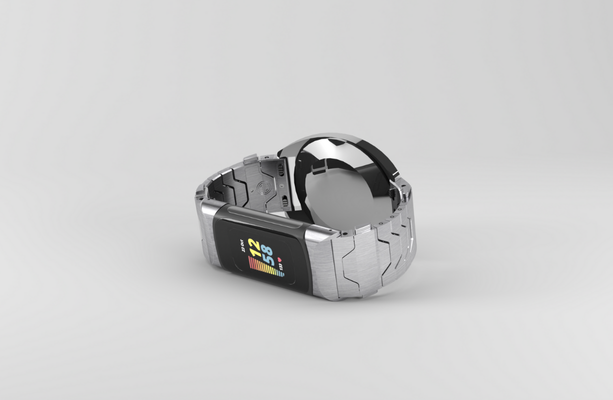
Smartlet One Classic. The pod profile of 9 to 12 mm fits at or below the 10 to 13 mm produced by a standard butterfly deployant clasp on a leather strap.
The highest compliment you can pay a strap system is that after the first week, you stop thinking about it. That is the benchmark Smartlet was engineered to meet.
The NATO strap tail problem nobody talks about
We’re huge fans of NATO straps here at Timeless Watches and it’s easy to see why you are too. They’re rugged, easily interchangeable and a great casual everyday look. However, there’s one factor that’s rarely considered, and we believe it’s time it was talked about.
A NATO strap is a piece of nylon about long enough to fit your wrist with about 8 inches of slack. Most wrists being of average or smaller size, the tail, which is the excess strap, which passes through the buckle and keeper ring after the strap has been fastened is simply coiled into a small heap on the underside of the wrist. On a 1.4 mm premium NATO strap this coil of strap is about 4 to 6 mm high and is laid on top of the 2.5 mm length of strap, which lies beneath the case back.
A total of about 8.5 mm. Compare with say a butterfly clasp or a Smartlet pod, where this excess strap is anchored in place. A NATO strap coil of strap under the case back drifts around all day as it is dragged along by the main length of strap as you slide it across your wrist, as it is bunched along with the strap as you bunch it, and as it un winds and rewinds with the strap as you swing your arm.
Many NATO wearers their wrists
For many NATO wearers, their wrists are small enough that the bulk of the tail of the strap is more of a problem than is the NATO buckle itself. This is a theme that is often mentioned in various online forums – such as WatchUSeek – as well as in Teddy Baldassarre’s strap reviews. WatchUSeekAnd Teddy Baldassarre's strap guides.
In this size, the Smartlet is a fixed and non-mobiling structure at 9 to 12 mm. It does not move during wear and always stays in the same position. An other great benefit of the Smartlet is that you will never miss your NATO tail bundle.
What Smartlet adds in real millimeters
Referring to the official length (9 to 12 mm), according to the market comparison table above, the thickness of the Smartlet is within the common thicknesses of watch straps, that of a butterfly deployant clasp, that of a NATO tail bundle and is even thinner than a folded steel watch bracelet clasp (which is usually in the range of 5 to 8 mm with the thickness of the strap layers).
We can’t really compare the Smartlet to anything else as every strap has a buckle or clasp. So the comparison is always between the Smartlet and what you replace it with. And what you replace it with is most commonly a standard 10 to 13mm long butterfly clasp on your current strap. So when you compare the length of the Smartlet, 9 to 12mm, to the standard length of a 10 to 13mm clasp, you need to remember that you are giving up a piece of folded steel for a heart rate monitor, GPS device, messaging hub and an SOS alert hub that can reach loved ones in case of an emergency and so much more.
Who actually removes their watch at the desk
The most common desk objection to Smartlet runs is “I’ll never be able to type with the pod sitting on my desk.” The solution to this objection is a wrist strap that can be tightened enough to hold the pod in place.
People with tight-fitting watches, fitted to the wrist so that the watch case remains on top of the wrist during movement, and who do not rest their wrist on the desk while typing, have a strap that lies on the wrist rather than on the desk. For these people the pod never makes contact with a solid surface.
If you wear your Smartlet bracelet in a way that your back wrist is still in contact with objects, you may already be aware that taking heavy mechanical watches off at a desk can be a hassle. We weighed the Omega Seamaster300M on a bracelet, and it is 154g. The Rolex GMT-Master II on a Jubilee is 140g. This isn’t an issue for the Smartlet, nor is it in any way unique to the Smartlet – but it does mean that heavy watch wearers who prefer a looser fit on their watches will likely be aware of this issue long before Smartlet existed. Omega Seamaster 300M on bracelet at 154 g and the GMT-Master II on Jubilee at 140 g already create wrist-to-desk contact in this configuration. This is not a Smartlet-specific problem. It predates Smartlet entirely and affects every heavy watch wearer who prefers a loose fit.
This isn’t an issue for the Smartlet, nor is it in any way unique to the Smartlet – but it does mean that heavy watch wearers who prefer a looser fit on their watches will likely be aware of this issue long before Smartlet existed. Omega Seamaster300M on bracelet at 154 g and the GMT-Master II on Jubilee at 140 g already create wrist-to-desk contact in this configuration. This is not a Smartlet-specific problem. It predates Smartlet entirely and affects every heavy watch wearer who prefers a loose fit.
You might, not know yet about Smartlet, and you may not be fond of wearing glasses, but Smartlet does not bring anything new or uncomfortable for you. You have already been used to wearing glasses, and you knew long before Smartlet its own degree of discomfort.
The comfort logic for snug-fit wearers
If you wear your watch tight on the wrist, there should be no difference between wearing the Smartlet and having the strap at the back of the watch face. A study published in PMC (National Center for Biotechnology Information) analysed 24 hour 1 minute interval heart rate and activity data from PPG derived from free living smartwatch wearers. In order to obtain the best possible readings from the photodetector on the inside of the wrist strap band, the band should be fitted as tightly as possible to ensure no gap whatsoever between the PPD and the skin, but as loosely as possible given that no tightness of the band should inhibit any flow through the circulatory pathways of the wrist. The surprising (and perhaps unsurprising to most of us) conclusion is that the band should be fitted in exactly the same way as would be the case if the watch had a normal interchangeable watch strap. PMC (National Center for Biotechnology Information), examining 24-hour free-living smartwatch PPG data, established the core fitting principle: tighten the device enough that the sensor maintains skin contact, loose enough to avoid restricting circulation. This is identical to the fitting guidance for any quality watch strap, from premium leather to woven NATO.
In order to obtain the best possible readings from the photodetector on the inside of the wrist strap band, the band should be fitted as tightly as possible to ensure no gap whatsoever between the PPD and the skin, but as loosely as possible given that no tightness of the band should inhibit any flow through the circulatory pathways of the wrist.
The surprising (and perhaps unsurprising to most of us) conclusion is that the band should be fitted in exactly the same way as would be the case if the watch had a normal interchangeable watch strap.PMC (National Center for Biotechnology Information), examining 24-hour free-living smartwatch PPG data, established the core fitting principle: tighten the device enough that the sensor maintains skin contact, loose enough to avoid restricting circulation. This is identical to the fitting guidance for any quality watch strap, from premium leather to woven NATO.
If you are a snug fit wearer, swapping your Smartlet for your current strap is an option. The pod that sits under the wrist is specifically designed to hug your wrist and will sit flat against your skin without any overhang. Apple actually also have a support document around Workouts: Tips for getting accurate sensor readings at support.apple.com, and again suggest good skin contact and a snug fit for workouts. In Smartlet, the pod ensures your smartwatch is firmly against the inner wrist, rather than sitting with any space between. support.apple.com, recommends good skin contact and a snug fit during workouts. Smartlet's architecture supports this directly: the pod keeps the smartwatch pressed against the inner wrist rather than floating away from it.
In Smartlet, the pod ensures your smartwatch is firmly against the inner wrist, rather than sitting with any space between.support.apple.com, recommends good skin contact and a snug fit during workouts. Smartlet's architecture supports this directly: the pod keeps the smartwatch pressed against the inner wrist rather than floating away from it.
The watch is designed to be worn on a daily basis. The wearer will experience a transition period, which may last from one to two days. This is similar to adjusting to a new strap, for example going from a rubber to a deployant style leather strap and vice versa. Large case watches such as Panerai Luminor or IWC Portugieser wearers will experience no transition period whatsoever. Panerai LuminorOr the IWC PortugieserAre already experienced with significant wrist-side profiles. For them, the Smartlet transition is particularly smooth.
Explore your compatible configuration
Compatibility Any watch from 18 to 24mm lug width Full model compatibility list for every confirmed reference. Brand level guides for Omega, TAG Heuer and Seiko, which cover the most common collector segments. Garmin Fenix smartwatch compatibility listing covering the full Fenix 7 and 8 series Withings ScanWatch compatibility for those looking for a sleeker alternative. full model compatibility listCovers every confirmed reference. Brand-level guides for Omega, TAG Heuer, and SeikoAre good starting points for the most common collector segments. On the smartwatch side, Withings ScanWatch compatibilityCovers wearers who prefer a slimmer health-tracking device.
Brand-level guides forOmega,TAG Heuer, andSeikoAre good starting points for the most common collector segments. On the smartwatch side,Withings ScanWatch compatibility covers wearers who prefer a slimmer health-tracking device.
Recommended
Featured Articles
No people found
We couldn’t find anything with that term. Please try again.


