


How every minute of delayed notification costs pros revenue

Founder & CEO, Smartlet - CentraleSupelec engineer - Concours Lepine 2025, Awarded - CES 2026
Table of contents
Key takeaways
| Point | Details |
|---|---|
| Delay costs revenue per minute | For independent professionals, every minute of delay directly reduces earning potential and can compound into six-figure annual losses |
| Five-minute response boosts conversions | Responding within five minutes increases conversion by 391% compared with longer delays |
| First responder advantage | In competitive markets, the first reply often wins the deal regardless of experience or expertise |
| Silent wrist alerts enable awareness | Smartwatch vibration delivers instant notification without visible phone checking during meetings or client interactions |
A real estate agent misses a lead notification for 15 minutes during lunch. That delay just cost her $427 in lost commission. A lawyer checks his phone 30 minutes after a consultation request arrives and loses a client worth $12,000 to a competitor who replied in five. Responding within 5 minutes increases conversion 391% compared to waiting longer. For independent professionals, notification delays translate directly to measurable revenue loss.
The gap between awareness and action determines whether independent professionals earn six figures or lose them.
How much does one minute of delay cost?
The financial impact of delayed responses is calculable, immediate, and devastating. For professionals whose income depends on client acquisition speed, every minute between notification and response directly erodes earning potential.
Consider the mathematics. A real estate agent earning 3% commission on a $300,000 home makes $9,000 per sale. If delayed responses reduce her conversion rate by just 10%, she loses $900 per prospect. Scale that across 20 monthly leads and the annual cost reaches $216,000 in vanished income.
Lawyers face similar pressure. A corporate attorney billing 299 EUR per hour who loses three clients monthly due to slow initial responses sacrifices $57,600 annually. Event professionals operating on thin margins watch $2,000 bookings evaporate when competitors reply first.
The core issue is not willingness to respond quickly - it's awareness. Phones stay in pockets during meetings, get silenced in professional settings, or sit in bags during client interactions. By the time professionals check their devices, competitors have already claimed the opportunity.
- Initial response window closes rapidly in competitive markets
- Clients interpret delayed replies as disinterest or unavailability
- First responder advantage creates winner-take-all dynamics
- Cumulative monthly delays compound into six-figure annual losses
Reaction time is the primary variable determining whether independent professionals capture or lose high-value opportunities. The difference between a five-minute and 30-minute response often represents the difference between closing a deal and watching it disappear.
Real estate: turning minutes into thousands
Real estate demonstrates the clearest correlation between notification speed and revenue. Responding within 5 minutes increases conversion 391% compared to waiting just six minutes longer. That single statistic explains why top agents obsessively monitor their communication channels.
The average cost of a slow lead response sits at $427 per prospect. For agents handling 25 leads monthly, delayed notifications destroy $10,675 in potential commission every 30 days. Annually, that's $128,100 in revenue that simply vanishes because alerts went unnoticed for minutes.
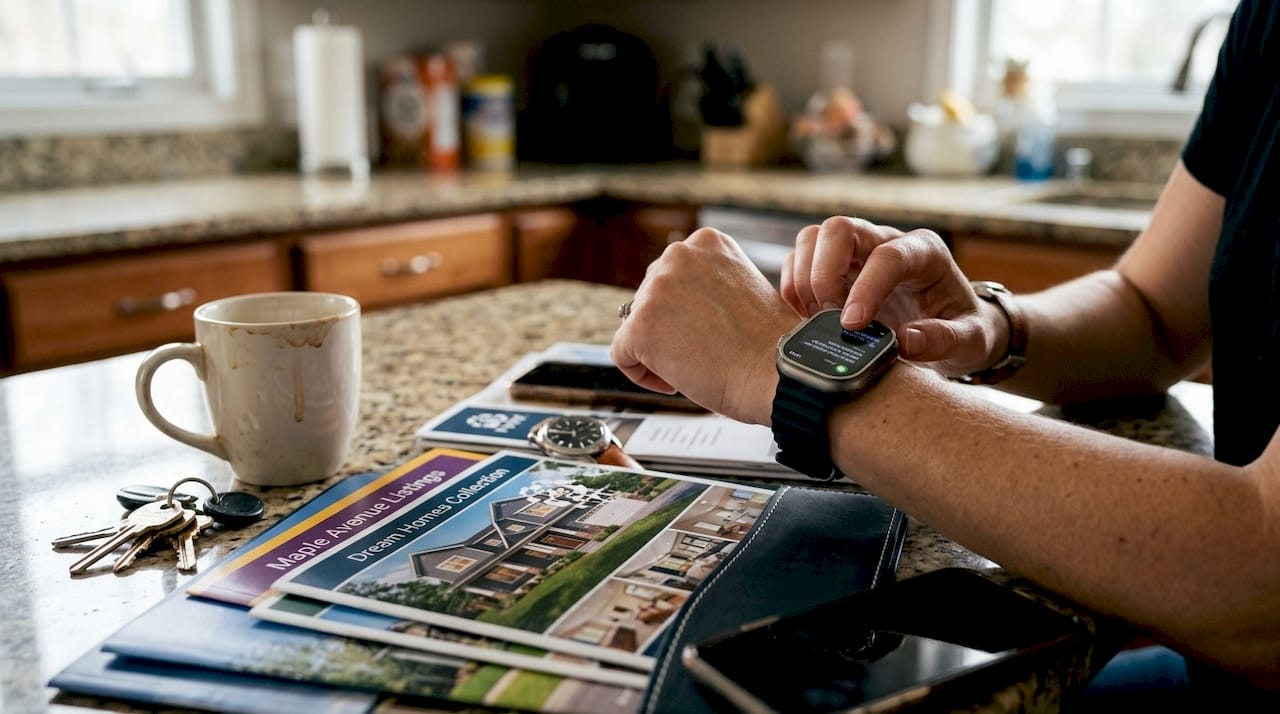
78% of buyers choose the first agent who responds. This is not about building relationships or demonstrating expertise. It's pure speed. The professional who replies within five minutes wins. Everyone else loses, regardless of experience, local knowledge, or service quality.
| Response time | Conversion rate | Revenue impact per lead |
|---|---|---|
| Under 5 minutes | 391% higher | Full commission potential |
| 5-10 minutes | Baseline | $427 average loss |
| Over 30 minutes | 21x lower | Deal likely lost to competitor |
The mathematics become brutal when examining individual transactions. A $500,000 home at 3% commission generates $15,000. Missing that initial notification for 20 minutes while in a showing often means losing the entire $15,000 to an agent who felt their Smartlet dual-watch strap vibrate and excused themselves to reply immediately.
- Lead value peaks in the first five minutes after inquiry
- Buyers contact multiple agents simultaneously
- Phone-checking during showings appears unprofessional
- Silent wrist alerts enable instant awareness without visible distraction
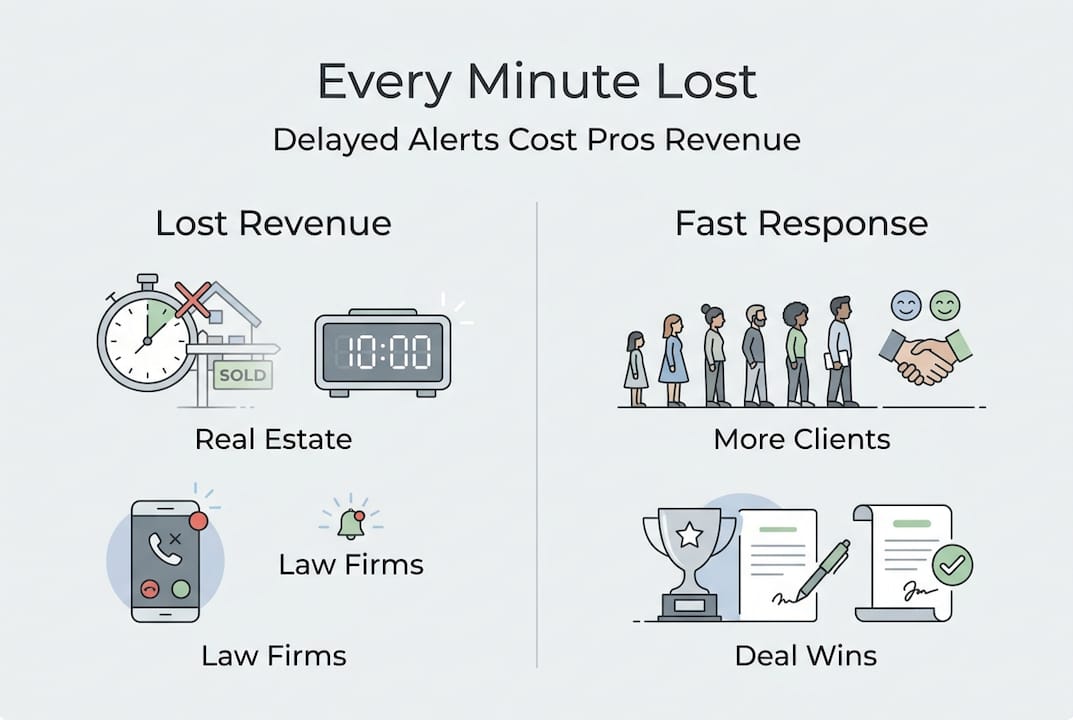
Lawyers and event professionals
Legal professionals face similar urgency with higher stakes. A corporate client seeking counsel for a $2 million contract dispute contacts three firms simultaneously. The lawyer who responds in five minutes is 21 times more likely to secure the engagement than one who waits 30 minutes. That single delay costs $40,000 in legal fees.
Client perception drives these dynamics. Fast responses signal availability, competence, and prioritization. Delayed replies, even by 15 minutes, communicate disinterest or overextension. In competitive legal markets, perception determines client selection before expertise enters consideration.
Event professionals operate under identical pressure. A couple planning a $50,000 wedding contacts five venues on Saturday morning. The venue coordinator who replies within minutes books the consultation. The four who check their phones an hour later after finishing another event tour never get the opportunity to compete.
- Court appearances and client meetings prevent phone checking
- Professional settings make visible phone use inappropriate
- Silent mode causes missed high-value opportunities
- Delayed awareness creates compounding response lag
The solution is not checking phones more frequently - that damages professionalism and client relationships. Event coordinators cannot interrupt venue tours to scroll through messages. Lawyers cannot pull out phones during depositions.
Discreet wrist notifications solve the awareness problem without creating new professional issues. A subtle vibration on the wrist signals incoming opportunities without visible distraction. Professionals excuse themselves naturally, respond immediately, and return to their current commitment without appearing divided in attention.
A well-sized Smartlet bracelet is made for all-day wear, without the bulk or aesthetic compromise of a second smartwatch band. Lawyers maintain their Datejust presentation while receiving instant case alerts. Event professionals keep their elegant timepiece visible while staying connected to booking inquiries.
Bodyguards and security professionals
Security professionals face life-impacting consequences from delayed notifications. A bodyguard protecting a high-profile client receives a threat assessment update. If that alert sits unread in a phone for three minutes, the response window closes and risk escalates.
Unlike other professions where delays cost money, security delays risk safety and contracts. A single missed notification during a protection detail can end a career. Clients expect instant situational awareness. Bodyguards who demonstrate even momentary communication gaps lose assignments to more responsive competitors.
The phone-checking problem intensifies in security roles. Pulling out a device signals distraction and vulnerability. It reveals that attention has shifted from environmental monitoring to screen interaction - contradicting the core security function.
- Configure priority contacts for immediate wrist notification
- Set up geofenced alerts for location-based security updates
- Use haptic-only notifications to avoid audio or visual signals
- Pair traditional watch on the outer wrist with concealed smartwatch underneath
Security contracts worth $200,000 annually disappear when bodyguards miss critical communications. The professional wearing a Portugieser with integrated smartwatch notification receives threat updates instantly without breaking environmental scan. The one relying on a phone discovers the alert after the critical response window closes.
Immediate awareness is not a convenience feature for security professionals. It's the foundational requirement that determines both safety outcomes and career viability.
The professional wearing a luxury watch with a concealed smartwatch underneath receives every critical alert without pulling out a phone. Clients see composure and presence. The professional sees everything they need to see.
The false choice: style vs function is outdated
Independent professionals have long accepted a frustrating tradeoff. Wear a luxury mechanical watch and miss critical notifications. Or wear a smartwatch and sacrifice the aesthetic authority that traditional timepieces communicate in client-facing industries.
Real estate agents choose between the Rolex that signals success to high-net-worth clients and the Apple Watch that ensures they never miss a lead. Lawyers select either the Omega that conveys established expertise or the smartwatch that keeps them connected during court sessions.
This false choice costs professionals both revenue and presentation quality. Those who prioritize style lose income to delayed responses. Those who choose function sacrifice the visual authority that luxury watches provide in client-facing industries.
The assumption underlying this tradeoff is obsolete. Technology now enables wearing both watches simultaneously without bulk, discomfort, or aesthetic compromise.
Smartlet eliminates the false choice. Both watches, same wrist, same moment. No modification. No compromise.
The Datejust remains visible during client meetings, communicating success and attention to detail. The Apple Watch sits concealed underneath, delivering instant notification through subtle wrist vibration. Professionals no longer sacrifice income for appearance or appearance for income.
How Smartlet solves the notification problem
The Smartlet modular strap resolves the dual-watch challenge through precision engineering: a metal link bracelet in SS316L steel or Grade 2 titanium, compatible with 18-24mm lug width watches and the major smartwatch platforms.
Compatibility covers any watch with 18mm to 24mm lug width on a standard spring bar. No modification to your existing timepiece. The traditional watch sits on top, its original strap replaced by the Smartlet bracelet. The smartwatch sits underneath, in the central part of the bracelet.
| Feature | Traditional smartwatch | Luxury watch alone | Smartlet system |
|---|---|---|---|
| Instant notifications | Yes | No | Yes |
| Professional aesthetic | No | Yes | Yes |
| All-day comfort | Limited | Yes | Yes |
| Brand compatibility | Single device | N/A | Any 18-24mm watch |
| Modification required | N/A | N/A | None |
Three versions of the Smartlet address different professional contexts. Classic (299 EUR) in hand-brushed SS316L pairs cleanly with steel watch cases, suited to real estate agents pairing a Submariner with an Apple Watch. Shadow (399 EUR) in black PVD suits darker dials and legal or security environments requiring discretion. Titanium (549 EUR) in Grade 2 titanium is the lightest of the three, relevant for all-day wear during long events or protection details. Concours Lepine 2025, Awarded - CES 2026.
The system transforms notification management from a choice between style and function into a seamless integration of both. Professionals maintain their established watch aesthetic while gaining the instant awareness that protects revenue and competitive position. Review the brand compatibility guide to confirm your existing watches work with Smartlet.
Featured Articles
No people found
We couldn’t find anything with that term. Please try again.


