


From calculator watches to Apple Watch: The full smartwatch history

Founder & CEO, Smartlet - CentraleSupelec engineer - Concours Lepine 2025, Awarded - CES 2026
Table of Contents
- Early digital pioneers: calculator watches and wrist computers
- From geek gadget to mainstream: Pebble, Galaxy Gear, and Apple Watch
- Defining what makes a smartwatch: features, debates, and hybrid innovation
- Collecting smartwatches: trends, value, and the two-watch movement
- What collectors and enthusiasts often miss about smartwatch history
- Experience the best of both worlds with Smartlet
- Frequently asked questions
Key takeaways
| Point | Details |
|---|---|
| Smartwatches started early | Wrist computers and calculator watches from the 1980s were the first seeds of the modern smartwatch. |
| Mainstream adoption took decades | It took the Pebble, Galaxy Gear, and Apple Watch to make smartwatches widely accepted and desired. |
| Collectors drive innovation | Horology enthusiasts have influenced and adopted hybrid, two-watch trends that continue today. |
| Debates shape definitions | Arguments over what counts as a smartwatch reflect evolving technology and collector tastes. |
Smartwatches feel like a product of the last decade, but that assumption is wrong by about forty years. The concept of a wrist-worn computer predates the iPhone, the internet browser, and even the compact disc. Watch collectors and horology enthusiasts know better than most that innovation rarely happens in a straight line, and the story of the smartwatch is no exception. From clunky calculator bezels to surgical-grade ECG sensors, this is the full timeline of how wearable technology evolved, and why the mechanical and digital worlds were always destined to converge.
Early digital pioneers: calculator watches and wrist computers
The first wrist-worn devices capable of more than timekeeping appeared in the mid-1970s. Pulsar launched a calculator watch in 1975, and Hewlett-Packard followed with the HP-01 in 1977, a device that required a stylus to operate its tiny keyboard. These were expensive, fragile, and deeply impractical. Yet they sold. Tech enthusiasts and engineers wore them as status symbols, proof that you understood where the future was heading.
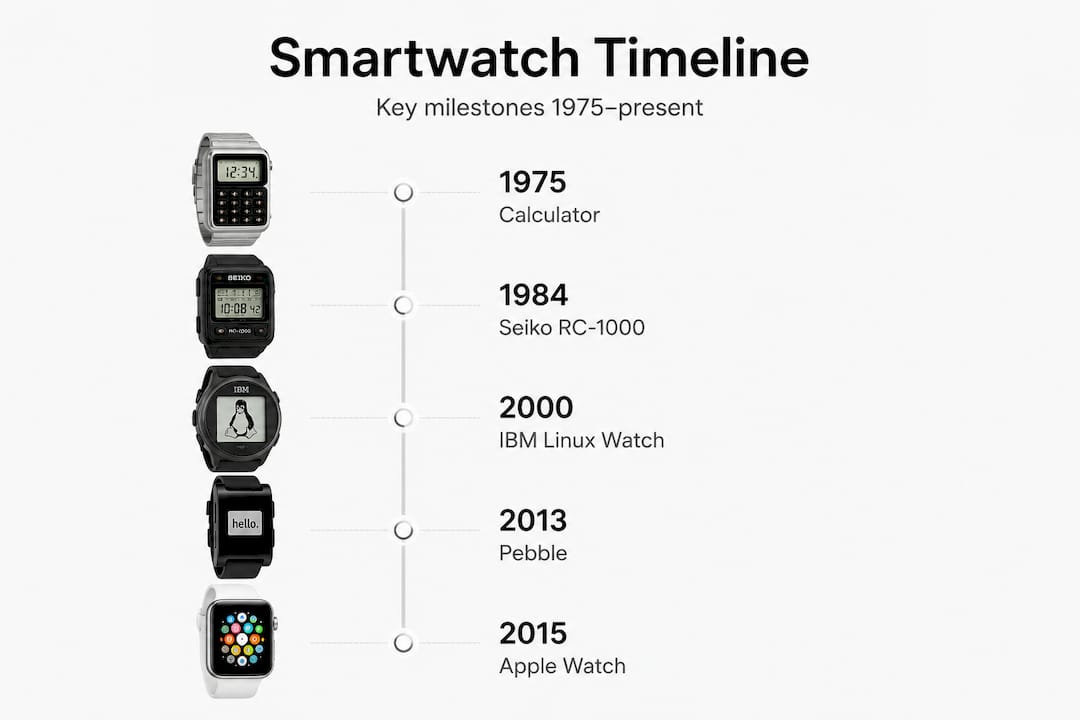
Seiko changed the game entirely. Starting with the Data-2000 of 1983 that needed an external keyboard to function, then the RC-1000 of 1984 which could be paired with a range of computers including the Commodore 64, and finally the programmable UC-2000 with 4KB of RAM, 26KB of storage, BASIC language support, and a docking station with a printer. Today, Seiko wrist computers are sought after by collectors. Seiko's smartwatch heritage
Key milestones in early wrist computing:
- 1975: Pulsar introduces the first commercial calculator watch
- 1977: HP-01 launches with stylus input and algebraic functions
- 1983: Seiko Data-2000 syncs with an external keyboard
- 1984: Seiko RC-1000 connects to personal computers via cable
- 1984: Seiko UC-2000 runs BASIC and ships with a docking printer
- 1985: Casio launches its own calculator watch line, bringing the concept to mass-market pricing
| Year | Device | Key innovation |
|---|---|---|
| 1975 | Pulsar calculator watch | First wrist calculator |
| 1977 | HP-01 | Algebraic functions, stylus input |
| 1983 | Seiko Data-2000 | External keyboard sync |
| 1984 | Seiko RC-1000 | PC connectivity, Commodore 64 compatible |
| 1984 | Seiko UC-2000 | BASIC programming, docking station with printer |
| 1985 | Casio calculator watch | Mass-market affordability |
LED displays drained batteries in hours. The keypads were too small for practical daily use. Prices for flagship models ran into hundreds of dollars at a time when that was a serious investment. Mass adoption never happened, but the enthusiast community was captivated. These devices proved that smart wearables were not a Silicon Valley invention. They were a watchmaker's ambition first.
If you are building a collection that spans both heritage and technology, early Seiko data watches are a logical anchor point. They bridge the gap between traditional watchmaking precision and digital ambition, and they are increasingly rare on the secondary market. You can read more about pairing vintage and smartwatches as a practical lifestyle choice.
From geek gadget to mainstream: Pebble, Galaxy Gear, and Apple Watch
Between the Seiko era and the 2010s, wrist computing went quiet. The IBM Linux Watch appeared in 2000, running a full Linux kernel on your wrist, but it never reached consumers. Microsoft launched the SPOT watch platform in 2004, delivering news and weather via FM radio signals. Neither broke through. The hardware was ahead of the software ecosystem, and consumers were not yet ready to manage a wrist-worn device alongside a phone.
Then Pebble arrived. In 2012, Eric Migicovsky launched a Kickstarter campaign for a simple e-ink smartwatch that connected to your smartphone. The campaign raised over $10 million, shattered crowdfunding records, and catalyzed mainstream adoption in a way no previous product had managed. Pebble sold over one million units by 2014. The formula was clear: pair the watch with the phone, keep the interface simple, and give people notifications on their wrist.
The three launches that changed everything:
- Pebble (2012): E-ink display, week-long battery, open app platform, $10M+ Kickstarter
- Samsung Galaxy Gear was the first major manufacturer to jump into the smartwatch race, providing camera and voice call capabilities from the wrist. Samsung Galaxy Gear (2013):
- When Apple first launched the Apple Watch in 2015, focus was placed on health and wellness, the app ecosystem, and the Digital Crown, which enabled users to scroll, pinch, and zoom. It was a natural evolution, riding a wave of what had worked well for the brand in the past. Apple Watch (2015):
- Apple Watch Series 4 (2018): ECG monitoring approved by the FDA, elevating the device from gadget to medical tool
Apple's entry was the inflection point. The Apple Watch did not just add features. It reframed the entire category. Suddenly, smartwatches included monitoring your heart rhythm, detecting falls, and calling emergency services autonomously. The Apple Watch ECG feature on Series 4 was the first truly medical-capable feature on a mainstream consumer device. Apple Watch ECG
| Device | Launch year | Defining feature | Market impact |
|---|---|---|---|
| Pebble | 2012 | E-ink, open platform | Proved consumer demand |
| Samsung Galaxy Gear | 2013 | Camera, voice calls | Major brand validation |
| Apple Watch Gen 1 | 2015 | App ecosystem, health | Mainstream cultural adoption |
| Apple Watch Series 4 | 2018 | ECG monitoring | Medical credibility |
| Apple Watch Ultra | 2022 | Rugged, precision GPS | Premium segment expansion |
For collectors already navigating the smartwatch compatibility guide, this era matters because it established the feature benchmarks that every connected watch is measured against today. Galaxy Watch compatibility with premium mechanical straps became a real conversation among collectors who refused to give up their heritage pieces.
Defining what makes a smartwatch: features, debates, and hybrid innovation
The evolution from basic calculators to data-sync devices to full app-capable wearables has not always been clear cut. Power-hungry LED screens gave way to always-on AMOLED screens. Cabled connections became Bluetooth and Wi-Fi. Stylus input became voice commands and touch gestures.
Core features that define a modern smartwatch:
- Timekeeping with automatic sync to atomic or GPS signals
- Smartphone notifications including calls, messages, and app alerts
- Fitness and health monitoring: steps, heart rate, SpO2, ECG
- Installable third-party apps and custom watch faces
- Wireless connectivity via Bluetooth, Wi-Fi, and sometimes LTE
- Onboard storage for music, contacts, and health data
The debate about the first smartwatch is genuinely unresolved. Seiko's 1984 RC-1000 could sync to a computer and run applications. But without an app ecosystem or wireless syncing, some argue it does not qualify. The answer shapes how collectors assign value and historical significance when building a collection.
"The line between a very capable watch and a smartwatch has always been a moving target. Every generation redraws it based on what technology makes possible."
Hybrid models have become the most interesting development for enthusiasts. Brands like Withings and Garmin have succeeded in creating watches that look like mechanical timepieces but feature connected technology to monitor health in every aspect. The choice between a beautiful mechanical watch and a connected timepiece is no longer simply one between style and functionality. connecting smartwatches and mechanicalssmartwatch heart monitoring
When evaluating a hybrid smartwatch for your collection, check whether it uses a standard spring bar and lug width. Many hybrid models are designed to accept traditional straps, which means they can integrate with the same strap ecosystem as your mechanical pieces.
Collecting smartwatches: trends, value, and the two-watch movement
Collecting smartwatches is a different discipline from collecting mechanical watches, but the underlying instincts are the same. Rarity matters. Condition matters. Provenance matters. The Seiko RC-1000 and UC-2000 are already commanding serious attention on auction platforms because surviving examples in working condition are increasingly scarce.
What drives value in vintage smartwatch collecting:
- Rarity: Limited production runs and low survival rates for working units
- Functionality: devices that still power on and operate correctly command a premium. Functionality:
- Completeness: original packaging with cables, docking stations, and documentation increases value significantly. Completeness:
- Historical significance: first-generation models from landmark releases like Pebble Gen 1 and Apple Watch Gen 1 are appreciating in value over time. Historical significance:
- Brand heritage: Seiko, Casio, and HP models carry collector credibility from both the watch and tech communities. Brand heritage:
Practical steps for building a smartwatch collection:
- Research production numbers before purchasing. First-generation Pebble units had quality control variations worth understanding.
- Verify battery condition. Lithium batteries in older smartwatches degrade and can swell, damaging the case.
- Confirm software functionality. Many early smartwatches depend on server infrastructure that no longer exists.
- Seek original accessories. A Seiko UC-2000 with its docking station and printer is a fundamentally different collectible than the watch alone.
- Document your pieces. Photographs, serial numbers, and purchase records protect value and support authentication.
The two-watch movement is the most exciting development in collector culture right now. Today, collectors utilize specialized adapters to simultaneously wear a vintage mechanical watch alongside a smartwatch. The practice has gone mainstream in the watch collecting world. collecting classic and smartwatches
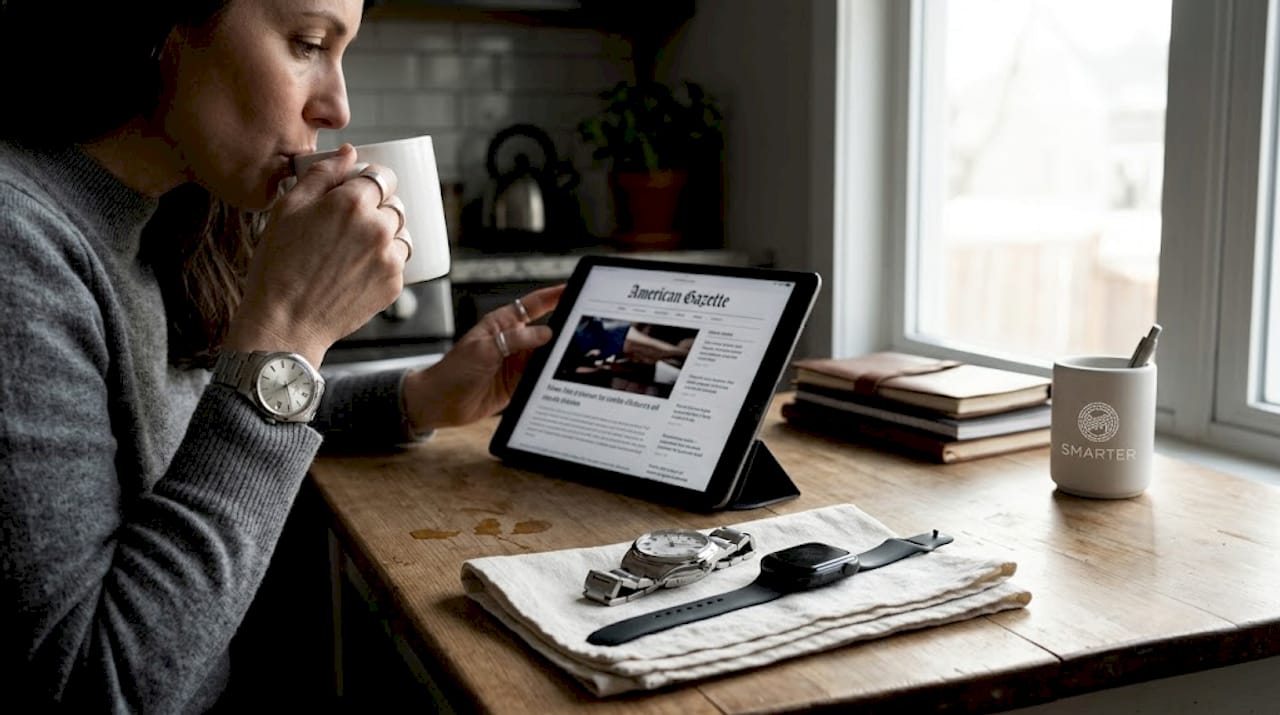
The convergence of mechanical and digital is not a contradiction. It is the logical next step in a history that has always been about pushing what a watch can do.
What collectors and enthusiasts often miss about smartwatch history
The mainstream narrative about smartwatches almost always starts with Apple. That is understandable. But starting there means missing forty years of context that fundamentally changes how you understand the category. Apple brought wearables into the mainstream, but they left forty years of digital wearables history behind.
Watch purists sometimes dismiss smartwatches as a tech industry intrusion into horology. That perspective misses the fact that Seiko, one of the most respected names in watchmaking, was building wrist computers before most of today's smartwatch engineers were born.
What is genuinely surprising is how the history of wrist computing mirrors the history of mechanical watchmaking. Every major leap was met with skepticism from traditionalists and enthusiasm from innovators. The pattern repeats. And every time, the result is a richer, more capable category that eventually earns the respect of the purists who initially resisted it.
The collector's path is uniquely positioned to appreciate this. A watch is a record of what human ingenuity valued at a specific moment in history. The Seiko RC-1000 tells you something profound about 1984. The first Apple Watch tells you something equally profound about 2015. Owning both, wearing both, is a way of carrying that history on your wrist every day.
The collector's path is uniquely positioned to appreciate this. You already understand that a watch is never just a timekeeping device. It is a record of what human ingenuity valued at a specific moment in history. The Seiko RC-1000 tells you something profound about 1984. The first Apple Watch tells you something equally profound about 2015. Owning both, wearing both, is a way of carrying that history on your wrist every day.
The convergence of mechanical craft and digital intelligence is not a trend. It is the logical conclusion of a story that began the moment someone decided a watch could do more than tell time.
Experience the best of both worlds with Smartlet
The entire arc of smartwatch history points toward one conclusion: collectors should not have to choose between heritage and technology. Smartlet was founded on exactly that conviction. David Ohayon, inventor and watch collector, engineered a patented modular strap adapter in brushed SS316L steel and Grade 2 titanium that lets you wear your mechanical watch and your smartwatch simultaneously, with no modification to either piece.
The Smartlet modular strap is compatible with any watch from 18 to 24mm lug width via standard spring bar. Three versions available: Classic (299 EUR), Shadow (399 EUR), and Titanium (549 EUR). Check the compatibility guide to confirm your specific pairing. Bronze Medal at Concours Lepine 2025. Presented at CES 2026. Don't choose. Compose.
Featured Articles
No people found
We couldn’t find anything with that term. Please try again.


