


Smartwatch sensors for glucose and blood biomarkers

Founder & CEO, Smartlet - CentraleSupelec engineer - Concours Lepine 2025, Awarded - CES 2026
Table of Contents
- Smartwatch glucose monitoring: current realities and key players
- Beyond glucose: next-generation blood biomarker sensors
- Accuracy, edge cases, and technology pitfalls in health watches
- Practical application: combining sensors, data, and luxury timepieces
- Why trend-tracking beats perfect numbers in wearable health
- Upgrade your collection: modular straps and compatibility
- Frequently asked questions
Key takeaways
| Point | Details |
|---|---|
| Reliable sensor integration | Dexcom G7 offers the most reliable retail glucose integration, while direct non-invasive watch sensors lag behind. |
| Expanded blood markers | Smartwatches now track lactate, cortisol, and other markers beyond glucose through cutting-edge biosensors. |
| Accuracy challenges | Motion, skin tone, and temperature can affect sensor readings. Trend tracking is more useful than single measurements. |
| Luxury and tech pairing | Modular straps empower collectors to wear traditional and smart watches for both style and comprehensive health tracking. |
Flip over almost any smartwatch box today and you will find bold claims about health monitoring. Yet the truth is sharper: most wrist-worn devices still cannot directly measure blood glucose without an external sensor or a fingerstick. That gap between marketing and clinical reality frustrates collectors and health-conscious wearers alike. But the technology is accelerating fast. From Apple's quietly advancing non-invasive sensor program to sweat-based cortisol patches showing real clinical correlation, the next generation of smartwatch sensors is reshaping what "health monitoring" actually means on your wrist.
Smartwatch glucose monitoring: current realities and key players
The most reliable glucose monitoring available today relies on continuous glucose monitors (CGMs). These are small wearable patches that sit just beneath or on the skin, sampling interstitial fluid to estimate blood sugar. The Apple Watch blood sugar monitoring approach currently pairs with Dexcom's G7 CGM over Wi-Fi, displaying glucose data directly on your watch face. Apple's own non-invasive sensor technology is likely years away, with commercial readiness estimated around 2027 at the earliest.
The five sensors shaping the next generation
Five specific sensor technologies are now in active R&D, each targeting a different blood marker:
| Sensor type | Target marker | R&D stage | Estimated launch |
|---|---|---|---|
| Near-infrared optical (Apple, Samsung) | Blood glucose | Clinical validation | 2027 (estimated) |
| Pulse transit time ultrasound (PTT) | Blood pressure | Late-stage prototype | 2026 to 2028 |
| Mid-infrared spectroscopy (Halo) | Blood alcohol | Early clinical trials | 2028+ |
| Sweat electrolyte patch (MIT) | Electrolytes (sodium, potassium) | Research/pilot | 2027+ |
| Hyperspectral optical | Multiple blood markers | Early R&D | 2029+ |
PTT-based blood pressure monitoring measures the time between your heartbeat and the pulse wave reaching your wrist. Samsung has incorporated this into Galaxy Watch models, though periodic recalibration is still required. Garmin is pursuing HbA1c estimation as a practical first step for users who want glucose trend awareness without full CGM integration.
Key limitations collectors should know
- Optical prototypes for near-infrared or hyperspectral glucose analysis, which offer the potential for bloodless glucose monitoring, have yet to be clinically validated on a commercial scale.
- CGM plus watch combinations achieve a mean absolute relative difference (MARD) below 10%, making them the only clinically reliable wrist-based glucose solution today.
- Microwave and mid-infrared sensors face significant interference from skin water content and body temperature variation
- Halo's alcohol sensor is still in early clinical trials and has not received FDA clearance.
Pair your smartwatch with an FDA-cleared CGM like the Dexcom G7 for reliable data. Treat prototype readings from any non-cleared device as directional, not diagnostic.
The future of wearables clearly points toward integrated, multi-marker platforms. But for now, smart collectors stay grounded in what is clinically validated rather than what is technically impressive.
Beyond glucose: next-generation blood biomarker sensors
Alongside glucose, new sensors are advancing how we track a wider set of blood and stress markers. This is where the technology gets genuinely exciting for health-focused collectors.
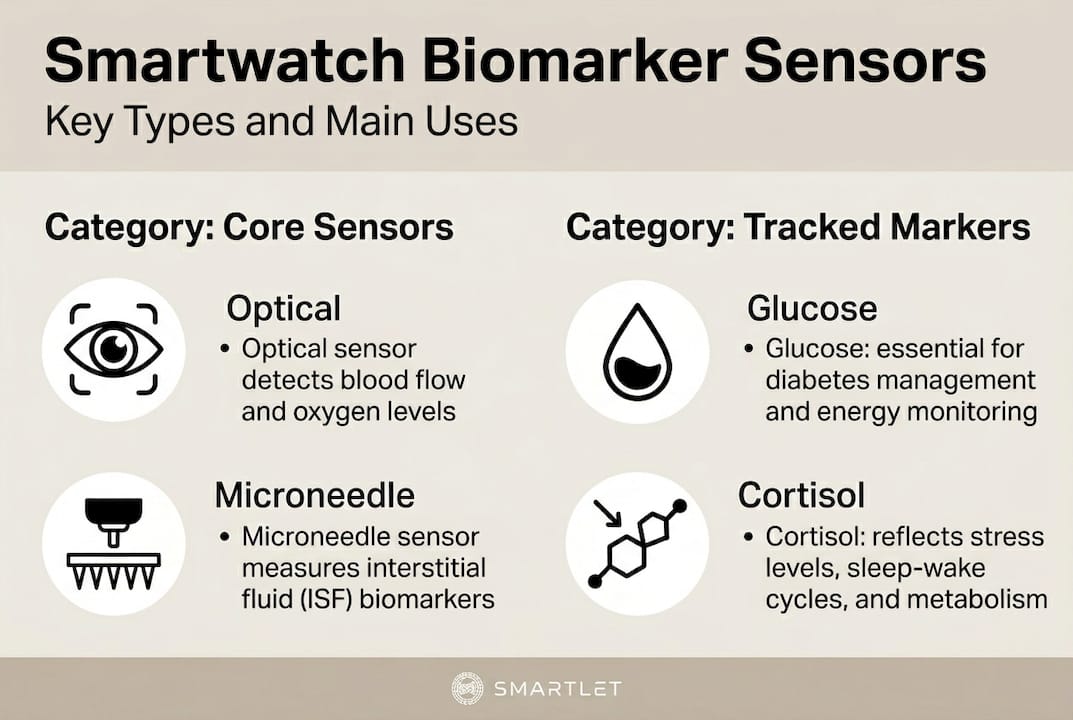
Microneedle patches capable of continuous monitoring for glucose, lactate, and alcohol simultaneously, while also integrating ultrasound-based blood pressure and heart rate tracking, are in active clinical trials. Results are being published in Nature Biomedical Engineering. Nature Biomedical Engineering
What does this mean practically?
Lactate monitoring is particularly relevant for collectors who are also active. Lactate builds up in muscles during intense exercise and is a key indicator of cardiovascular load. Non-invasive lactate tracking via multi-sensor fusion has shown an R-squared value of 0.9661 and a root mean square error of 0.5891 mmol/L in research conditions. Sweat lactate biosensors also show a detection limit of 0.07785 mM, meaning they can pick up meaningful signals at genuinely low concentrations.
Cortisol is your primary stress hormone, following a natural circadian rhythm that peaks in the morning and drops at night. Sweat-based cortisol sensors have demonstrated a correlation of r=0.73 with saliva tests in controlled studies.
"Sweat cortisol sensors show correlation r=0.73 with saliva tests, making them a promising non-invasive tool for daily stress tracking and circadian rhythm assessment."
That is a moderate but meaningful correlation. It is not a replacement for a blood test, but for trend-level insight over days and weeks, it offers genuine value.
Sensors beyond glucose at a glance
- Glucose via near-infrared and CGM integration (most mature technology)
- Lactate via sweat biosensors and multi-sensor fusion (strong research correlation)
- Cortisol via sweat-based electrochemical sensors (moderate clinical correlation)
- Blood alcohol via mid-infrared skin-contact sensors (early clinical stage)
- Electrolytes (sodium, potassium) via MIT-developed skin patches (pilot phase)
Understanding how smartwatch sensors work at the hardware level helps set realistic expectations for each of these. Photoplethysmography (PPG), the optical sensor behind most heart rate monitors, is the foundation for many of these advances.
The discussion around smart wearables is evolving rapidly from "step counter with notifications" to "continuous biochemical monitor." That shift has significant quality-of-life implications, particularly for collectors aged 45 and above who are managing metabolic health proactively.
Use next-gen biomarker sensors for trend tracking and awareness, not as a substitute for medical diagnosis. Flag meaningful trends to your physician for clinical follow-up.
Accuracy, edge cases, and technology pitfalls in health watches
Non-invasive glucose sensors are particularly vulnerable to three variables: motion artifacts, skin tone variation, and ambient temperature shifts. Mid-infrared sensors, often touted as the most promising non-invasive glucose technology, may double the error rate compared to invasive methods under real-world conditions.
Top pitfalls in non-invasive sensor performance
- Skin contact quality: even minor gaps between sensor and skin introduce significant optical noise. Skin contact quality:
- Sweat interference: sweat changes skin conductance and optical properties, affecting both glucose and cortisol sensors. Sweat interference:
- Motion artifacts: walking, typing, or hand gestures create movement in the sensor-skin interface, degrading PPG signal quality. Motion artifacts:
- Calibration drift: many sensors lose accuracy over hours or days as skin conditions change, requiring recalibration. Calibration drift:
- Melanin interference: higher melanin concentrations in darker skin tones affect near-infrared light absorption, requiring algorithm correction that not all manufacturers have implemented correctly. Melanin interference:
- Temperature sensitivity: cold environments reduce peripheral blood flow, weakening the signal at the wrist. Temperature sensitivity:
Mid-infrared glucose sensors may double the measurement error rate compared to invasive blood draws under real-world conditions. Sensing users are likely to obtain more value from monitoring long-term trends over 7 days or more, rather than putting a premium on data from a particular day.
When comparing platforms, the smartwatch vs ring sensor comparison is useful context. Rings often maintain better skin contact than watches, particularly during sleep, which is why some manufacturers are exploring multi-device approaches for continuous overnight monitoring alongside daytime watch wear.
Wear your smartwatch snugly, avoid measuring immediately after exercise, and always evaluate health trends over at least 7 days rather than acting on a single reading.
Practical application: combining sensors, data, and luxury timepieces
A study published in Nature found that combining smartwatch data including heart rate, steps, and sleep with blood biomarker analysis can predict insulin resistance with an AUROC of 0.88. Resting heart rate alone correlates with HOMA-IR at r=0.27. These correlations suggest that consistent smartwatch use contributes meaningfully to metabolic health awareness.
For collectors, the question is not whether to trade a Rolex for an Apple Watch. It is how to wear both with purpose. The best smartwatches for health features today include the Apple Watch Series 10, Samsung Galaxy Watch 7, and Garmin Fenix 8, each offering different sensor strengths. None of them replaces the aesthetic and mechanical satisfaction of a fine timepiece.
Integration strategies for dual-wear
- Modular straps: allow a smartwatch to sit under your luxury watch on a single wrist, with precision-engineered watch adapters
- Connector compatibility checks: verify lug width (18 to 24mm) and spring bar compatibility before investing in a dual-wear setup
- Rotating schedules: wear your smartwatch during active or sleep periods, and your mechanical watch during formal occasions
- Data continuity: most platforms sync passively, so even part-day smartwatch wear generates meaningful trend data
Steps to combine a luxury timepiece with smartwatch sensors daily
- Check your luxury watch's lug width and select watch adapters of the matching width
- Attach your smartwatch underneath your mechanical watch, in the central part of the bracelet, with no modification to either piece
- Set your smartwatch to continuous heart rate and SpO2 monitoring throughout the day
- Review weekly trend summaries every Sunday, noting any anomalies in resting heart rate, HRV, or sleep quality
- Share trend data with your physician at your next check-up as a supplementary health reference
The top tips for modular straps guide covers how to optimize placement for both comfort and sensor contact quality. Connecting your watches via a precision adapter means connecting your lifestyle to a new level of health awareness without sacrificing the aesthetic integrity of a fine collection.
Why trend-tracking beats perfect numbers in wearable health
There is a temptation in any precision-oriented community to chase perfect numbers. Watch collectors understand this instinctively. We measure chronometer accuracy in seconds per day. We scrutinize movement finishing under magnification. That same mindset, applied to health data, can actually work against you.
A single glucose reading that is 8% off is not actionable. But a pattern of elevated morning readings over three weeks absolutely is. The real-world tips that experienced users rely on are almost all about consistency and pattern recognition, not chasing a perfect number on any given morning.
Wearable sensors today are genuinely powerful, not because they match clinical lab precision, but because they generate continuous longitudinal data that no single lab visit can replicate. That is the insight worth building your health monitoring approach around.
"In wearable tech, it is the big picture, not the decimal, that counts."
Pair a quality smartwatch with a thoughtful review routine, and you have something a lab visit every six months simply cannot offer: the ongoing story of your health, written one data point at a time.
Upgrade your collection: modular straps and compatibility
Smartlet's patented modular strap was built for exactly this scenario: wearing your luxury mechanical watch and your health-tracking smartwatch on the same wrist simultaneously, without modification to either piece.
Compatible with any watch from 18 to 24mm lug width via standard spring bar. Engineered in brushed SS316L steel and Grade 2 titanium. Available in three versions: Classic (299 EUR), Shadow (399 EUR), and Titanium (549 EUR). Use the brand compatibility guide to confirm fit with your specific timepiece. Don't choose between style and health. Compose both.
Featured Articles
No people found
We couldn’t find anything with that term. Please try again.


