


How doctors wear two watches without looking unprofessional

Fundador y director ejecutivo de Smartlet - Ingeniero por la CentraleSupelec - Galardonado en el Concurso Lepine 2025 - CES 2026
Índice
- Why doctors wear two watches in 2026
- The clinical value of a smartwatch in medical settings
- The mechanical watch in medicine: a signal, not a habit
- Colocación: cómo queda cada reloj en la muñeca
- Infection control and dual wear
- Outside the clinic: the same setup in a different register
- How Smartlet makes dual wear practical for physicians
- Elegir la versión adecuada de Smartlet
- Preguntas frecuentes
Puntos clave
| Tema | What this article covers |
|---|---|
| Clinical context | Why ECG, SpO2, and haptic alerts matter during a working shift |
| Positioning logic | Smartwatch toward the forearm, mechanical watch as the visible piece |
| Infection control | What the evidence says, and which settings require a different approach |
| Watch selection | Compatible mechanical watches with 18-24mm lugs and spring bar |
| Sistema Smartlet | How the adapter threads both watches onto one strap without tools |
A cardiologist checking an Apple Watch ECG reading while a Longines sits under the cuff of a white coat. It is more common than most people assume. In 2026, the question is no longer whether doctors wear smartwatches at work. It is how they manage both watches without one undermining the other.
"The stethoscope around one's neck, the reflex hammer in one's pocket, and two timepieces on the same wrist: one analogue, one digital, held together on a single strap."
Why doctors wear two watches in 2026
Medicine is a profession built on precision and accountability. A mechanical watch and a smartwatch worn together reflect the twin demands the profession places on a timepiece, demands no single watch has yet fully met.
Apple Watch records important health metrics throughout a twelve-hour shift. Heart rate variability, resting heart rate trends, sleep quality between on-call nights, ECG readings when something feels off. These are not vanity metrics. A 2023 study published in Circulation found that consumer smartwatch ECG algorithms detected atrial fibrillation with sensitivity above 90% in clinical validation. That number matters when the physician wearing the watch is the patient.
The mechanical watch communicates something different. A Tissot Gentleman, a Longines HydroConquest, a Seiko Presage on the wrist during a patient consultation signals permanence, precision, and care. It is not about the brand. It is about the object. A mechanical watch is a deliberate choice. Patients read that signal.
Neither watch replaces the other. In most clinical contexts outside the operating room, both can coexist on the same wrist without creating a problem.

The clinical value of a smartwatch in medical settings
Healthcare professionals are at elevated risk for burnout, cardiovascular events, and sleep deprivation. The smartwatch on the wrist is not surveillance. It is the same evidence-based monitoring the physician prescribes to patients, applied to themselves.
Haptic alerts for incoming calls and messages allow the physician to keep a phone in a pocket or locker while remaining reachable. During consultations, pulling out a phone interrupts the interaction. The watch taps the wrist. The physician decides whether to step out. The patient does not see the interruption.
The ECG function on Apple Watch Series 9 and later generates a single-lead ECG in 30 seconds. For a physician who feels palpitations during a long shift, this is immediate clinical information. Not a diagnosis. Data. Those readings can be shared with colleagues, helping decide whether a Holter monitor is warranted.
SpO2 monitoring is less precise on consumer devices than on clinical oximeters. Every physician knows this. But as a trend indicator across a shift, a falling baseline is worth noticing. The shape of the trendline matters even when the absolute number does not.
No physician makes a clinical decision based on a consumer smartwatch reading alone. The value is in the trend over time and in the alert, not in the absolute value. That distinction matters for how to think about this data professionally.
The mechanical watch in medicine: a signal, not a habit
Physicians who wear mechanical watches at work are not ignoring the smartwatch question. They are making a deliberate choice about what they want visible on their wrist during patient interaction.
The analogue watch face is readable at a glance without waking a screen. During a consultation, checking the time on a mechanical watch reads as discreet. Checking a smartwatch risks appearing distracted. The patient cannot know whether the physician is checking the time or reading a message. The mechanical watch removes that ambiguity.
Most physicians choose timepieces in the 38-42mm range, something that disappears under a shirt cuff but remains readable quickly. Brands like Longines, Tissot, Seiko, and Hamilton sit in the practical range for a working watch. All use standard spring bar systems with lug widths between 18mm and 22mm, placing them within the compatibility range of the Smartlet system.
A Longines HydroConquest at 20mm lug width, a Tissot Gentleman at 20mm, a Seiko Presage at 22mm. All confirmed compatible with Smartlet via standard spring bar. The watch does not need to be expensive. It needs to be mechanical, readable, and appropriately sized.
"The physician who wears a mechanical watch makes a statement about precision and intention. The patient reads that statement whether the physician intended it or not."
Colocación: cómo queda cada reloj en la muñeca
The positioning question is the most practical one, and it has a clear answer. The mechanical watch sits in the conventional position, centered on the wrist with the dial facing up. Apple Watch sits higher, toward the forearm, between the mechanical watch's position and the elbow.
This placement keeps the mechanical watch as the visible piece when the hand is extended toward a patient or resting on a desk. Apple Watch is accessible by raising the cuff or rotating the wrist, but it does not dominate the visual. During a consultation, the physician appears to be wearing one watch. The patient sees the mechanical dial. The physician receives notifications on the forearm.
The Smartlet adapter threads one single strap through both watches. The strap passes through the adapter, which holds both pieces at a fixed separation calibrated to prevent the watches from contacting each other. No metal-on-metal pressure. No dial scratching. The geometry works across standard lug widths of 18-24mm.

Strap material matters for clinical settings. A silicone or rubber strap is easier to clean and more resistant to moisture than leather. For physicians who need to wipe down equipment at the end of a shift, a silicone strap paired with the Smartlet adapter is the practical choice. Leather remains appropriate for rounds or outpatient consultations where standard precautions are different.
Infection control and dual wear
This is the question every physician will ask, and it deserves a direct answer without hedging.
Watches can harbour bacteria. A 2020 review published in the Journal of Hospital Infection found that wristwatches and jewellery can be colonised with potentially pathogenic organisms including MRSA and Enterococcus species. The review did not find direct evidence of transmission from watches to patients, but it noted that compliance with hand hygiene was lower when watches were worn.
Policies governing watch-wearing by healthcare workers vary widely. In the United Kingdom, NHS bare-below-the-elbow policy asks clinical staff to remove watches during direct patient care. In the United States, CDC guidelines focus on hand hygiene compliance and do not uniformly prohibit watches. In many outpatient and academic settings in France and Germany, physician discretion governs.
For physicians working in settings where watches are permitted, wearing two is no more hazardous than wearing one. The Smartlet adapter is stainless steel (brushed SS316L in the Classic version) or Grade 2 titanium (Titanium version), both materials that tolerate standard clinical disinfectants.
For physicians working in surgical or procedural settings where bare-below-the-elbow is required, the dual wear setup comes off entirely before entering the space. The Smartlet system is designed to be worn and removed as a unit. The setup serves the consultation, the ward round, the outpatient clinic. It does not enter the operating room or the sterile field. No watch does.
Installing the Smartlet system requires a spring bar tool and good manual dexterity. The initial setup takes around ten minutes. After that, the system stays on the strap. Removing and replacing the entire wrist assembly takes the same time as removing a single watch.
Outside the clinic: the same setup in a different register
A physician's professional identity does not disappear at the end of the shift. The dual wear setup that works in the outpatient clinic also works at a medical conference, at a dinner with colleagues, at a fundraising event for a hospital foundation.
The difference is in the positioning. During the working day, Apple Watch sits toward the forearm for discreet access. In a social setting, the same wrist geometry allows the mechanical watch to function as the visible piece while Apple Watch handles background monitoring. The physician is not choosing between the two. Both are present. One leads the visual.
For high-impact social settings, the Smartlet Titanium version in Grade 2 titanium weighs less and reads as more refined than the Classic. The weight difference is real across a long evening. The Grade 2 titanium case is lighter than the brushed SS316L of the Classic, and the surface finish is distinct. The choice depends on the mechanical watch it accompanies and the register of the occasion.

For high-intensity physical activity outside work, including running between hospital buildings or a morning session before a shift, Apple Watch works best on its standard strap for that session. The dual wear setup is built for the consultation and the corridor. For high-impact activity, keep your Apple Watch on its standard strap for that session.
How Smartlet makes dual wear practical for physicians
The Smartlet adapter is a patented modular system designed in Paris. It connects two independent watches, one mechanical and one smartwatch, onto a single strap through a spring bar mechanism. Neither watch is modified. Both function independently. Apple Watch charges on its own charger when removed at night. The mechanical watch is serviced on its own schedule. They share the strap and the adapter. Nothing else.
Apple Watch uses a proprietary sliding connector system, not a standard spring bar. The adapter included with your Smartlet handles the connection between the Apple Watch connector family and the Smartlet system. The small group connector covers 38, 40, 41, and 42mm Apple Watch cases. The large group covers 42, 44, 45, 46, and 49mm cases including Ultra 3. Bands within each group are interchangeable. The adapter handles the interface.
The Smartlet system is compatible with any mechanical watch using a standard spring bar and a lug width between 18mm and 24mm. A Longines HydroConquest (20mm), a Tissot Gentleman (20mm), a Seiko Presage (22mm), a Hamilton Khaki Field (22mm). All confirmed compatible. The lug width determines which spring bar fits the adapter, not the watch brand.

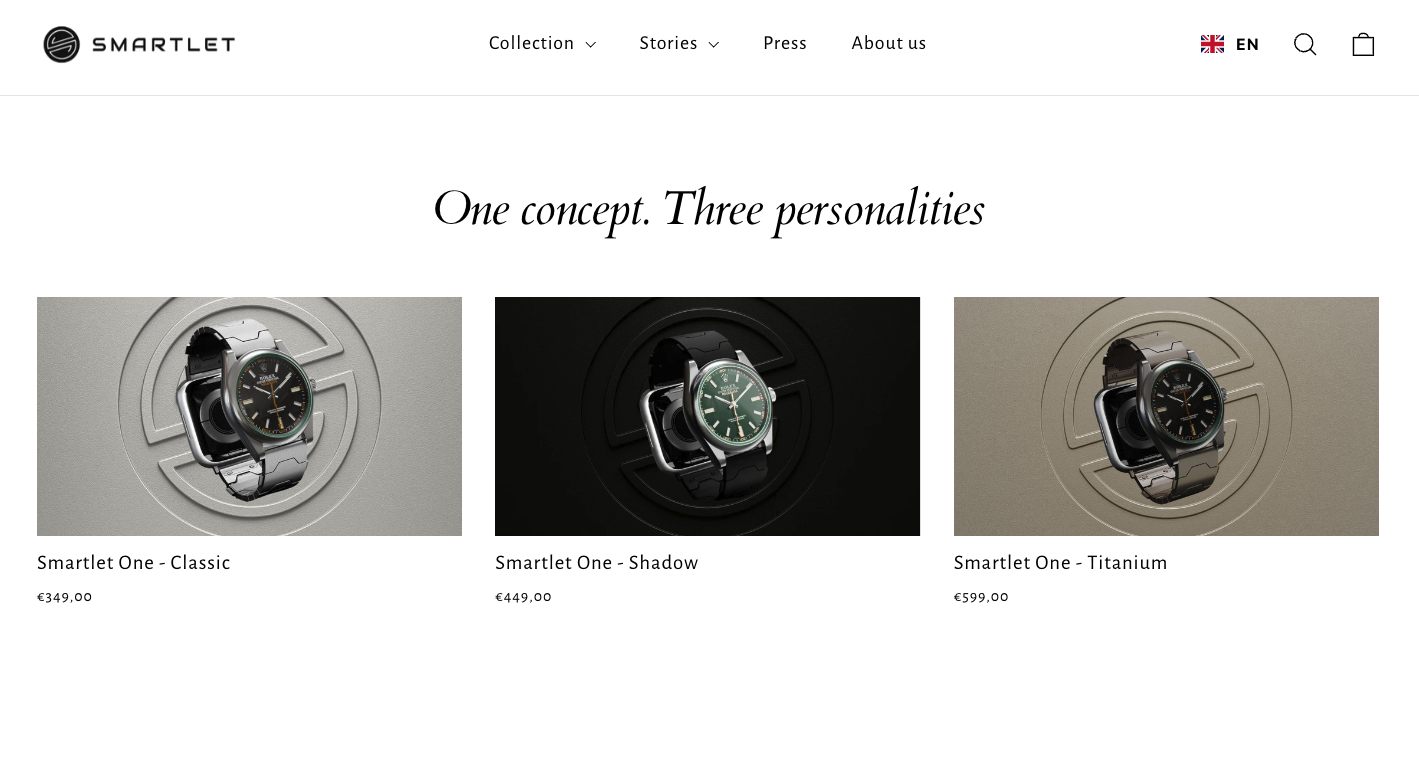
Three versions are available. Classic in brushed SS316L steel at 349 EUR. Shadow in black PVD SS316L at 449 EUR. Titanium in Grade 2 titanium at 599 EUR. All three share identical dimensions. The difference is finish and material weight. For a physician working long shifts, the Titanium version is the lightest option by a meaningful margin. For outpatient or academic settings, the Classic is the most versatile across different watch aesthetics.
Choosing the right Smartlet version for clinical dual wear
| Versión | Material | Precio | Ideal para |
|---|---|---|---|
| Clásico | Acero inoxidable 316L cepillado | 349 EUR | Outpatient clinics, academic medicine, versatile daily use |
| Sombra | Acero inoxidable 316L con recubrimiento PVD negro | 449 EUR | Physicians who prefer a low-profile, darker aesthetic |
| Titanio | Titanio de grado 2 | 599 EUR | Long shifts, maximum comfort, high-end mechanical pairings |
The physician who spends twelve hours on ward rounds will notice the Titanium's weight advantage by hour six. The physician who splits time between an outpatient clinic and a research role will find the Classic more adaptable across different watch pairings and professional registers.
Preguntas frecuentes
Can doctors wear watches at work?
This depends on the clinical setting and national guidelines. In the UK, NHS bare-below-the-elbow policy requires removal of watches during direct patient care. In the US, CDC guidelines focus on hand hygiene compliance without uniformly prohibiting watches. In outpatient, academic, and administrative settings, physician discretion governs in most countries. Surgical and sterile procedure environments generally require removal of all wrist items regardless of local policy.
Does wearing two watches look unprofessional?
Positioning determines perception. When the mechanical watch sits in the standard wrist position and Apple Watch sits higher toward the forearm under the cuff, a patient in consultation sees one watch. The professional register is maintained. The dual setup becomes visible only when the physician raises the sleeve, or in informal contexts where it reads as intentional rather than careless.
Which mechanical watches work with Smartlet in a clinical context?
Any mechanical watch with a standard spring bar and a lug width between 18mm and 24mm is compatible. Brands commonly worn by physicians include Longines, Tissot, Seiko, and Hamilton. The Garmin Fenix series is not compatible with Smartlet due to its proprietary lug geometry.
How do I clean the Smartlet adapter between patients?
The Classic and Shadow versions use brushed SS316L steel. The Titanium version uses Grade 2 titanium. Both materials tolerate standard clinical surface disinfectants. Wipe with an alcohol-based wipe in the same way as any stainless steel medical accessory. Allow to air dry before wearing. Avoid prolonged immersion, but brief handwashing contact presents no problem for either material.
Can the Apple Watch ECG function be used while wearing the Smartlet adapter?
Yes. The ECG function requires Digital Crown contact on Apple Watch and sensor contact on the back of the watch against the wrist. The Smartlet adapter sits between the mechanical watch and the smartwatch and does not interfere with either contact point. The Apple Watch sensor makes direct wrist contact in its standard position. ECG recording functions normally.
Is the dual setup appropriate for a medical conference or hospital board setting?
In professional settings outside direct patient care, including conferences, board presentations, and academic lectures, the dual setup is appropriate. The mechanical watch reads as the visible piece. Apple Watch remains functional for notifications and health monitoring without drawing attention. The professional signal is clear and the setup reads as deliberate rather than casual.
The Smartlet system makes the setup practical for physicians who want both functions present during a working day without asking them to choose. The mechanical watch stays visible during consultations. Apple Watch monitors what it monitors. Both work independently. The Smartlet adapter holds them together on one wrist.


