


Sony Wena descontinuado en 2026: Smartlet es la mejor alternativa

Fundador y CEO, Smartlet · Ingeniero CentraleSupélec · Concours Lépine 2025, Galardonado · CES 2026
Tabla de contenidos
- El fin de Sony Wena 3: qué pasó y por qué importa
- El auge y caída de Wena: innovación limitada por diseño propietario
- Por qué las bandas inteligentes propietarias enfrentan obsolescencia estructural
- Smartlet: el futuro de combinar relojes analógicos con funciones de reloj inteligente
- Smartlet vs Sony Wena: comparación de características y compatibilidad
- Descubre Smartlet: combinando lujo e innovación inteligente de forma limpia
Conclusiones clave
| Punto | Detalles |
|---|---|
| Los servicios de Sony Wena 3 terminaron el 28 de febrero de 2026 | Las funciones principales, incluida la configuración inicial y los servicios conectados, fueron terminados permanentemente. |
| El diseño propietario causó el fracaso | Wena estaba vinculado a una marca de reloj, una aplicación, un proveedor. Cuando el servidor se detuvo, el producto se detuvo. |
| Smartlet no requiere servidor | Sistema de conector mecánico. No se requiere aplicación para la función principal. Sin dependencia del proveedor. |
| Compatible con ancho de asas de 18-24 mm | Cualquier reloj en ese rango funciona con Smartlet. Rolex, Omega, Tudor, Grand Seiko y cientos más. |
| Sin bloqueo de proveedor | Si Smartlet alguna vez se descontinúa, las barras de resorte y tus relojes permanecen intactos. El sistema es mecánico. |
El concepto de Sony Wena fue fantástico. Mantienes tu reloj, tu esfera, tu movimiento – exactamente los elementos por los que has ahorrado y has llegado a amar. Mantienes el peso, el equilibrio y la sensación de tu reloj, familiar y reconfortante. Simplemente cambias la correa por una pieza moderna de alta tecnología. Una idea simple y elegante, y cuando finalmente se lanzó la tercera generación de relojes Wena parecía que Sony había entregado esa promesa.
Ahora, aquí estamos el 28 de febrero de 2026 y ayer fue un día muy triste para todos los propietarios de relojes Wena – fue entonces cuando Sony anunció que descontinuarían sus servicios de servidor. El reloj continuará funcionando como un contador de pasos normal, pero el elemento de dispositivo portátil inteligente que estaba en el corazón de la innovación de Wena ya no funcionará.
Esta no es una reseña de relojes Wena, sino más bien una guía para lo que una correa inteligente para coleccionistas de relojes necesita entregar en el futuro. Continúa leyendo si eres un fan de Wena, ya que entenderás qué se requiere para hacer que tal tecnología sea atractiva para los coleccionistas.
El fin de Sony Wena 3: qué pasó y por qué importa
Sony suspendió los servicios del Wena 3 a finales de febrero de 2026. Con ellos desaparecieron funciones esenciales como la configuración inicial y las conexiones con los servicios de Sony, incluidos los pagos con Suica. Quien compró la correa esperando un dispositivo duradero se quedó con mucho menos de lo que había pagado.
Entonces, si compraste la Banda Inteligente de Reloj de Muñeca buscando un dispositivo portátil que pudieras usar por el resto de tu vida, podrías llevarte una sorpresa. Los aficionados a los relojes inteligentes sabrán que algunas de las características clave que hacen que estos dispositivos sean útiles y divertidos de usar, como control remoto, seguimiento de fitness y mostrar el clima y noticias en tu muñeca ya no estarán disponibles.
Qué pasó y por qué importa
La suspensión afectó también a las integraciones: las aplicaciones de terceros que dependían de los servidores de Sony dejaron de funcionar, y el firmware ya no se actualizará. La correa aún puede mostrar algunas notificaciones y registrar la actividad, pero no llegarán nuevas funciones.
Las características afectadas incluyen:
- Configuración inicial del dispositivo y emparejamiento
- Integración de pago sin contacto Suica
- Conectividad de hogar inteligente Qrio Lock
- Integraciones de servicios de terceros
- Actualizaciones de firmware y parches de seguridad
El problema estructural del bloqueo
Pihole se ejecuta en un servidor propietario. Esto significa que hay un único punto de fallo. Y cuando la empresa detrás del hardware decide dejar de soportarlo, el hardware obsoleto se vuelve imposible de mantener en funcionamiento. Lo que a su vez significa que el servidor pihole ya no puede ejecutarse.
La Nueva Banda de Reloj Inteligente Wena 3 Es una Mala Idea Los coleccionistas de relojes compran relojes con la esperanza de que los usarán durante años. La comodidad de uso es una preocupación principal para casi todos los coleccionistas. Cuando uno compra un reloj generalmente asume que durará muchos años. La longevidad es una parte central de la filosofía de la colección de relojes mecánicos.
Una nueva correa de reloj inteligente propietaria, que efectivamente corta un reloj de la funcionalidad inteligente después de algunos años, socava completamente ese principio. Como escribimos hace algunas semanas aquí en AB, las piezas de reloj propietarias son una idea terrible para los coleccionistas. Parecen ser hostiles a las habilidades tradicionales de relojería, y a la longevidad de un reloj, e integran tecnologías modernas de una manera pobre.
El auge y caída de Wena: innovación limitada por diseño propietario
El reloj inteligente Wena es un dispositivo portátil, presentado por Sony como una pulsera que puede usarse como correa para un reloj analógico. La campaña de financiación colectiva del dispositivo comenzó en Makuake en diciembre de 2015. La esfera del reloj analógico se retiene, mientras que la pulsera se transforma en un reloj inteligente completamente funcional. En 2019, se lanzó la nueva versión Wena Pro del producto en el Reino Unido, con un precio de £399. El dispositivo presenta notificaciones push, seguimiento de fitness y NFC para pagos sin contacto.
El Wena 3 era la tercera generación de correas inteligentes de Sony, con una pequeña pantalla en el cierre y pagos con Suica. Aportaba tecnología a un reloj mecánico sin modificarlo, pero el sistema de correa propietario del Wena 3 limitaba la elección y las actualizaciones, lo que contribuyó a su declive.
Era un producto muy innovador con sin embargo una opción limitada de correas, y posibilidades limitadas para actualizaciones, lo que también contribuyó a la disminución de la demanda de Wena 3. Sistema de banda propietaria de Wena 3Opción de usuario limitada y capacidad de actualización, contribuyendo a su declive.
Limitaciones clave que sembraron el fracaso:
- Compatibilidad restringida a anchos de asas de solo 18 mm, 20 mm y 22 mm
- Sin soporte para Apple Watch u otros relojes inteligentes independientes
- Función GPS faltante incluso en el modelo Pro
- Ecosistema cerrado dependiente de los servidores de Sony para funciones principales
- Integración limitada de terceros en comparación con plataformas abiertas
Walkman era diseño cerrado que
El Walkman era un diseño cerrado, y no podías reemplazar componentes individuales del Walkman. Entonces, cuando Sony decidió descontinuar el producto, ya no fue soportado ni mantenido, y se volvió obsoleto de inmediato. Ahora que he sido apagado, solo puedo funcionar como un podómetro básico sin acceso a la red. El bloqueo de proveedor que hace que el diseño de sistemas cerrados sea tan popular en la electrónica de consumo es una mala idea.
Los sistemas cerrados ganan batallas iniciales, pero siempre pierden la guerra Los sistemas propietarios pueden ganar la victoria a corto plazo, pero en última instancia el sistema abierto siempre prevalece. Todos los que estén interesados en relojes inteligentes eventualmente llegarán a la conclusión de que combinar la relojería mecánica tradicional con la tecnología digital requerirá un sistema abierto y modular que será mucho menos dependiente de fabricantes individuales. La lección de Wena es una advertencia para todos aquellos que depositan mucha fe en una plataforma particular ya que esto puede ser cerrado por un único fabricante.
Por qué las bandas inteligentes propietarias enfrentan obsolescencia estructural
Una de las características definitorias de los dispositivos cerrados y bloqueados es que los usuarios se ven obligados a depender de servidores de terceros y sistemas operativos extranjeros para hacer el trabajo que se supone que el dispositivo debe hacer. Y entonces cuando el dispositivo ya no es soportado por el fabricante, toda esa funcionalidad se corta. Los usuarios de teléfonos inteligentes están acostumbrados a este destino, pero es menos aceptable en un reloj, que es posiblemente el único producto portátil del que los usuarios se preocupan por que sobreviva durante años.
El servidor del proveedor es parte del servicio que aloja y ejecuta la aplicación. Entonces hay un único punto de fallo. Esto podría ser un problema en caso de un cambio de opinión, dificultades financieras o una decisión comercial de retirar una línea de productos no rentable.
En este caso, cuando la empresa decidió retirar una línea de productos no utilizada, todas las bandas inteligentes sin activar restantes se volvieron inútiles ya que ya no es posible configurar un dispositivo sin activar cuando el servidor del proveedor está cerrado. Un ejemplo de esto es que ninguna de las Wena 3 pre-ordenadas a partir del 1 de febrero de 2026 podrá ser activada para usar con sus bandas inteligentes.
Qué estaba mal con Wena
Entonces, ¿qué tenía de malo el Wena W? ¿Por dónde empezamos? Pues bien, la interoperabilidad era un problema importante. Si bien es posible copiar algunos datos a la aplicación del teléfono y obtener una idea general de los niveles de forma física, la interoperabilidad con otros relojes inteligentes o sistemas operativos es nula. La correa de ejemplo que teníamos solo encajaba en un reloj analógico con un ancho de patillas de 19, 20 o 22 mm. Ningún reloj inteligente, como el Apple Watch o el Samsung Galaxy Watch, sería compatible con el módulo. En realidad, con este producto solo quedan dos opciones: usar la funcionalidad bastante limitada que ofrece Wena, o cambiar el módulo por un reloj inteligente con todas las funciones.Samsung Galaxy Watch, u otros ecosistemas de relojes inteligentes populares. Los usuarios enfrentaban una opción binaria: usar las características limitadas de Wena o cambiar completamente a un reloj inteligente independiente. Esta rigidez impidió la flexibilidad que los consumidores modernos esperan.
Riesgos clave de las bandas inteligentes propietarias:
- La dependencia del servidor elimina la función del dispositivo cuando termina el soporte
- Los ecosistemas cerrados impiden la integración con tecnología más nueva
- Las actualizaciones de firmware se detienen, dejando vulnerabilidades de seguridad sin parches
- Las piezas de repuesto se vuelven no disponibles a medida que cesa la fabricación
- El valor de reventa cae a cero una vez que se anuncia la descontinuación
Los dispositivos propietarios están construidos para durar aproximadamente el tiempo que tarda una empresa en generar una ganancia. Cuando una empresa decide hacer un cambio en su modelo de negocio, el consumidor se queda con una pieza de tecnología heredada que ya no es soportable o actualizable, y por lo tanto se queda desconectada de los sistemas en constante evolución que componen nuestro mundo conectado.
Por qué los Estándares Abiertos o Modulares Importan Cualquier producto que compres hoy debe basarse en un estándar abierto o modular. Los productos basados en estándares son aquellos que utilizan conectores universales, protocolos de comunicación abiertos, y son completamente independientes de cualquier empresa individual. Los diseños modulares significan que en lugar de tener que comprar un producto completo porque un componente individual ha llegado al final de su vida útil, un usuario puede comprar actualizaciones o piezas de repuesto para componentes individuales, en lugar de tener que comprar el producto completo nuevamente.
Smartlet: el futuro de combinar relojes analógicos con funciones de reloj inteligente
Smartlet permite llevar a la vez un reloj analógico de lujo y un smartwatch. Creado por el inventor francés y apasionado de los relojes David Ohayon, Smartlet parte de la misma observación que Wena: los relojes de herencia se quedan en el cajón porque hace falta llevar un reloj conectado. Con su correa modular patentada en acero SS316L o titanio grado 2, se cambia de reloj con facilidad.
Sony Wena fracasó porque estaba vinculado a un reloj, un ecosistema, un proveedor. Smartlet se ajusta a cualquier reloj de 18 mm a 24 mm. La correa cambia. El reloj permanece.

La alternativa que evita la misma trampa
El Smartlet admite anchos de asas de 18 a 24 mm en el lado analógico, lo que cubre referencias de Omega, Tudor, Rolex, Seiko, Grand Seiko, Citizen y Orient con pasadores estándar. En el lado del smartwatch, funciona con el Apple Watch, el Samsung Galaxy Watch, el Google Pixel Watch, los modelos Garmin con pasadores estándar, el Fitbit Charge 5/6 y el Whoop 5.0 / MG. Esa amplitud evita la dependencia de un único fabricante que condenó al Wena.
Este sistema de cabeza de reloj está hecho de módulos que utilizan barras de resorte estándar, por lo tanto no es necesario hacer ningún ajuste al reloj mismo. Puede ser ajustado a la mayoría de relojes analógicos así como relojes inteligentes. Por lo tanto, tu inversión siempre es valiosa ya que siempre puedes cambiar a una nueva cabeza de reloj cuando la tecnología avanza.
El sistema de cabeza de reloj Wena Sozo combina la cabeza del reloj (piezas mecánicas) con el módulo electrónico. En este sistema, es posible cambiar los componentes mecánicos, pero el componente electrónico no puede ser cambiado. Smartlet permite que las piezas mecánicas y la parte electrónica se separen entre sí, de modo que cada parte pueda ser actualizada o cambiada cuando sea necesario.
Versiones disponibles y precios:
- Classic: 299 EUR en acero SS316L
- Shadow: 399 EUR con revestimiento negro
- Titanium: 549 EUR en titanio Grado 2
Smartlet usa SS316L, la misma familia de acero que las cajas del Omega Speedmaster, resistente a la corrosión, y titanio grado 2, un metal más ligero: a igual volumen, el titanio pesa unos 4,5 g/cm3 frente a 7,9 g/cm3 del acero 316. Smartlet recibió la medalla de bronce en el Concours Lépine 2025 y se presentó en el CES 2026.
Ambos materiales están hechos para durar tanto como los relojes mecánicos que llevan.
Smartlet es reversible y no requiere modificación permanente. El sistema de barra de resorte estándar significa que cualquier relojero puede ayudar si es necesario.
La posibilidad de tener un enfoque de pulsera de doble relojPermite a los usuarios una alternativa innovadora a las limitaciones tradicionales de los productos producidos en masa. Al permitir que los relojes se conecten a Smartlet, se vuelve posible ajustar y vincular relojes de una manera que no es posible usando sistemas de fijación estándar. Smartlet cierra la brecha entre reloj analógico e inteligenteSin forzar compromisos. El enfoque de pulsera de doble relojTe permite conectar relojes con SmartletDe formas que los sistemas propietarios nunca permitieron.
| Característica | Smartlet | Sony Wena 3 |
|---|---|---|
| Compatibilidad de ancho de asas | 18-24 mm | Solo 18 mm, 20 mm, 22 mm |
| Soporte de reloj inteligente | Apple Watch, Samsung, Garmin, Fitbit, Whoop, Google Pixel | Ninguno |
| Pantalla | Usa pantalla de reloj inteligente | OLED de 3 líneas en el cierre |
| GPS | A través del reloj inteligente emparejado | No |
| ECG | A través del reloj inteligente emparejado | No |
| Dependencia del servidor | Ninguna | Total |
| Longevidad del producto | Modular, indefinida | Terminó el 28 de febrero de 2026 |
No se trata de ingeniería
Esto no se trata de ingeniería. Wena fue hecho con cuidado. El diseño de la banda fue un ejercicio muy filosófico en la futilidad de intentar hacer lo que es fundamentalmente imposible. Intentar integrar electrónica adecuada en una banda hecha por una empresa, que tiene un negocio principal en relojes y obtiene ganancias del hecho de que todos los accesorios que no sean cuero/banda hechos de materiales muy baratos se vuelven obsoletos en un par de años.
Smartlet comienza desde la premisa opuesta. Es una correa mecánica simple. El "reloj inteligente" es tu propio reloj, tu reloj que has comprado sin condiciones, libremente. Y si el próximo año Apple decide "actualizar" su Watch, puedes cambiar fácilmente el conector Smartlet. Nada se rompe. Nada se desgasta. Nada se vuelve obsoleto. Y esa es la verdadera innovación aquí, una innovación que no está a merced de los caprichos del fabricante.
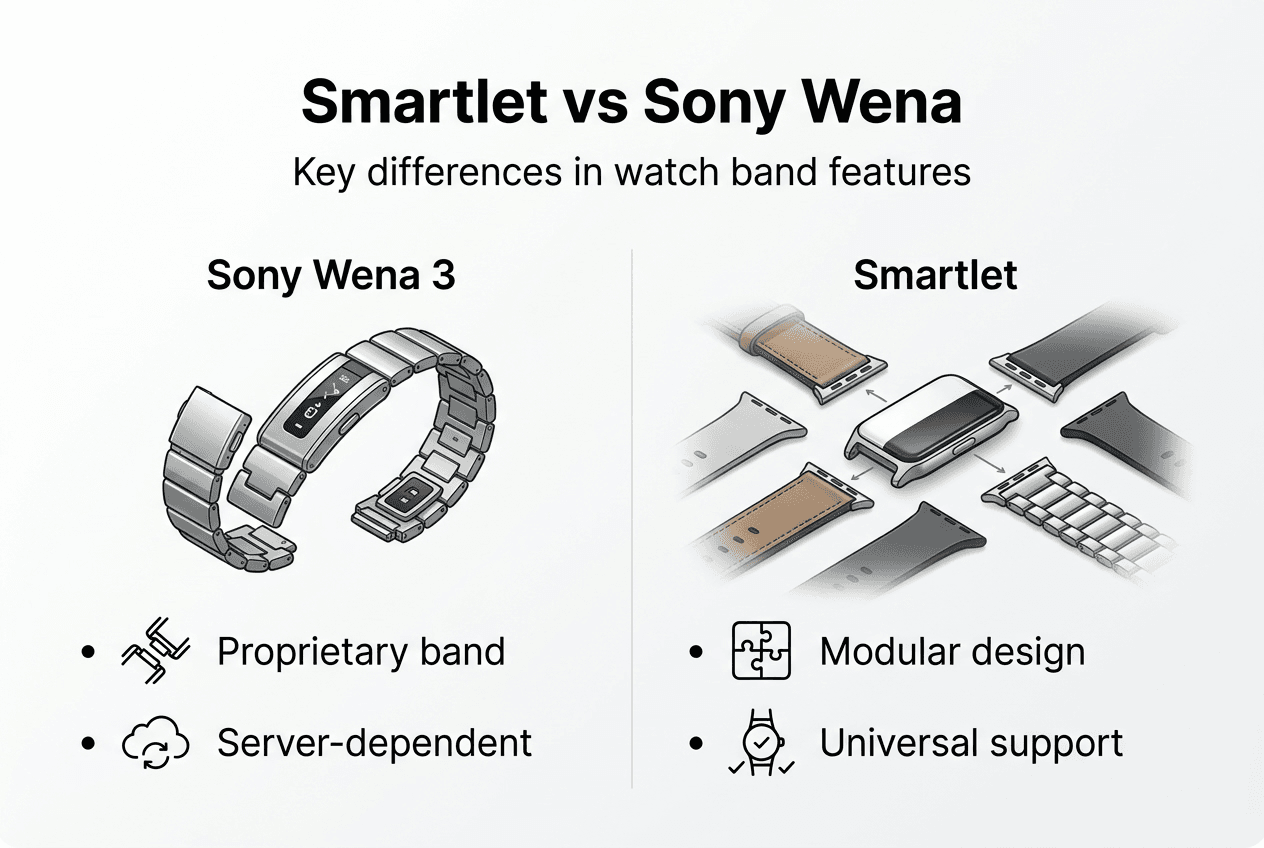
Smartlet vs Sony Wena: comparación de características y compatibilidad
El Smartlet ofrece una compatibilidad más amplia porque su filosofía es distinta. El Wena convertía una correa de reloj en un dispositivo conectado; el Smartlet sostiene dos relojes completos en una sola muñeca, un reloj mecánico encima y un smartwatch debajo, de modo que cada uno puede sustituirse por separado.
Uno es un reloj de moda con monitoreo de frecuencia cardíaca y actividad. El otro es un dispositivo portátil de alta tecnología que utiliza una plataforma de tecnología diferente. La banda fue proporcionada por Wena y fue propietaria de su banda y reloj.
Cuando la empresa responsable de la electrónica dejó de darle soporte, el Wena ya no podía seguir tal como estaba. Smartlet adopta el enfoque opuesto: cada reloj conserva su propia electrónica, o ninguna, y el brazalete simplemente los sostiene, de modo que cualquiera de los dos puede sustituirse a medida que evoluciona la tecnología. Dos relojes, una muñeca.
En términos de compatibilidad hay un mundo de diferencia
En términos de compatibilidad hay un mundo de diferencia entre los dos relojes. El reloj Wena está limitado al universo de Sony y no funcionará con Apple Watch, Samsung o ningún otro reloj inteligente. Smartlet, por otro lado, funciona con cualquier reloj analógico con un ancho de asas de 18-24 mm y es compatible con todas las principales plataformas de relojes inteligentes actuales.
Entonces, como hemos visto con Wena, casi todas sus funciones y casi todas sus características de conectividad requerían el uso de los servidores de Sony. Bueno, esos han sido cerrados por Sony, y ahora todas esas funciones se pierden. Lo bueno para nosotros es que Smartlet no necesita ningún servidor en absoluto, porque no es electrónico. Toda la conectividad será posible a través de la propia plataforma de Smartlet.
Puntos clave de comparación:
- Wena Pro: banda personalizada, anchos de asas restringidos, sin compatibilidad generalizada de reloj inteligente, basado en servidor; se espera que se vuelva obsoleto para 2026
- Smartlet es una correa modular para relojes de 18 a 24 mm de ancho de asas. Es compatible con la mayoría de las principales marcas de smartwatch.
Ambos diseños muestran diferentes opciones con las que tenemos que trabajar. El diseño de Wena incluye algunas de las características inteligentes que mencionamos antes como notificaciones push y pagos móviles directamente en la correa, pero puede significar que todo el servicio podría perderse. El reloj inteligente Smartlet te permite usar tanto las características de un reloj analógico como las de un reloj inteligente al mismo tiempo. El reloj analógico está aquí para proporcionar la característica de medición del tiempo – su propósito principal. El reloj inteligente está entonces allí para proporcionar las características de conectividad.
El Smartlet es fácil de montar y ajustar, y deja margen para futuros relojes en ambos lados. El concepto de correa doble para reloj permite cambiar de configuración en cualquier momento, y el enfoque de la hora a doble cara conviene a los coleccionistas que se niegan a elegir entre patrimonio y tecnología.
| Aspecto | Sony Wena 3 | Smartlet |
|---|---|---|
| Diseño | Banda integrada propietaria | Correa modular con adaptadores de reloj estándar |
| Compatibilidad de reloj analógico | Solo 18 mm, 20 mm, 22 mm | Universal 18-24 mm |
| Compatibilidad de reloj inteligente | Ninguna | Apple Watch, Samsung, Garmin, Fitbit, Whoop, Google Pixel |
| Dependencia del servidor | Total (configuración, servicios, actualizaciones) | Ninguna (adaptador mecánico) |
| Longevidad | Terminó el 28 de febrero de 2026 | Indefinida (actualizaciones modulares) |
| Personalización | Diseño de banda fijo | Intercambia cualquier reloj compatible |
| Precio | 36.300 JPY (~$330) | 299 EUR-549 EUR |
Descubre Smartlet: combinando lujo e innovación inteligente de forma limpia
Uno de los grandes dilemas de los aficionados a la relojería es querer llevar siempre un bello reloj mecánico en la muñeca, junto con un dispositivo conectado para los mensajes y todo lo demás. Sony intentó resolverlo con el Wena y lo hizo bastante bien, pero el producto nunca llegó al gran público. La correa modular para reloj Smartlet sigue otro camino: un único brazalete metálico de eslabones sostiene ambos relojes en una sola muñeca, manteniendo intacto el reloj mecánico y añadiendo conectividad moderna. Las demás opciones, de los relojes híbridos a los sensores en el fondo de la caja, se comparan en ¿se puede hacer inteligente un reloj analógico?
Sin embargo, creo que ellos y una serie de otros diseñadores de relojes finalmente han sido superados por Smartlet, que han creado una correa de reloj de alta tecnología que utiliza ingeniería ingeniosa para que parezca que estás usando, no solo un reloj apropiado, sino dos, donde uno es en realidad un reloj conectado que suena muy decente.correa de reloj modularUtiliza ingeniería de precisión para sostener ambos relojes en una muñeca, preservando la estética de la relojería de lujo mientras entrega conectividad moderna.
El Smartlet está disponible en tres acabados: Classic, Shadow y Titanium. Utilice la guía de compatibilidad de relojes para confirmar el ancho de asas de su reloj y que utiliza pasadores estándar; abarca marcas desde Seiko y Grand Seiko hasta Omega y Rolex.
La configuración puede evolucionar con su colección: los accesorios del Smartlet One incluyen adaptadores de reloj adicionales para otros relojes, un segundo juego de lados del brazalete en otro acabado y el Clasp, que cierra el brazalete cuando solo se lleva un reloj.
Intercambia entre relojes de vestir y relojes de buceo, cambia bandas de reloj inteligente, o reconfigura completamente según tus necesidades diarias. Esta flexibilidad asegura que tu inversión se adapte a medida que tu colección crece.
Eras un usuario de Wena y entendías algo que el resto del mundo no: no hay necesidad de deshacerse de tu reloj tradicional para tener un reloj inteligente. Y que te gustaría mantener tanto tu reloj tradicional como tu reloj inteligente. Eso es exactamente lo que se nos ocurrió en Smartlet, y está aquí para quedarse. Nuestros servidores no se caen.
Recomendado
- Reseña de Smartlet One: el fin del compromiso - relojes tradicionales y tecnología conectada, unidos en una sola muñeca
- Usa un reloj inteligente con tu Seiko
- Smartlet, la pulsera que combina un reloj clásico y conectado en la misma muñeca
- Smartlet: la pulsera que combina un reloj clásico y conectado en la misma muñeca
- Usa un reloj inteligente con tu Grand Seiko
- Cómo funcionan los sensores de reloj inteligente: guía de orientación
Artículos destacados
No people found
We couldn’t find anything with that term. Please try again.


