


Combiner la surveillance de la VRC et les montres mécaniques : une précision de 86 %

Fondateur & PDG, Smartlet - Ingénieur CentraleSupelec - Concours Lépine 2025, Lauréat - CES 2026
Table des matières
- Pourquoi la surveillance de la VFC est importante pour la performance et la récupération
- Capteurs HRV à sangle thoracique avec montres mécaniques
- Montres hybrides avec surveillance HRV
- Conseils pratiques pour combiner les deux efficacement
- Comment Smartlet permet la surveillance continue en double port
- Questions fréquemment posées
Points clés à retenir
| Point | Détails |
|---|---|
| Précision ECG, sans interférence au poignet | L'ECG à sangle thoracique fournit des données HRV précises sans les imprécisions causées par les capteurs au poignet lors des mouvements |
| La ligne de base nécessite des semaines de données | La collecte continue sur 3-4 semaines établit une véritable ligne de base de récupération. Les lectures sporadiques de smartwatch produisent du bruit, pas du signal |
| Les sangles thoraciques sont invisibles | Portées sous les vêtements, elles laissent votre montre mécanique au poignet sans compromettre le style ou l'héritage |
| Les bracelets modulaires règlent le reste | Smartlet permet de porter une montre mécanique aux côtés d'une smartwatch simultanément - éliminant complètement le problème du tiroir |
| Les applications transforment les données en décisions | Kubios, Elite HRV et HRV4Training traduisent les intervalles R-R en scores d'aptitude à l'entraînement exploitables |
La plupart des collectionneurs qui s'entraînent sérieusement possèdent une Garmin ou une Apple Watch qu'ils ne portent pas régulièrement. Parce que leur Speedmaster était la bonne montre pour samedi. Le problème n'est pas la technologie ou la montre. C'est l'écart entre connaître votre ligne de base HRV nécessite une collecte continue de données et la collecter réellement. Trois semaines de lectures sporadiques ne construisent pas un profil de récupération significatif. Elles construisent du bruit.
Le problème du tiroir n'est pas une question de paresse. C'est une question d'identité. Votre Seamaster, c'est qui vous êtes. Votre Garmin, c'est ce que vous mesurez.
Pourquoi la surveillance de la VFC est importante pour la performance et la récupération
La variabilité de la fréquence cardiaque (VFC) est la variation du temps entre chaque battement cardiaque. Généralement, une variabilité de la fréquence cardiaque plus élevée est associée à une meilleure récupération et une plus grande résilience au stress, tandis qu'une variabilité de la fréquence cardiaque plus faible est un signe de fatigue ou de surmenage. De nombreux athlètes utilisent leur variabilité de la fréquence cardiaque pour déterminer l'intensité de leur entraînement du jour.
La précision du capteur dépend entièrement de la technologie utilisée. Le Polar H10 est validé comme l'étalon-or pour la VFC car il capture les signaux électriques directement du cœur en utilisant l'ECG. Cela vous donne une précision à la milliseconde sur les intervalles R-R.
Les capteurs PPG au poignet fonctionnent en projetant de la lumière à travers la peau et en lisant les changements de flux sanguin. Au repos, la précision est acceptable. Pendant l'exercice, les changements de température ou un mauvais contact cutané, le signal se dégrade considérablement.
L'horlogerie concerne l'artisanat, l'héritage et la valeur émotionnelle que nous attachons aux objets. Rien à voir avec l'électronique. Une bonne montre mécanique est une œuvre d'art où l'héritage est central.
En tant qu'athlètes, nous nous efforçons de comprendre notre physiologie pour planifier la phase de récupération de l'entraînement. Un moniteur HRV à sangle thoracique résout la tension entre ces deux mondes. Il se situe sous vos vêtements, invisible. Votre Seamaster reste à votre poignet. Les données de fréquence cardiaque et de variabilité biométrique circulent continuellement vers votre téléphone.
Principaux avantages de la surveillance HRV à sangle thoracique :
- Précision ECG lors des intervalles haute intensité et des extrêmes de température
- Pas d'interférence au poignet avec le port de la montre mécanique ou le confort
- Autonomie prolongée supportant le suivi de la ligne de base sur plusieurs jours
- Port discret sous les vêtements qui préserve les choix esthétiques
- Connectivité Bluetooth permettant l'intégration d'applications en temps réel
Le problème de la ligne de base est plus important que la plupart des collectionneurs ne le réalisent. Établir une ligne de base HRV significative nécessite 3-4 semaines de données continues et ininterrompues.
Les lectures sporadiques d'une smartwatch d'entraînement portée uniquement pendant les séances d'entraînement produisent du bruit fragmenté, pas du signal. Vous ne pouvez pas distinguer les véritables modèles de récupération des artefacts de mesure. Une sangle thoracique portée quotidiennement, sous vos vêtements, résout ce problème sans perturber les choix de port au poignet.
La sangle thoracique Polar H10 et votre Speedmaster ne sont pas en concurrence. Ils opèrent sur des plans entièrement différents - l'un mesure votre cœur, l'autre marque votre temps. Smartlet les met tous les deux au même poignet.
Capteurs HRV à sangle thoracique avec montres mécaniques
Le moniteur de fréquence cardiaque Polar H10 et la sangle Frontier X2 utilisent la méthode de mesure de la variabilité de la fréquence cardiaque basée sur l'ECG. La méthode fonctionne en plaçant des électrodes conductrices sur la poitrine et en détectant l'activité électrique du cœur. Le rythme cardiaque est ensuite mesuré avec une précision à la milliseconde, permettant le calcul des intervalles R-R.
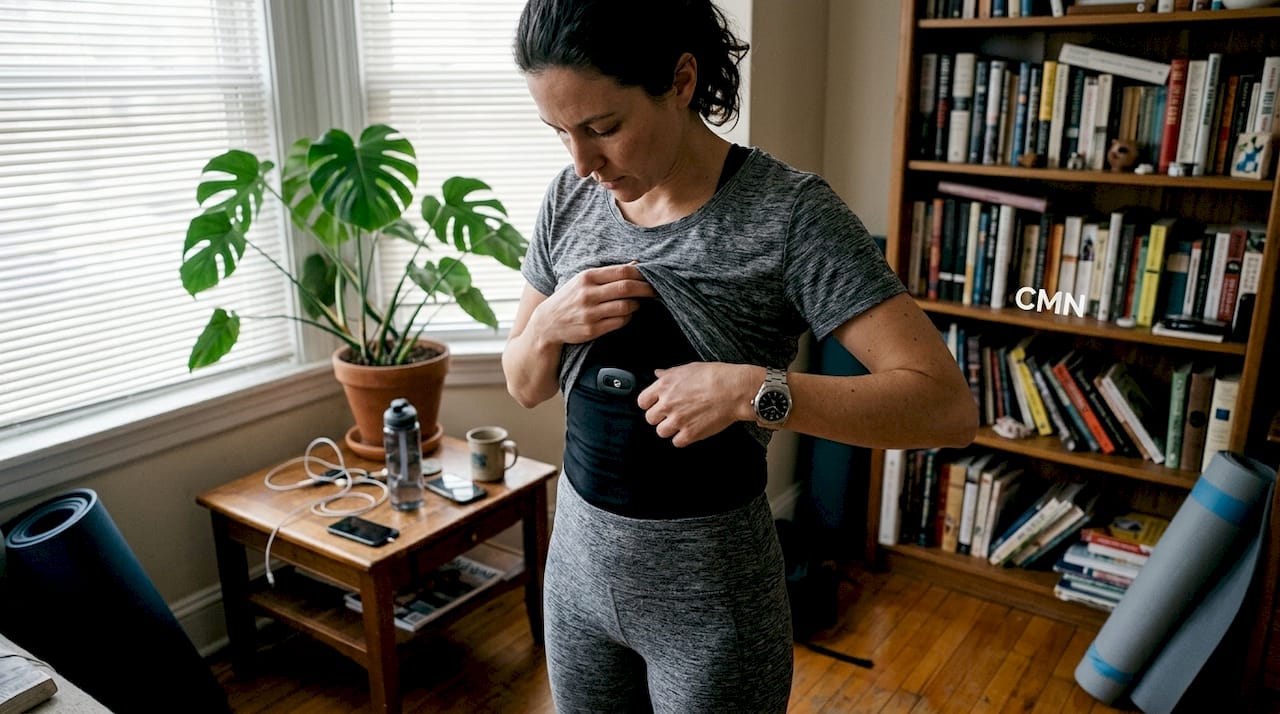
Initialement, vous devrez peut-être porter la sangle sur le dessus d'un t-shirt de compression. Il est préférable de la porter directement sur la peau. Vous voudrez positionner la sangle de sorte que les électrodes se trouvent directement sous les muscles pectoraux. À partir de la 3e séance environ, vous ne remarquerez probablement même pas que vous la portez. Comme toujours, vous porterez toujours votre montre mécanique pour un port régulier et une déclaration de style. Votre montre mécanique continue son rôle de chronomètre quotidien et de déclaration de style.
L'autonomie de la ligne de base est toujours importante, et le Polar H10 a un temps d'attente de 400 heures avec la capacité de stocker jusqu'à 30 heures de données d'entraînement. De cette façon, vous n'avez pas besoin d'avoir votre téléphone attaché à vous tout au long d'une longue séance d'endurance. Vous pouvez synchroniser plus tard quand vous le pouvez. Le Frontier X2 stocke toutes les données à bord tout au long de l'entraînement entier, et en plus des métriques standard basées sur la fréquence cardiaque, il est également capable de calculer la charge cardiaque et la fréquence respiratoire.
Les données de fréquence cardiaque et de VFC peuvent être converties en informations exploitables directement sur votre smartphone via des applications dédiées. Kubios, Elite HRV et HRV4Training lisent les valeurs HRV du matin et la récupération post-entraînement via Bluetooth, donnant accès à RMSSD, SDNN et des métriques du domaine fréquentiel.
Votre Polar Vantage peut également s'appairer avec le H10 pendant les séances d'entraînement pour un affichage en temps réel, puis revenir au mode standard une fois la séance terminée. Le pipeline de données connecte votre physiologie à votre plan d'entraînement sans vous obliger à choisir entre votre montre mécanique et vos outils de performance.
Stratégies de port pratiques :
- Appliquez la sangle 5-10 minutes avant l'activité pour permettre l'échauffement du capteur
- Positionnez les électrodes symétriquement pour une capture de signal équilibrée
- Ajustez la tension pour éviter le glissement sans restreindre la respiration
- Appairez avec le téléphone ou la montre avant de commencer pour confirmer la connexion
- Retirez et rincez après chaque utilisation pour maintenir la conductivité des électrodes
Une sangle thoracique peut donner des mesures très précises de votre condition physique, mais elle n'est pas du tout durable. Et une montre mécanique peut durer des décennies, mais elle ne mesure rien. Alors comment obtenir un système de surveillance portable qui dure longtemps ? Il suffit de combiner le meilleur de chacun.
Beau boîtier de montre et mouvement de montre durable, précision d'une sangle thoracique pour les mesures d'exercice. Pas besoin de choisir entre savoir ce que fait votre corps ou avoir une belle montre. Vous pouvez utiliser un outil de mesure comme bracelet de montre et une vraie montre pour tout le reste. Ils fonctionneront indépendamment l'un de l'autre, discrètement et efficacement.
Montres hybrides avec surveillance HRV
Les montres hybrides se situent entre les montres mécaniques et numériques. La Withings ScanWatch utilise un cadran analogique avec un capteur ECG caché, une activation à la demande via la lunette et une autonomie de 30 jours.
Ces appareils attirent les utilisateurs qui souhaitent une solution unique au poignet. Le cadran de style mécanique offre une lisibilité classique. Mais les limitations de précision émergent lors des mouvements - le PPG au poignet lutte contre les artefacts de mouvement, les variations de température et le mauvais contact. Les athlètes s'entraînant à l'intensité du seuil voient souvent des lectures dégradées par rapport aux données de la sangle thoracique.
Si vous voulez une seule montre pour faire le travail de plusieurs appareils, alors l'une de ces montres pourrait être pour vous. Si vous voulez une montre qui indique l'heure, mais qui surveille également votre condition physique, et vous ne voulez pas avoir à porter une sangle thoracique sur une montre de fitness ou une smartwatch qui a également un GPS intégré, alors ces montres pourraient valoir le coup. Elles disposent d'un cadran de style mécanique à l'ancienne qui affiche l'heure, tandis qu'à l'intérieur elles ont une suite de capteurs cachés qui suivent les métriques de fitness et de santé du porteur.
Tout le monde sait qu'il y a une certaine erreur quand nos corps bougent. Cela est vrai même des appareils portables PPG au poignet les plus simples. Les artefacts de mouvement, le mauvais contact capteur-peau et les variations de température cutanée affectent tous négativement la qualité du signal PPG. Bien que les appareils portables hybrides tels que la ScanWatch aient un ECG intégré, il est limité à des conditions très statiques comme celles mesurées en laboratoire.
Récemment, l'ECG de la ScanWatch 2 Gen a été comparé à une sangle thoracique lors d'une course de 30 minutes en neige à intensité de seuil d'un athlète d'endurance. Les résultats ont montré que le signal ECG de la ScanWatch 3Gen avait une moyenne de 30% inférieure à la racine carrée moyenne de la variabilité (RMS) par rapport à la sangle thoracique. Le temps froid a de nouveau joué un rôle.
Les collectionneurs puristes ont une nouvelle préoccupation : les montres hybrides. Les batteries, les circuits et les capteurs dans une montre sont contraires aux principes du collectionneur puriste. Ils considèrent les montres telles que l'Omega Speedmaster et Seamaster comme ayant des centaines d'années en termes d'horlogerie et le fait qu'elles remontent à 50 ans ou plus en termes de temps est de peu d'importance. Prendre une montre qui est un morceau d'histoire horlogère et transformer le temps en appareil électronique, même si le design de la montre s'inspire de la montre analogique, c'est simplement transformer la montre en tracker de fitness qui se trouve juste ressembler à une montre analogique.
| Approche | Précision | Authenticité du style | Complexité de la configuration | Gamme de prix |
|---|---|---|---|---|
| Montre mécanique + sangle thoracique | La plus élevée (ECG) | Héritage mécanique pur | Modérée (appareils séparés) | 90-200 EUR sangle + montre |
| Montre hybride avec HRV | Modérée (PPG/ECG) | Design inspiré mécanique | Faible (appareil unique) | 300-500 EUR |
| Montre connectée sur un Smartlet | Élevée (dépend du modèle) | Les deux montres visibles | Faible (solution intégrée) | 299-549 EUR adaptateur + montres |
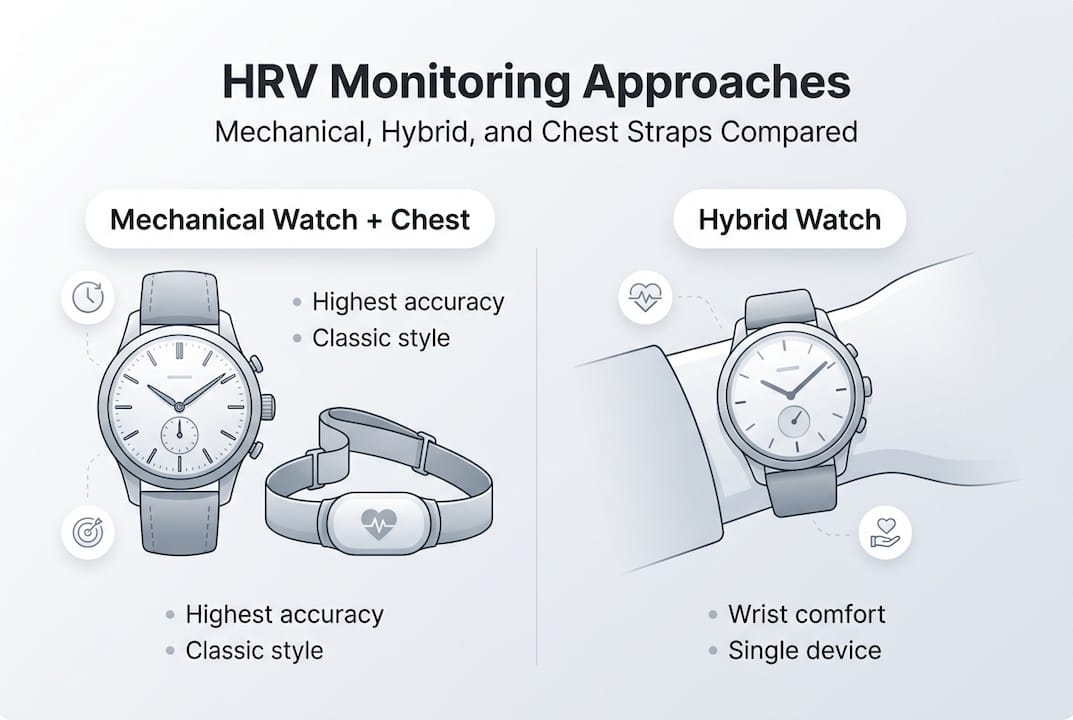
Avantages des montres hybrides :
- Un seul appareil simplifie la routine quotidienne et l'emballage pour les voyages
- L'autonomie prolongée réduit la fréquence de charge par rapport aux smartwatches
- L'affichage analogique offre une lisibilité classique sans éblouissement numérique
- Les certifications médicales permettent des mesures de qualité clinique pour des conditions spécifiques
Les montres hybrides sont par nature un compromis entre la précision de mesure et la véritable performance mécanique. En conséquence, le collectionneur qui souhaite avoir la performance la plus élevée possible dans chaque aspect doit utiliser deux montres. C'est là que la modularité intervient. Notre conception permet une montre qui offre une véritable performance mécanique tout en permettant l'utilisation d'une autre montre pour la mesure dédiée de la variabilité de la fréquence cardiaque (VFC). Tout cela sans avoir à porter deux montres ou compromettre le design d'aucune d'elles.
Conseils pratiques pour combiner les deux efficacement
L'art d'équilibrer le besoin de données de haute qualité pour l'analyse de la variabilité de la fréquence cardiaque (VFC) et le désir de porter une montre mécanique au quotidien est un art qui nécessite une approche structurée. Voici les étapes à suivre pour collecter une bonne ligne de base.
- Commencez par suivre votre lecture HRV du matin immédiatement après le réveil et avant de prendre du café ou de faire de l'exercice. Vous pouvez définir cette lecture sur votre appareil portable pour qu'elle fasse partie de votre routine matinale. Ensuite, vous pouvez suivre votre fonction autonome tout au long de toutes les activités et conditions tout au long de la journée.
- Portez la sangle thoracique de sorte que les électrodes se trouvent directement au milieu entre les deux muscles pectoraux. La sangle doit être bien ajustée, mais pas trop.
- Utilisez de l'eau ou une solution saline pour humidifier les points de contact des électrodes afin d'assurer un signal fort dès le premier battement.
- Assurez-vous que le capteur est appairé avec la bonne application pour la mesure que vous souhaitez effectuer. Afin d'éviter la perte de données, assurez-vous que le capteur est correctement appairé avec la bonne application avant la mesure.
- Restez immobile pendant une lecture de 3-5 minutes, en respirant naturellement sans modèles forcés
- Ajoutez un journal d'entraînement personnel pour suivre la qualité perçue du sommeil, les niveaux de stress perçus et la charge d'entraînement globale. Cela permettra de corréler les tendances individuelles des données à vos expériences personnelles.
- Synchronisez les données immédiatement après la mesure pour éviter le débordement de mémoire sur les enregistrements multi-jours
- Portez votre montre mécanique tout au long de la journée sans vous soucier des lacunes de suivi
La plupart des applications de fitness et d'aptitude à l'entraînement prennent les intervalles R-R du suivi de la variabilité de la fréquence cardiaque et vous donnent une certaine mesure de la condition physique ou de l'aptitude à l'entraînement. Elles fonctionnent toutes avec l'écart type repos-mouvement (RMSSD), la puissance de bande 50% (pNN50) et parfois avec certaines mesures du domaine fréquentiel.
Nous utilisons réellement Kubios HRV dans de nombreuses études de recherche. D'autres applications comme Elite HRV donnent une mesure très basique et limitée de « feu tricolore » de la condition physique et de l'aptitude. HRV4Training fonctionne plutôt avec une adaptation dynamique de la ligne de base plus complexe, et elle fournit des informations plus détaillées sur la récupération du cœur et l'activité électrique du corps.
Protéger votre montre mécanique pendant les séances d'entraînement est simple : retirez-la avant les activités à fort impact ou exposées à l'eau. Rangez-la dans un coffret à montre ou un casier.
La sangle thoracique gère toutes les mesures pendant la séance. Votre montre revient à votre poignet après, protégée de la sueur, des impacts et de l'exposition aux champs magnétiques qui pourraient affecter la précision du mouvement. Cette division garde les deux instruments en bon état de fonctionnement.
En termes de flux de travail d'entraînement, le timing de la synchronisation des données est une très petite considération. Les sangles thoraciques que nous utilisons ont une mémoire interne d'environ 20-30 heures de données. Cela signifie que vous pourriez vous entraîner pendant quelques jours avant de devoir garder votre téléphone à proximité de la sangle pour synchroniser les données. Avec notre méthode, un collectionneur peut synchroniser 1 semaine de données en une seule session de synchronisation. Une montre mécanique ne quitte jamais le poignet. La collecte de données est un processus silencieux et l'analyse se fait plus tard.
Les performances des sports d'hiver nécessitent un peu plus d'attention. La conductivité de la sangle à la peau est considérablement réduite lorsque l'air est en dessous d'environ 10°C si la peau est sèche et les électrodes ne se sont pas encore suffisamment réchauffées par la chaleur corporelle. Dans ce cas, l'humidification préalable de la sangle passe de facultative à nécessaire. Certains athlètes portent la sangle 10-15 minutes avant de partir à la neige pour augmenter la température de la sangle et avoir un meilleur contact humide avec leur peau. D'autres utilisent du gel conducteur d'une électrode ECG d'une pharmacie.
Il y a quelques avantages à ce que l'esprit sépare la montre de l'affichage. Il y a moins de couplage mental entre l'appareil de mesure du temps et le temps affiché, et dans un contexte d'entraînement, il y a moins de comportement servile envers la trotteuse. La montre vous localise dans le temps et l'espace tandis que les données vont en mémoire pour être examinées plus tard.
Comment Smartlet permet la surveillance continue en double port
Je porte ma sangle thoracique pour mes mesures HRV du matin et mes séances d'entraînement. Un défi courant pour les collectionneurs de montres est de savoir comment porter une montre mécanique et une smartwatch. C'est un scénario classique de « problème du tiroir ». Je laisse ma Garmin à la maison et je porte ma Seamaster pour le dîner. Il y a un deuxième scénario : vouloir à la fois une montre mécanique et une smartwatch au poignet simultanément, sans retirer l'une ou l'autre. C'est le problème du tiroir sous sa forme la plus courante : la Garmin reste à la maison parce que la Seamaster était le bon choix pour le dîner.
Le bracelet modulaire Smartlet règle ce problème directement. Fabriqué en acier SS316L ou en titane grade 2, il accueille des adaptateurs de montre qui se logent dans les trous de corne de toute montre dont l'entrecorne est comprise entre 18 mm et 24 mm, à la place des barrettes d'origine. Votre Speedmaster reste exactement telle qu'elle a toujours été. Votre Apple Watch Ultra 2 ou une autre montre connectée compatible se place sous le poignet, pleinement fonctionnelle et hors de vue.
Trois versions du bracelet Smartlet répondent à différentes priorités. Le Classic (299 EUR) en SS316L brossé s'accorde à tout boîtier acier. Le Shadow (399 EUR) en PVD noir convient aux cadrans sombres et à une esthétique discrète. Le Titanium (549 EUR) en titane grade 2 : à volume égal, le titane pèse environ 4,5 g/cm3 contre 7,9 g/cm3 pour l'acier 316, ce qui compte quand on porte deux montres pendant toute une journée de suivi d'entraînement.
Le guide de compatibilité des marques couvre Omega, Rolex, Tudor, Breitling et autres. Le guide de compatibilité des smartwatches inclut Garmin, Apple, Polar et Withings. Médaille de bronze au Concours Lépine 2025 et CES 2026 valident l'ingénierie. Smartlet garde vos données HRV en circulation et votre Seamaster à votre poignet - tous les jours, pas seulement les jours d'entraînement.
Recommandé
- Entraînement de marathon et surveillance smartwatch : les données qui séparent les coureurs sérieux
- Comment la surveillance cardiaque smartwatch sauve des vies
- Comment fonctionnent les capteurs smartwatch : pourquoi l'orientation est sans importance
- Portez votre Whoop avec votre montre mécanique
- Portez votre Polar Vantage avec votre montre mécanique
- Découvrez Smartlet One
Articles stars
No people found
We couldn’t find anything with that term. Please try again.


