


Guide sur la largeur des crampons : ce que tout nouveau collectionneur doit savoir

Fondateur & PDG, Smartlet - Ingénieur CentraleSupélec - Concours Lépine 2025, Lauréat - CES 2026
Vérifiez votre largeur de cornes : cherchez votre montre dans le finder Smartlet, il donne la largeur exacte et la configuration qui convient.
Table des matières
- Qu'est-ce que la largeur de barrette et pourquoi est-ce important ?
- Préparation à la mesure : outils et vérifications préalables
- Étape par étape : comment mesurer la largeur de barrette de votre montre
- Choisir et changer les bracelets de montre en toute confiance
- Compatibilité des barrettes et solutions modulaires
- Questions fréquemment posées
Points clés à retenir
| Point | Détails |
|---|---|
| Bases de la largeur de barrette | La distance interne entre les barrettes en millimètres - la seule spécification qui contrôle toute la compatibilité des bracelets |
| Conseils de mesure | Retirez d'abord le bracelet, utilisez un pied à coulisse numérique, mesurez face interne à face interne - ne devinez jamais ni n'arrondissez |
| Différences des montres intelligentes | Les montres intelligentes utilisent souvent des systèmes de barrettes propriétaires - vérifiez la compatibilité avant d'acheter un nouveau bracelet |
| Éviter les erreurs courantes | Ne supposez jamais que le nom du modèle suffit - vérifiez toujours la référence spécifique avant de commander |
Le bracelet est arrivé après deux semaines. Un cuir magnifique, une couture parfaite, exactement la couleur que vous aviez imaginée. Vous avez glissé l'outil de barrette à ressort, l'avez aligné, et vous avez senti cette résistance familière. Trop large. Pas de beaucoup - peut-être un millimètre ou deux - mais suffisant pour le rendre complètement inutilisable. Ce moment, à parts égales frustrant et instructif, est comment la plupart des collectionneurs découvrent pour la première fois ce que la largeur de barrette signifie réellement. Vous ne l'oublierez pas après cela.
Il n'y a rien de plus critique que la largeur de barrette d'une montre, car c'est ce qui relie votre montre au bracelet. Et maintenant, vous pouvez être ensemble pour toujours.
Qu'est-ce que la largeur de barrette et pourquoi est-ce important ?
La largeur de barrette est la mesure interne en millimètres entre les deux barrettes où le bracelet s'attache au boîtier. Faites-le correctement et tout bracelet de qualité du marché secondaire s'insère proprement. Faites-le mal et vous risquez un bracelet endommagé, une barrette rayée, et un achat gaspillé. Pour la réponse complète, voir qu'est-ce que l'entrecorne, et comment la mesurer.
La largeur de barrette est généralement environ la moitié du diamètre du boîtier - la seule spécification qui contrôle l'ajustement et l'esthétique. Un bracelet qui est 1 mm trop étroit va bouger. Un qui est 1 mm trop large ne s'ajustera pas du tout. Aucun des deux ne semble bon sur une montre dont vous vous souciez.
Les largeurs de barrette standard se regroupent autour de quelques tailles courantes :
- 16 mm : Montres habillées, pièces vintage, profils fins
- 18 mm : Petites montres de sport et habillées
- 20 mm : La taille la plus courante parmi les références emblématiques
- 22 mm : Plongeurs, montres d'outil, modèles de sport plus grands
- 24 mm : Montres d'outil surdimensionnées et certaines références militaires
La Rolex Submariner 124060 et l'Omega Speedmaster 310.30 fonctionnent toutes les deux à 20 mm, tout comme la Rolex Datejust 41. La Tudor Black Bay 41 passe à 22 mm. Rolex a changé la Submariner de 20 mm à 21 mm en 2020 avec la 126610 - ce seul millimètre signifie que les anciens bracelets 20 mm ne s'ajustent plus au nouveau boîtier.
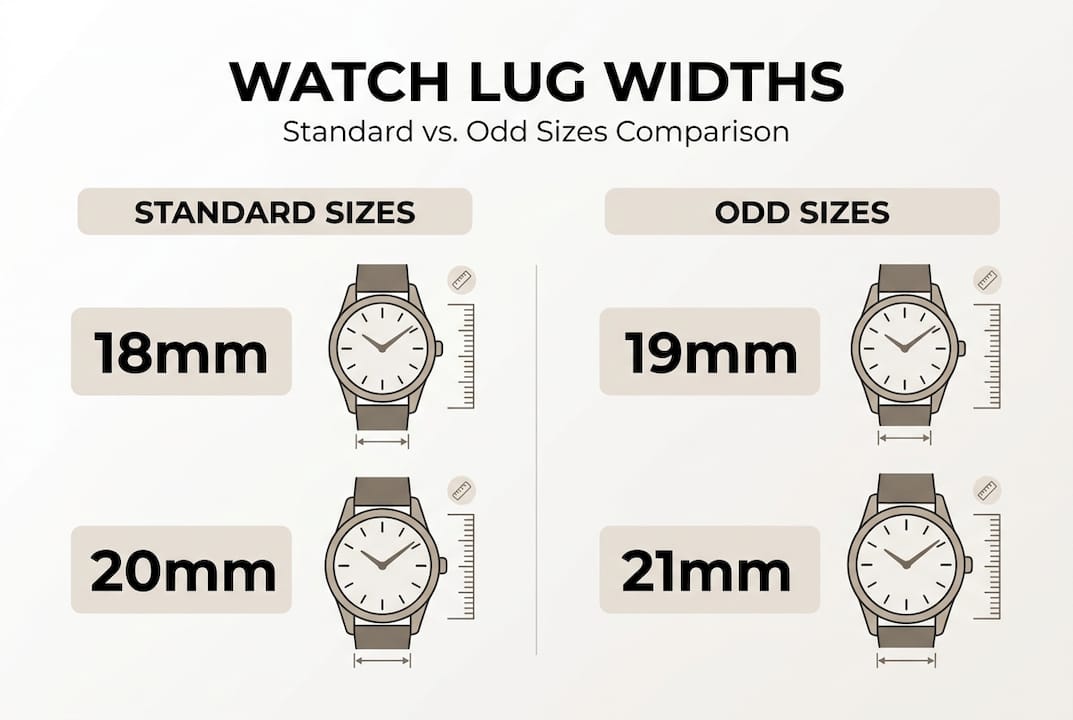
Certaines marques utilisent des tailles impaires comme 17 mm, 19 mm ou 21 mm comme signature de design. Cela rend l'achat du marché secondaire plus difficile, c'est pourquoi vérifier le guide standard de largeur de barrette avant d'acheter quoi que ce soit vaut les deux minutes que cela prend.
Préparation à la mesure : outils et vérifications préalables
Vous n'avez pas besoin d'un établi d'horloger pour mesurer la largeur de barrette. Vous avez besoin de deux choses : le bon outil et quelques minutes de patience.
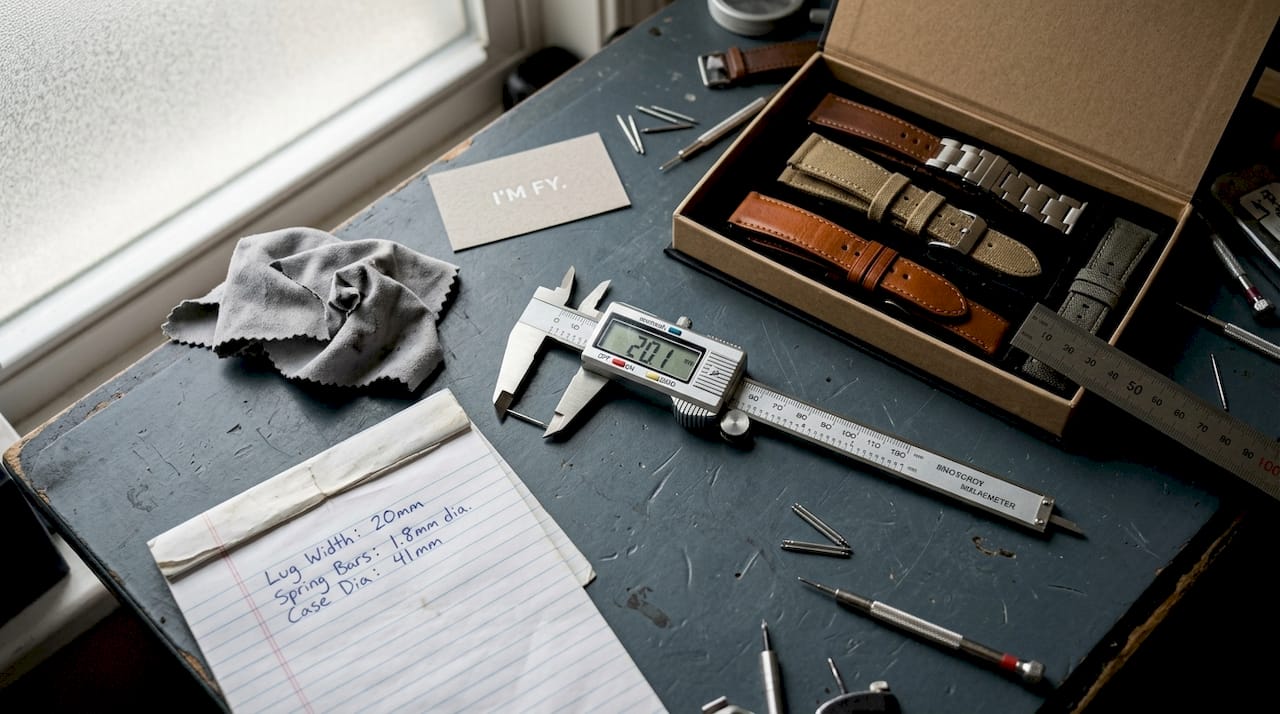
Un pied à coulisse numérique vous donne une lecture précise à 0,1 mm. Une règle millimétrique fonctionne en cas de besoin, mais la marge d'erreur est plus élevée. Sur les petites tailles, cette marge compte - une barrette de 19 mm mesurée comme 20 mm signifie un achat gaspillé.
| Ce dont vous avez besoin | Où le trouver |
|---|---|
| Pied à coulisse numérique | Quincaillerie, Amazon, fournisseurs d'horlogerie |
| Règle millimétrique | Papeterie, imprimez-en une en ligne |
| Outil de barrette à ressort | Détaillants d'accessoires de montres |
| Fiche technique du fabricant | Site de la marque, sites de base de données de montres |
| Bracelet existant (pour vérification du timbre) | Déjà sur votre montre |
Pour la précision, retirez le bracelet avant de mesurer la montre. Mesurer avec le bracelet en place introduit une erreur dans l'ajustement en raison de la compression du matériau du bracelet contre les barrettes de la montre, créant une largeur de barrette faussement plus petite ; le métal sur métal est préférable.
- La page de spécifications officielle du fabricant
- Les bases de données de montres comme Chrono24 ou WatchBase
- La largeur de barrette estampillée à l'intérieur de votre bracelet actuel
- Les forums communautaires pour des références spécifiques
Avoir une simple feuille de calcul qui répertorie toutes vos montres actuelles avec leurs largeurs de barrette peut vous faire gagner des heures à l'avenir lorsque vous cherchez à acheter de nouvelles montres et à découvrir si un bracelet ou un maillon est compatible. Avoir une paire de pieds à coulisse numériques peut également faciliter la vie, et un décent ne coûte pas plus que quelques dollars.
Étape par étape : comment mesurer la largeur de barrette de votre montre
Ce processus prend environ trois minutes une fois que vous l'avez fait une fois.
- Rassemblez vos outils. Ayez votre pied à coulisse numérique ou votre règle prêts avant de toucher la montre.
- Retirez le bracelet. Utilisez un outil de barrette à ressort pour libérer les deux barrettes à ressort et mettez le bracelet de côté.
- Positionnez le pied à coulisse. Placez les mâchoires entre les faces internes des barrettes - pas les bords externes.
- Prenez la mesure. Lisez le nombre en millimètres. N'arrondissez pas vers le haut ou vers le bas.
- Enregistrez-le immédiatement. Écrivez-le ou photographiez le pied à coulisse à côté de la montre.
- Mesurez deux fois. Prenez une deuxième lecture pour confirmer - une erreur de 0,5 mm suffit à causer un problème d'ajustement.
Vous devez vous assurer que vous mesurez correctement car quelques millimètres peuvent faire la différence entre le bracelet ayant la bonne longueur ou non, et en tant que question de point de vente, cet article est un article non retournable une fois ajusté.
Lors de la sélection d'un bracelet, veuillez noter que la largeur de barrette est mesurée de l'intérieur à l'intérieur des barrettes avec le bracelet actuel retiré. La mesure du bord externe est sans pertinence à cette fin. Il est utile de prendre une photo d'un pied à coulisse à côté de votre montre pour l'utiliser comme référence à l'avenir lors de la commande de bracelets en cuir pour des montres spécifiques.
Il est à noter que lors de l'achat d'un bracelet pour une montre intelligente, vous devez mesurer en incluant le renfoncement entre les broches du boîtier ou à un angle car certaines montres intelligentes ont une « barrette » intégrée à la montre et sont conçues et fabriquées en tenant compte de cela.
Interprétation des mesures : systèmes de barrettes standard, impairs et pour montres intelligentes
Une fois que vous avez votre nombre, vous devez savoir ce qu'il signifie dans le contexte. Tous les systèmes de barrettes ne fonctionnent pas de la même manière.
Pour les montres mécaniques : 16-18 mm pour les pièces habillées et vintage, 20 mm pour les références standard, 22 mm pour les plongeurs et modèles de sport, 24 mm pour les montres d'outil surdimensionnées. Tous utilisent des barrettes à ressort standard - la sélection du marché secondaire est énorme.
Contrairement à ce qu'on pourrait penser, le motif de barrette sur une montre intelligente a peu à voir avec celui d'une montre traditionnelle. Alors qu'un bracelet de montre est généralement attaché via des barrettes de style broche et trou, le système de barrette sur les montres intelligentes est entièrement séparé. L'Apple Watch utilise des barrettes propriétaires Apple de style coulissant sur différentes tailles de boîtiers de montre, et viennent en différentes tailles, tandis que de nombreuses montres intelligentes Garmin utilisent les bracelets standard 22 mm à 26 mm avec les barrettes à ressort familières intégrées au pince-bracelet, encore une fois selon le modèle spécifique.
Ainsi, mélanger les bracelets de votre collection est peu probable. Garmin utilise des barrettes à ressort standard 22 mm à 26 mm selon le modèle. Cette distinction compte énormément lorsque vous essayez de mélanger et d'assortir.
| Type de montre | Système de barrette | Compatibilité des bracelets |
|---|---|---|
| Mécanique (la plupart des marques) | Barrette à ressort standard | Marché secondaire universel |
| Rolex 126610 Submariner | Barrette à ressort 21 mm | Marché secondaire limité |
| Apple Watch | Coulisse propriétaire | Apple et sous licence uniquement |
| Série Garmin Fenix | Standard 22/26 mm | Large marché secondaire |
| Samsung Galaxy Watch | Standard 20/22 mm | Large marché secondaire |
- Apple Watch 38/40/41 mm : Un groupe de taille de bracelet propriétaire
- Apple Watch 42/44/45/49 mm : Deuxième groupe de taille de bracelet propriétaire
- Garmin 22 mm : Séries Vivoactive, Forerunner, Instinct
- Garmin 26 mm : Séries Fenix, Tactix, Enduro
- Samsung Galaxy Watch : Barrette à ressort standard 20 mm ou 22 mm
C'est exactement l'écart que Smartlet a été construit pour combler. Lorsque vous voulez porter votre montre mécanique et votre montre intelligente sur le même poignet, vous avez besoin d'un système qui comprend les deux mondes de barrettes.
Choisir et changer les bracelets de montre en toute confiance
Cela commence par connaître votre largeur de barrette. Mais connaître cette information cruciale n'est que la moitié de la bataille, car cela nécessite également de l'appliquer intelligemment lors de la sélection de montres. L'abus de largeur de barrette est un fléau qui peut coûter cher aux collectionneurs de montres.
- Bien que certaines marques puissent utiliser le même diamètre sur plusieurs modèles, la largeur de barrette peut varier entre les références spécifiques. Vérifiez toujours la largeur de barrette du modèle de montre particulier qui vous intéresse plutôt que de vous fier à la largeur de barrette moyenne d'une marque.
- Vérifiez que l'annonce du bracelet spécifie la largeur correcte en millimètres - pas approximatif, pas une plage.
- Il vaut la peine de vérifier d'abord si la montre à améliorer a une barrette à ressort standard ou une configuration de clip alternative. Cependant, d'après l'expérience, les bracelets de différentes « maisons » sont largement interchangeables.
- Vérifiez le diamètre de la barrette à ressort si vous achetez un bracelet pour une montre avec des barrettes épaisses. Le diamètre affecte la façon dont le bracelet s'ajuste de manière sécurisée - négliger cela est une erreur courante.
- Confirmez la largeur de barrette de votre référence de montre spécifique - pas seulement la marque ou la famille de modèles.
Erreurs courantes que font les nouveaux collectionneurs :
- Acheter un bracelet avant de mesurer, en supposant que le nom du modèle suffit
- Arrondir une mesure de 21 mm à 20 mm et commander la mauvaise taille
- Ignorer les tailles de barrette impaires et espérer qu'une taille standard s'étendra pour s'adapter
- Négliger le diamètre de la barrette à ressort, qui affecte la façon dont le bracelet s'ajuste de manière sécurisée
Il n'y a pas autant d'options pour les bracelets du marché secondaire dans la largeur de barrette impaire que pour les paires. Ce n'est pas parce qu'une montre a une largeur de barrette impaire (comme le ferait un fabricant impair) que vous êtes condamné à chercher en vain un excellent bracelet. Bien sûr, il y aura certaines montres et designs pour lesquels vous ne pouvez pas en trouver un, mais en général, il y a beaucoup plus de grands bracelets en existence pour la largeur de barrette impaire que vous pourriez le penser.
Pour les collectionneurs ayant plus d'une référence, qu'elle soit mécanique ou intelligente, ces tableaux peuvent aider à construire une collection qui est à la fois fonctionnelle et confortable à porter.guide de confort des bracelets de montre et l'analyse du poids du bracelet fournissent des cadres pratiques pour construire une collection polyvalente et confortable.
Compatibilité des barrettes et solutions modulaires
Une fois la largeur de cornes comprise, la question suivante est de faire travailler davantage votre collection. C'est exactement ce que le bracelet modulaire Smartlet a été conçu pour résoudre.
Trois versions répondent à différentes priorités de collectionneur. Classic (299 EUR) en SS316L brossé. Shadow (399 EUR) en PVD noir. Titanium (549 EUR) en titane grade 2 : à volume égal, le titane pèse environ 4,5 g/cm3 contre 7,9 g/cm3 pour l'acier 316. Toutes les versions sont compatibles avec les entrecornes de 18 à 24 mm, sur les montres à barrettes standard. Médaille de bronze au Concours Lépine 2025, CES 2026.
Parcourez les modèles de compatibilité pour trouver votre référence exacte. Que vous portiez une Submariner, une Speedmaster ou une Black Bay - la largeur de barrette que vous venez de mesurer est le nombre qui fait fonctionner tout.
Recommandé
- Guide complet de largeur de barrette : 18 mm à 24 mm pour les collectionneurs
- Guide du bracelet du collectionneur de largeur de barrette Tudor Black Bay 58
- Remplacement de barrette à ressort : guide du collectionneur de montres
- Poids du bracelet de montre : les chiffres derrière le port quotidien
- Guide de compatibilité des modèles de montres
- Découvrez Smartlet One
Articles stars
No people found
We couldn’t find anything with that term. Please try again.


