


Remplacement des barrettes : guide à l'intention des collectionneurs de montres

Fondateur & PDG, Smartlet · Ingénieur CentraleSupélec · Concours Lépine 2025, Lauréat · CES 2026
Table des matières
- Comprendre les barrettes de ressort et les outils essentiels
- Préparation au remplacement des barrettes de ressort : mesure et configuration de l'espace de travail
- Processus de remplacement des barrettes de ressort étape par étape
- Gestion des cas limites et dépannage des problèmes courants
- Explorez les options de bracelets de montre intelligents et modulaires avec Smartlet
Points clés à retenir
| Point | Détails |
|---|---|
| Mesurez avant de commander | Utilisez des pieds à coulisse numériques pour mesurer la largeur de la corne en millimètres. Faites correspondre exactement la longueur de la barrette de ressort pour éviter d'endommager la corne ou un ajustement lâche. |
| L'acier SS316L est la norme | Le même grade d'acier utilisé dans les boîtiers Omega Speedmaster. Les alliages bon marché s'oxydent et se compriment de manière inégale sous charge latérale. |
| Outil fourchu, pas de pinces | Un outil fourchu de style Bergeon avec des pointes durcies prévient les rayures sur la corne. Le ruban de masquage protège les surfaces polies lors du retrait. |
| Le clic signifie bien assis | Une barrette de ressort correctement installée produit un clic distinct des deux côtés. Pas de clic signifie que la goupille n'est pas complètement engagée. |
| Remplacer tous les 2-3 ans | Pour ceux qui changent fréquemment de bracelet. Inspectez les goupilles pliées, les ressorts faibles ou les extrémités rugueuses à chaque changement de bracelet. |
Comprendre les barrettes de ressort et les outils essentiels
La barrette de ressort est le composant le moins photographié et le moins discuté dans la collection de montres. C'est aussi celui dont la défaillance est la plus mémorable.
La plupart des montres mécaniques utilisent des barrettes de 18 mm à 24 mm de long, correspondant à l'entrecorne (voir nos mesures d'entrecorne). Le diamètre se situe généralement entre 1,5 mm et 2,0 mm, les barrettes plus épaisses offrant davantage de solidité pour les bracelets plus lourds. Les nuances d'acier inoxydable comme le 316L résistent mieux à la corrosion que les alliages bon marché, qui s'oxydent et s'affaiblissent avec le temps ; c'est la même famille d'acier que celle utilisée pour les boîtiers Omega Speedmaster.
Mesurer avant de commander
Pourquoi la qualité des barrettes de ressort est importante
Les outils indispensables sont une pince à barrettes à fourche, un chiffon doux, une pince brucelles, une loupe, du ruban de masquage et un pied à coulisse. Les outils Bergeon sont la référence professionnelle, mais des alternatives moins coûteuses font l'affaire. Un pied à coulisse numérique précis au 0,01 mm confirme l'entrecorne, et du ruban de masquage sur les cornes polies les protège pendant le retrait des barrettes.
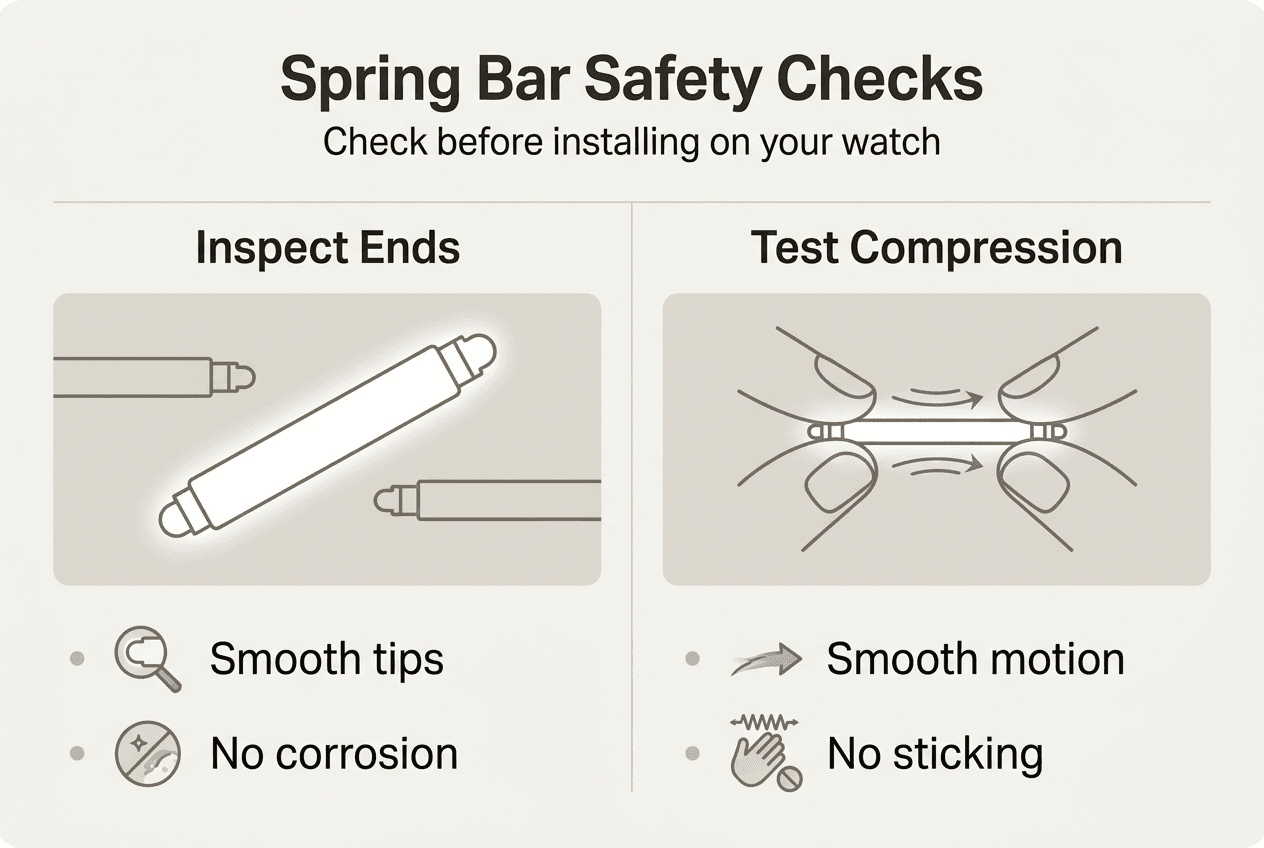
Spécifications des barrettes de ressort par type de montre :
| Catégorie de montre | Largeur de corne typique | Diamètre de la barre | Recommandation de matériau |
|---|---|---|---|
| Montres de soirée vintage | 18-20 mm | 1,5 mm | Acier inoxydable standard |
| Montres de sport modernes | 20-22 mm | 1,8 mm | Acier inoxydable courbe |
| Montres de plongée | 22-24 mm | 2,0 mm | Acier inoxydable robuste |
| Bracelet intégré | Variable | Personnalisé | Spécifique au fabricant |
Préparation au remplacement des barrettes de ressort : mesure et configuration de l'espace de travail
Changer une barrette de ressort sur une montre, et vous devez faire attention à quelques points, sinon vous pourriez être victime d'un accident coûteux. Tout d'abord, assurez-vous que votre espace de travail est exempt de poussière ou de saleté, qui pourrait tomber sur le cadran de votre montre ou dans le mouvement lorsque vous retirez le fond du boîtier. Deuxièmement, assurez-vous d'avoir un bon éclairage.
Pour cette procédure, j'ai placé une lumière LED très brillante à un angle de sorte qu'il n'y ait pas d'ombres sur l'extrémité de la corne du bracelet ou du bracelet sur lequel je travaille. Enfin, placez un coussin de bijoutier ou un chiffon doux sans peluches autour du verre et du boîtier de la montre pour les protéger d'un contact accidentel et d'endommagement.
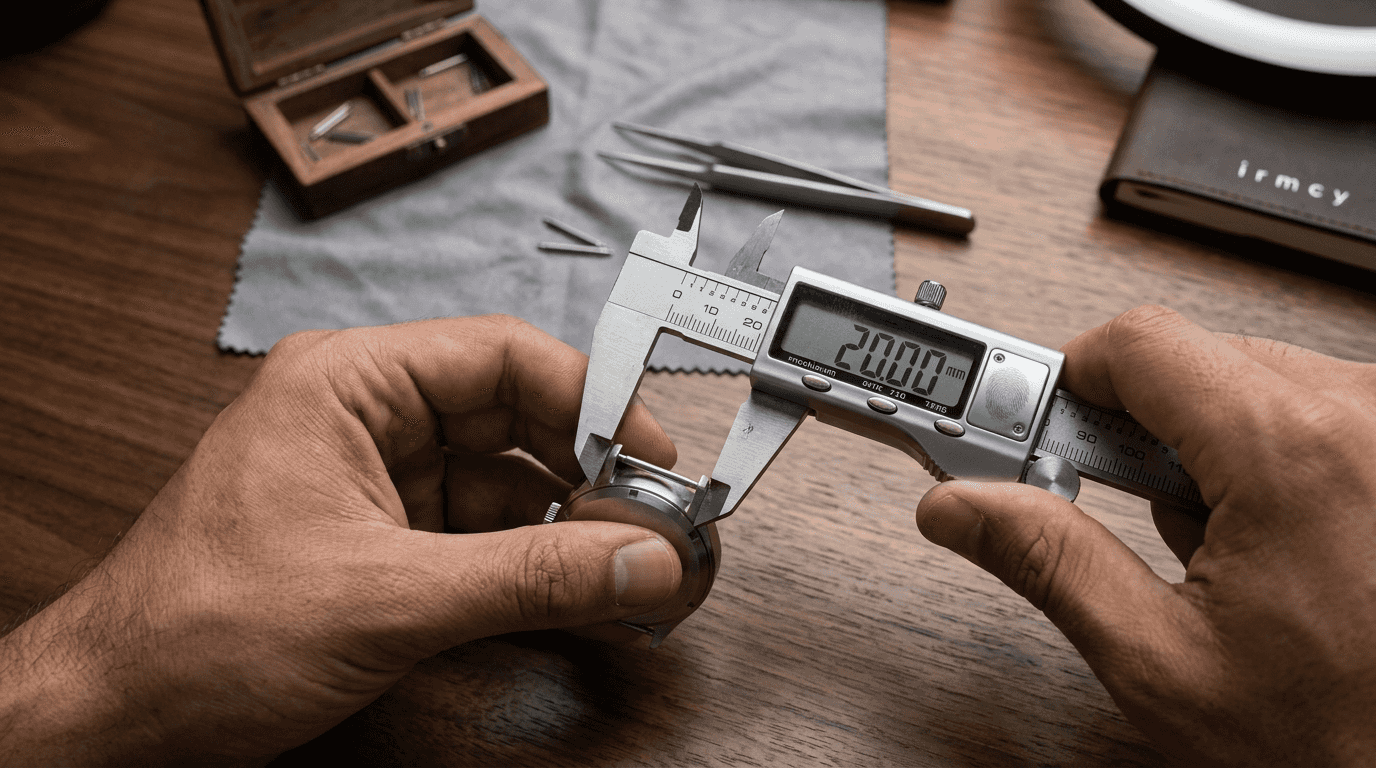
Une métrique peu connue pour déterminer la taille appropriée d'une barrette de ressort est la largeur de la corne de la montre. Vous pouvez mesurer la largeur de la corne du bracelet de montre à l'aide de vos pieds à coulisse numériques. Mesurez entre les surfaces intérieures des cornes où les barrettes de ressort s'assoient. Mesurez cette dimension trois fois, car même de petits changements entre les mesures pourraient être le résultat de petits changements de dimension causés par de petites variations dans les tolérances de fabrication.
Enregistrer la mesure arrondie
Enregistrez cette mesure en mm et arrondissez au nombre entier le plus proche. Cela facilitera le choix d'une barrette de ressort de remplacement car pratiquement tous les fabricants de bracelets de montre utilisent des tailles de barrette de ressort standard qui diffèrent de 1 mm de longueur de 18 mm à 24 mm, certains fournisseurs offrant les tailles moins courantes de 19,5 mm et similaires.
Placez de petits morceaux de ruban de masquage étroit en travers des cornes, là où l'outil à barrettes va travailler, afin de les protéger d'un dérapage qui pourrait les rayer ; faire polir une rayure coûte cher. Posez le ruban bien à plat contre les cornes, ses bords alignés sur les trous de corne pour que l'outil puisse toujours les atteindre. La qualité d'un bracelet de montre dépend en partie de points d'attache aux cornes sûrs et intacts, et le ruban aide à les préserver.
Choisir une nouvelle barrette de ressort de même
Choisissez une nouvelle barrette de ressort de même longueur et épaisseur que le poids de votre nouveau bracelet. Choisissez parmi les longueurs et épaisseurs de barrette de ressort ici. Choisissez jusqu'à 3 mm de cuir et associez-le à des barrettes de ressort de 1,5 mm. Choisissez des bracelets en caoutchouc lourd ou NATO et des barrettes de ressort de 1,8 ou 2,0 mm pour éviter l'incurvation. Les barrettes de ressort doivent être en acier inoxydable. Recherchez également une extrémité de goupille lisse et arrondie - les barrettes de ressort bon marché peuvent avoir une extrémité de goupille mal finie et une barrette de ressort sujette à la rupture.
Le remplacement de la barrette de ressort prend vingt minutes à apprendre. Cela se paie la première fois que vous entendez ce clic et que la montre reste à votre poignet.
Assemblez votre kit complet avant de commencer :
- Outil fourchu pour barrette de ressort avec pointes durcies
- Pieds à coulisse numériques précis à 0,01 mm
- Barrettes de ressort de remplacement de la bonne taille
- Ruban de masquage pour la protection de la corne
- Pinces pour manipuler les petits composants
- Loupe de grossissement pour l'inspection
- Chiffon de nettoyage doux
- Bonne source d'éclairage
Processus de remplacement des barrettes de ressort étape par étape
La plupart des chutes de bracelet ne se produisent pas pendant l'installation mais trois mois plus tard, lorsqu'une barrette qui n'a jamais été complètement assise finit par céder.
Avant de commencer, assurez-vous de sécuriser les cornes avec un morceau de ruban de masquage comme indiqué précédemment. Placez maintenant la montre face vers le bas et procédez au travail sur les points d'attache du bracelet. Décidez quelle extrémité de l'outil de barrette de ressort est requise pour votre montre, car l'extrémité fourchue est pour les barrettes de ressort régulières, et l'extrémité pointue est pour les cornes percées.
Installation étape par étape
À l'aide de votre loupe de grossissement, vérifiez les trous de corne pour toute obstruction telle que la saleté, la rouille ou les dommages qui pourraient interférer avec l'installation de votre nouvelle barrette de ressort. Nettoyez tout débris avec une brosse douce ou de l'air comprimé. Vous devriez maintenant vous référer à l'évaluation initiale que vous avez effectuée pour cette montre et déterminer si l'autre barrette de ressort nécessite également un remplacement.
À l'aide de la nouvelle barrette de ressort, comprimez une goupille avec vos doigts ou l'outil de barrette de ressort. Insérez la goupille comprimée dans l'un des trous de corne. En maintenant la goupille en place, comprimez la deuxième goupille et insérez-la dans le deuxième trou de corne. Vous entendrez et sentirez un clic lorsque la goupille est assise et que la barrette de ressort est engagée.
Meilleur test de sécurité
Le meilleur test pour la sécurité de l'installation est de tenter de tirer le bracelet loin du boîtier en saisissant simplement le bracelet et en tirant dessus tout en tirant également sur la barrette de ressort à un angle. Cela ne devrait pas bouger ou desserrer la barrette de ressort. Un autre test consiste à tenter de fléchir latéralement le bracelet pour s'assurer que les deux goupilles sont correctement assises. Maintenant que nous avons retiré le ruban de masquage des extrémités des cornes, nous pouvons regarder de plus près et sous grossissement pour vérifier les rayures ou les marques sur la corne qui auraient pu se produire pendant la procédure.
Erreurs courantes par rapport à la technique correcte :
| Erreur | Approche correcte | Conséquence de l'erreur |
|---|---|---|
| Forcer la barre sans compression | Comprimez complètement la goupille avant l'insertion | Trous de corne rayés, goupilles endommagées |
| Ignorer la protection de la corne | Appliquez le ruban de masquage avant de commencer | Rayures permanentes du boîtier |
| Utiliser une barre de diamètre incorrect | Faites correspondre la barre au poids du bracelet | Barres pliées, défaillance du bracelet |
| Précipiter l'installation | Travaillez méthodiquement avec un bon éclairage | Composants tombés, assise incomplète |
Si les cornes de votre montre sont endommagées lors d'un changement de barrette de ressort, votre montre peut ne pas fonctionner correctement et toute revente future de la montre peut être diminuée en valeur. Même les plus petites rayures qui ne sont visibles que sous grossissement peuvent être un facteur négatif important lors de la vente d'une montre vintage ou en édition limitée à un collectionneur de montres sérieux.
Les bracelets de montre modulaires conçus par Smartlet reposent sur le même principe : sur toute montre équipée de barrettes standard, les adaptateurs de montre Smartlet se logent dans les trous de corne à la place des barrettes, sans abîmer la montre, et le bracelet d'origine se remonte quand vous le souhaitez.
Gestion des cas limites et dépannage des problèmes courants
Les cornes percées semblent être une fonction de commodité. C'est le cas - jusqu'à ce que l'outil glisse et que le trou de forage devienne une rayure qui attire la lumière sous tous les angles.
Cornes percées Les cornes percées sont conçues avec de petits trous de chaque côté du boîtier extérieur du bracelet de montre. À l'aide d'un outil de barrette de ressort, on peut facilement accéder aux goupilles qui maintiennent le bracelet de montre au boîtier de la montre. On appuie simplement sur l'extrémité pointue de l'outil dans le trou et on comprime la goupille, ce qui permet au bracelet d'être tiré loin du boîtier de la montre.
-La prudence doit être exercée car le bracelet et le boîtier peuvent être un peu difficiles à aligner pour éviter de rayer le trou qui a été percé. Ce type de corne est le type le plus courant utilisé sur les montres de sport et rend les changements de bracelet très simples.
Je ne suis pas fan des barrettes de ressort à dégagement rapide. Celles-ci ont de petits leviers à chaque extrémité de la barrette de ressort, qui compriment la goupille dans le trou de la corne. Aucun outil n'est requis, et tout ce que vous faites est de saisir les extrémités de la barrette de ressort avec votre pouce et votre doigt, de tirer le bracelet loin du boîtier, et la goupille tombe du trou de la corne.
Vous collectionnez trop de bracelets
Si vous êtes un collectionneur avec trop de bracelets à porter et à changer beaucoup du temps, ceux-ci pourraient être bons pour vous. Mais à part la commodité, je ne suis pas sûr que le boîtier soit correctement sécurisé au poignet comme ce serait le cas avec une barrette de ressort régulière. Assurez-vous que la barrette de ressort que vous achetez peut avoir les leviers se déplacer le long de sa longueur librement sans aucune accroche ou pli à des points bon marché, qui peuvent facilement se casser.
Réparation de roue - Cas limites Les exemples suivants sont considérés comme des cas limites : barres coincées/cassées qui nécessitent un outil de retrait de barre spécial ou un nettoyage par ultrasons. Barres courbes pour cornes coniques. Barres à vis qui nécessitent un petit tournevis. La plupart des barres coincées sont le résultat d'une corrosion qui a soudé la goupille au trou de la corne.
Appliquez de l'huile pénétrante sur la goupille et laissez-la reposer pendant 10-15 minutes pour permettre au solvant de faire son travail. Ensuite, tentez de retirer la roue avec seulement la pression la plus légère appliquée. La barre peut facilement se casser à l'intérieur de la corne si trop de pression est appliquée, ce qui se transformera alors en une réparation encore plus difficile.
Goupilles coincées, barres cassées
Les goupilles coincées sur les barres cassées et celles qui ont perdu leurs goupilles dans les trous de corne doivent être retirées avec des pinces ou d'autres outils de retrait de goupille. Pas mal de travail, car elles sont difficiles à sortir, mais vous pouvez les sortir si vous attrapez l'extrémité et la tournez en tirant. Si vous ne pouvez pas la sortir, trempez-la dans un nettoyeur à ultrasons avec une solution de nettoyage de montre. Il existe des outils de retrait de goupille disponibles pour l'horloger dans l'atelier à domicile qui sont conçus pour certaines goupilles que l'amateur ne peut pas retirer.
Une caractéristique commune des montres avec des cornes coniques est qu'elles ont des barrettes de ressort courbes pour correspondre à la forme des cornes. Cependant, toutes les montres de soirée et les montres vintage n'ont pas des cornes droites. Il existe un certain nombre de montres de soirée modernes et vintage qui ont des cornes courbes. Sur ces montres, l'utilisation d'une barrette de ressort droite causera des points de pression entre la corne et la barrette de ressort et le bracelet s'assoira également mal sur la montre. Il est beaucoup mieux de mesurer l'arc de la corne et ensuite d'obtenir une barrette de ressort qui correspond à cette courbe. Plus cher oui, mais cela vaut le coût supplémentaire.
La barrette à vis a des goupilles filetées qui se « vissent » dans la corne au lieu de se charger par ressort dans des trous comme la barrette de ressort. Pour retirer, tournez une extrémité avec un petit tournevis (de préférence 1,0-1,4 mm de largeur). Maintenez avec une pression uniforme et tournez dans la direction souhaitée. Trop de pression ou de couple croisera le filetage et endommagera les filets de la corne. Avant de réinsérer la barrette à vis, assurez-vous également de nettoyer tout débris des filets de la corne.
Conseils de dépannage pour les problèmes courants :
- La barre ne se comprime pas : le ressort peut être cassé ou corrodé ; remplacez immédiatement
- La goupille ne s'insère pas dans le trou ? Vérifiez que la longueur de la barre est correcte ? Y a-t-il des débris dans le trou de la corne ?
- Le bracelet semble lâche : confirmez que les deux goupilles sont complètement engagées ; testez avec une flexion latérale
- L'outil glisse à plusieurs reprises : ajoutez du ruban de masquage frais pour une meilleure surface de prise
- La barre se plie pendant l'installation : le diamètre de la barre sélectionné pour le poids du bracelet est trop petit. Augmentez le diamètre de la barre.
La méthode fonctionne avec tous les types de montres
Cette méthode fonctionne avec tous les types de montres et de matériaux de bracelets. En sachant comment gérer les cas limites, vous pouvez être confiant de garder une grande variété de montres qui ont l'air neuves et prêtes à porter, sans les envoyer au cordonnier pour de simples changements de bracelet.
Explorez les options de bracelets de montre intelligents et modulaires avec Smartlet
Maintenant que vous savez changer les barrettes de votre montre, voici un aperçu des systèmes de bracelets modulaires et de la souplesse qu'ils apportent. Sur un Smartlet, des adaptateurs de montre prennent la place des barrettes, et un seul bracelet à maillons en métal porte votre montre mécanique au-dessus et votre montre connectée dessous.
Vous n'aurez plus à choisir quelle montre porter pour répondre à vos besoins. Avec la conception brevetée de Smartlet, vous pouvez associer n'importe quelle montre ayant une largeur de corne entre 18 mm et 24 mm et utiliser les barrettes de ressort que vous venez d'apprendre à changer. Nous utilisons l'acier SS316L et le titane pour une qualité optimale.
Le système modulaire Smartlet a été conçu par des collectionneurs pour des collectionneurs. Son bracelet modulaire breveté convient à toute montre d'une entrecorne de 18 à 24 mm à barrettes standard.
Présenté au CES 2026, Smartlet représente la prochaine génération d'expérience de port de montre pour les collectionneurs de montres désireux d'évoluer, plutôt que simplement de s'adapter. Consultez le guide de compatibilité des marques de montres et le guide de compatibilité des montres intelligentes pour vérifier la compatibilité avec votre collection. Lauréat du Concours Lépine 2025 et présenté au CES 2026, Smartlet représente la prochaine évolution du port de montre pour les collectionneurs qui refusent de faire des compromis.
Recommandé
Articles stars
No people found
We couldn’t find anything with that term. Please try again.


