


Pourquoi les pilotes continuent-ils à faire confiance aux montres mécaniques pour mesurer le temps en 2026 ?

Fondateur & PDG, Smartlet - Ingénieur CentraleSupelec - Concours Lépine 2025, Lauréat - CES 2026
Table des matières
- Les montres de pilote mécaniques : lisibilité et fiabilité inégalées
- La tradition et la culture derrière la montre de pilote
- Avantages techniques : pas de batterie, durabilité extrême et fonctions éprouvées
- Montre de pilote moderne : combiner les montres mécaniques et intelligentes en 2026
- Pourquoi la montre de pilote prouve l'endurance analogique : ce que la plupart des articles oublient
- Améliorez votre montre de pilote : stratégies pour combiner les montres analogiques et intelligentes
- Questions fréquemment posées
Points clés à retenir
| Point | Détails |
|---|---|
| Avantage du chronométrage analogique | Les montres mécaniques offrent aux pilotes une lisibilité instantanée et un chronométrage de secours sans délais numériques. |
| La tradition rencontre la technologie | Les pilotes apprécient les montres mécaniques pour leur patrimoine culturel et les associent aux montres intelligentes pour une couverture complète. |
| Durabilité et indépendance | Les montres de pilote mécaniques ne nécessitent pas de batterie pour un fonctionnement ininterrompu. |
| Intégration pratique | Les pilotes modernes combinent les montres analogiques et intelligentes pour des solutions de données et de navigation plus riches. |
Malgré les cockpits vitrés, la précision GPS et les montres intelligentes qui surveillent votre fréquence cardiaque en vol, des milliers de pilotes professionnels attachent encore une montre mécanique avant chaque décollage. Ce choix n'est pas de la nostalgie. Les réglementations de l'EASA et de la FAA reconnaissent l'importance d'une navigation de secours et d'un chronométrage, et une montre mécanique reste l'un des outils les plus fiables et toujours prêts qu'un pilote puisse porter. Elle ne coûte pas de batterie, ne nécessite pas de balayage pour l'activer et se lit instantanément sous pression.
Les montres de pilote mécaniques : lisibilité et fiabilité inégalées
Le cockpit est un environnement à forte charge de travail. Lors de l'approche ou de la finale, chaque seconde de distraction compte. Les aiguilles de balayage analogique offrent un avantage critique par rapport aux affichages numériques : pas de tapotement, pas d'activation d'écran, pas de délai. Vos yeux se posent sur le cadran, votre cerveau lit l'heure et vous êtes de retour sur les instruments.aiguilles de balayage analogique
Les appareils numériques, y compris les montres intelligentes, nécessitent souvent un coup de poignet ou une pression sur un bouton pour éclairer l'affichage. En turbulences ou la nuit, cette petite interaction ajoute une charge cognitive que vous ne pouvez tout simplement pas vous permettre. Les montres mécaniques éliminent complètement cette friction.
La tradition de la fabrication de montres de pilote a produit des outils remarquablement fonctionnels. Breitling a construit la Navitimer avec un anneau à règle à calcul spécifiquement pour les calculs en vol. IWC a conçu la Big Pilot pour la lisibilité dans les cockpits non pressurisés. Longines a fourni les aviateurs militaires pendant des décennies. Ces montres n'étaient pas de la mode. C'étaient des instruments, et leurs principes de conception tiennent toujours aujourd'hui.
| Caractéristique | Montre de pilote mécanique | Affichage numérique/montre intelligente |
|---|---|---|
| Lisibilité de l'heure | Instantanée, aiguille de balayage | Nécessite une activation ou un délai de coup d'œil |
| Chronomètre | Poussoir mécanique, tactile | Écran tactile, incompatible avec les gants |
| Anneau à règle à calcul | Calculatrice analogique intégrée | Non disponible |
| Dépendance à la batterie | Aucune | Nécessite une charge quotidienne/hebdomadaire |
| Lisibilité en plein soleil | Cadran à contraste élevé | Reflet d'écran possible |
| Chronométrage de secours | Toujours disponible | Dépend du niveau de charge |
Caractéristiques clés que les professionnels de l'aviation apprécient le plus dans une montre de pilote mécanique :
- Aiguille des secondes de balayage pour des lectures précises du temps écoulé sans conversion mentale.Aiguille des secondes de balayage
- Couronne visséepour résister aux changements d'humidité et de pression
- Cadran à contraste élevé avec indices lumineux pour la lisibilité en cockpit en faible lumière.Cadran à contraste élevé
- Chronomètre mécanique pour chronométrer les segments d'approche et la consommation de carburant.Chronomètre mécanique
- Anneau à règle à calcul pour les calculs rapides de vitesse, de distance et de carburant.Anneau à règle à calcul
Explorez lacomparaison entre la montre de pilote classique et intelligenteavant un vol long-courrier. Réglez votre chronomètre mécanique au repoussage et recoupez avec votre journal des temps du FMS. Vous verrez rapidement comment la montre mécanique confirme les lectures numériques en un coup d'œil sans aucune interaction d'écran.
Le lieu où l'aviation rencontre la technologie n'est pas une histoire de remplacement. C'est une histoire complémentaire. Et cela commence par comprendre ce que chaque outil fait le mieux.l'aviation rencontre la technologie
La tradition et la culture derrière la montre de pilote
Au-delà du patrimoine et de la culture, les montres de pilote mécaniques portent un poids culturel qu'aucune application ne peut reproduire. L'aviation a toujours été une profession construite sur la discipline, la précision et la confiance dans les outils éprouvés. La montre au poignet d'un pilote fait souvent partie de cette identité.
« Une montre est l'un des instruments qui vous accompagne du premier vol en solo au dernier vol. Elle n'appartient pas à l'avion. Elle appartient au pilote. »
Les marques patrimoniales comme Breitling, IWC et Hamilton sont devenues des icônes précisément parce que leurs montres étaient fiables en altitude, en guerre et dans les programmes de formation du monde entier. Breitling a fourni la Royal Air Force. Hamilton a équipé les aviateurs militaires américains. IWC a construit des montres pour les navigateurs de la Luftwaffe allemande. Ce ne sont pas des histoires de marketing. Ce sont des chapitres documentés de l'histoire de l'aviation.

La tradition des montres mécaniques en aviation reflète une culture où la redondance n'est pas optionnelle. Les pilotes sont formés pour vérifier, recouper et sauvegarder chaque système. Une montre mécanique est la sauvegarde ultime : zéro électronique, zéro dépendance, zéro point de défaillance lié à l'alimentation.
| Dimension | Montre de pilote mécanique | Montre intelligente |
|---|---|---|
| Patrimoine | Des décennies d'histoire de l'aviation | Récent, en évolution |
| Identité | Fierté professionnelle, patrimoine | Avant-gardiste, connecté |
| Maintenance | Révision tous les 3 à 5 ans | Charge quotidienne requise |
| Valeur émotionnelle | Élevée, potentiel de relique familiale | Fonctionnelle, remplaçable |
| Réglementations | Acceptée comme outil de secours | Varie selon la politique de la compagnie aérienne |
Les pilotes partagent souvent des histoires de montres transmises par des instructeurs ou des pères qui volaient avant eux. L'origine du double port de montre remonte aux collectionneurs et aux professionnels qui refusaient de sacrifier l'un pour l'autre, et la culture de l'aviation l'a rendu courant avant que le monde des montres ne s'en aperçoive.l'origine du double port de montre
Avantages techniques : pas de batterie, durabilité extrême et fonctions éprouvées
Au-delà du patrimoine et de la culture, les montres de pilote mécaniques offrent des avantages techniques essentiels pour la sécurité aérienne. Le plus évident est l'indépendance de la batterie. Une montre mécanique remontée à pleine réserve de marche fonctionnera pendant 40 à 80 heures sans aucune intervention. Pas de câble de charge, pas d'écran mort au repoussage.
L'absence de dépendance à la batterie n'est pas une simple commodité. Pour un pilote en voyage multi-jours à travers les fuseaux horaires avec une infrastructure aéroportuaire limitée, c'est opérationnellement significatif.
Les mouvements mécaniques sont également construits pour absorber les vibrations différemment des cristaux de quartz. Dans les environnements de l'aviation générale et des compagnies aériennes commerciales, le profil de vibration constant des moteurs à pistons ou à turbine se situe dans la tolérance de la plupart des mouvements mécaniques modernes. Lorsque les forces G extrêmes deviennent une préoccupation, comme dans les avions de chasse militaires, les pilotes passent souvent au quartz ou au numérique pour la précision du chronométrage.
Caractéristiques pratiques qui définissent l'ensemble d'outils de la montre de pilote mécanique :
- L'anneau à règle à calcul est utilisé pour calculer la consommation de carburant, la vitesse anémométrique et les problèmes de temps/distance.Anneau à règle à calcul
- Chronomètre flyback pour une réinitialisation instantanée sans arrêt, critique pour le chronométrage des étapes.Chronomètre flyback
- La complication GMT permet la surveillance des deux fuseaux horaires sur les routes internationales.Complication GMT
- L'indicateur de réserve de marche montre exactement combien de temps de fonctionnement reste.Indicateur de réserve de marche
Les montres comme la IWC Big Pilot et la Hamilton Khaki Aviation ont été spécifiquement conçues pour une utilisation en cockpit, avec des couronnes surdimensionnées et des cadrans à contraste élevé qui fonctionnent avec des gants.IWC Big PilotHamilton Khaki Aviation
Utilisez votre anneau à règle à calcul pour vérifier les calculs de carburant du FMS sur les longs segments. Si vos systèmes principaux affichent une anomalie, l'anneau vous donne une référence indépendante en moins de 30 secondes, sans écran requis.
Montre de pilote moderne : combiner les montres mécaniques et intelligentes en 2026
Avec une compréhension claire de ce que chaque type de montre offre, la réponse est rarement l'un ou l'autre en 2026. C'est presque toujours les deux.
Fonctions de montre intelligente que les montres mécaniques ne peuvent tout simplement pas fournir :
- Alertes météorologiquespoussées directement à votre poignet par les services météorologiques de l'aviation
- Intégration du carnet de bord électroniquepour le suivi automatique du temps de vol
- Surveillance de la saturation en O2pour les segments de vol en haute altitude et non pressurisés
- Alertes de point de cheminement de navigationet avertissements de proximité d'espace aérien
- Synchronisation de la communicationpour les rappels de fréquence ATC et les déclencheurs de liste de contrôle
Les pilotes de chasse favorisent souvent les montres intelligentes Garmin pour la surveillance de l'O2, tandis que les pilotes de l'aviation générale et des compagnies aériennes se tournent régulièrement vers les options mécaniques ou analogiques pour leur fiabilité à faible maintenance et toujours active. La configuration de poignet la plus efficace combine les deux : montre mécanique au poignet principal pour le chronométrage instantané, montre intelligente au poignet secondaire pour les données connectées.
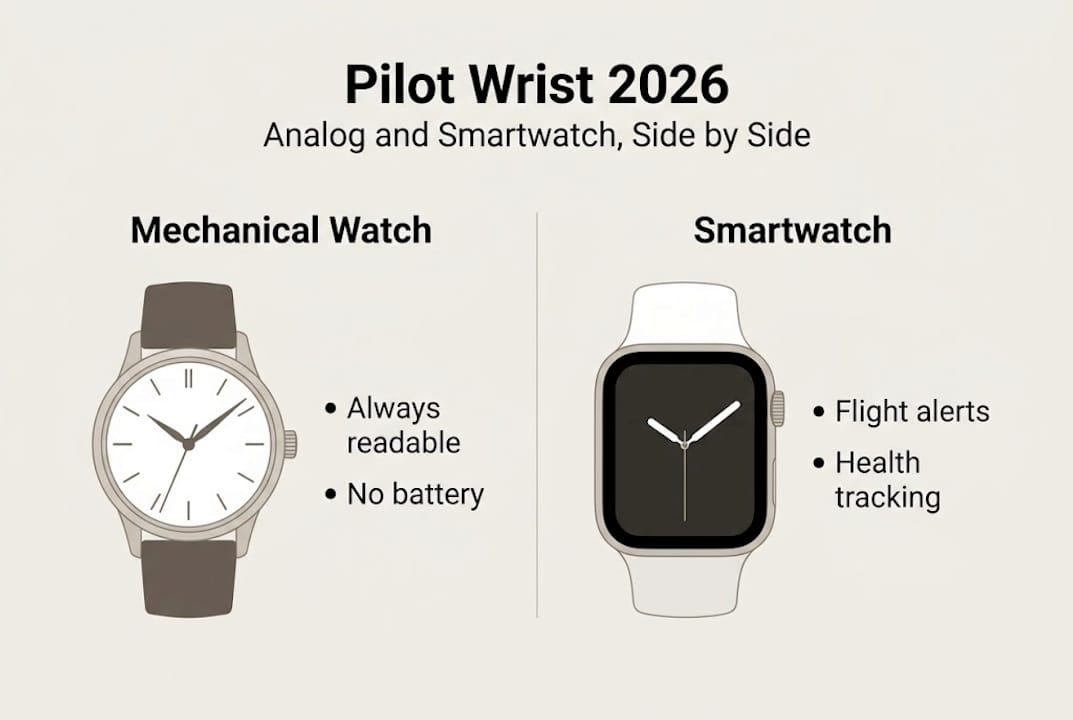
Un bracelet modulaire facilite la transition en réunissant les deux appareils sur un seul bracelet ergonomique. Vous adaptez votre configuration de poignet à la mission : court vol VFR, route IFR transatlantique ou vol en montagne. Chaque scénario a des priorités un peu différentes, et une configuration flexible permet de toutes les satisfaire sans compromis.
Organisez votre configuration de poignet avant la vérification avant vol, pas pendant. Mécanique à gauche pour le chronométrage, montre intelligente à droite pour les alertes. Construisez cette habitude et elle devient aussi automatique que votre liste de contrôle avant décollage.
Pourquoi la montre de pilote prouve l'endurance analogique : ce que la plupart des articles oublient
La plupart des couvertures technologiques présentent les montres mécaniques comme des reliques charmantes coexistant gracieusement avec des outils numériques supérieurs. Cette présentation omet complètement la réalité opérationnelle.
Les pilotes rapportent qu'ils se retrouvent en retard sur l'avion lorsqu'ils s'appuient sur des minuteurs iPad ou smartphone en raison des délais d'activation d'écran pendant les phases à forte charge de travail. Ce n'est pas une question de préférence. C'est un modèle comportemental pertinent pour la sécurité documenté par les aviateurs expérimentés.
La montre mécanique ne nécessite pas que votre attention soit prête. Elle est toujours active, toujours correcte, toujours lisible. Les pilotes sont formés pour se méfier des dépendances à point unique et pour s'appuyer sur des systèmes redondants.
Les partisans du numérique uniquement oublient un point critique : en cas d'urgence, l'objectif est de réduire la charge cognitive, pas de l'augmenter. Une montre mécanique au poignet supprime complètement une décision. Elle n'a pas besoin d'être vérifiée pour la charge, activée ou balayée. Elle fonctionne tout simplement.
« Le débat entre la montre de pilote classique et intelligente n'est pas vraiment un débat parmi les pilotes qui travaillent. La plupart d'entre eux utilisent déjà les deux. La question est juste comment le faire efficacement. »
Améliorez votre montre de pilote : stratégies pour combiner les montres analogiques et intelligentes
Le bracelet modulaire Smartlet a été conçu exactement pour ce scénario. En acier SS316L brossé et en titane grade 2, il convient à toute montre d'une entrecorne de 18 à 24 mm à barrettes standard. Aucune modification de votre IWC, de votre Breitling ou de votre Hamilton. Aucun compromis sur l'un ou l'autre appareil. Hamilton
Consultez le guide de compatibilité des marques pour confirmer votre modèle spécifique et explorez les accessoires de montre de pilote qui rendent la configuration à double port véritablement confortable sur les vols long-courrier. Trois versions : Classic (299 EUR), Shadow (399 EUR) et Titanium (549 EUR).guide de compatibilité des marquesaccessoires de montre de piloteClassicShadowTitanium
Recommandé
- Breitling Navitimer et Apple Watch : l'aviation rencontre la technologie
- Le bracelet de montre en 2026 est ce que la chaussure de sport était en 1993
- Montre mécanique vs montre intelligente : portez les deux sans compromis
- Portez une montre intelligente avec votre IWC Big Pilot
- Compatibilité Hamilton Khaki Aviation avec Smartlet
Articles stars
No people found
We couldn’t find anything with that term. Please try again.


