


Smartwatch on the back of the wrist: the scratch myth that doesn't hold up

Contents
| Question | Short answer |
|---|---|
| Does orientation affect scratch risk? | No. Scratch resistance is a property of the screen material, not of the way the watch faces. |
| What protects the screen? | Sapphire crystal on steel and titanium models, Ion-X glass on aluminum models. |
| How hard is sapphire? | About 9 on the Mohs scale, per Consumer Reports testing. |
| How hard is Ion-X glass? | It held to around 7 on the Mohs scale in the same testing. |
| Can Smartlet scratch an Apple Watch? | No more on the inside of the wrist than on the outside. |
Does wearing an Apple Watch on the inside of the wrist scratch it faster? No. A screen's scratch resistance comes from its material, not from its orientation. Apple Watch screens use sapphire crystal on the steel and titanium models and Ion-X glass on the aluminum ones. In testing reported by Consumer Reports, sapphire resisted a pick rated 9 on the Mohs hardness scale and Ion-X held to around 7. Turning the watch toward the wrist changes none of those numbers. The fear is real, the risk it points to is not.
The myth, stated plainly
It comes up in nearly every comment thread, article, and watch discussion: wear an Apple Watch on the inside of the wrist and you will wreck it. The claim is stated with confidence, rarely with evidence. It is worth taking seriously, because it sits on a real instinct about how watches get marked over time.
"Wearing an Apple Watch on the inside of the wrist will damage it." A recurring line, repeated until it sounds like fact.
At Smartlet, the whole point of the system is to carry a mechanical watch and a connected device on a single wrist, the analog watch on top and the smartwatch underneath, against the skin. So this objection lands directly on what we build. We did not want to wave it away. We wanted to check it.
Durability backed by materials science
Apple does not leave screen materials to chance. Aluminum models use Ion-X strengthened glass, light and shock resistant. Steel and titanium models use sapphire crystal, which is among the hardest materials short of diamond.
Hardness here means resistance to scratching, measured on the Mohs scale, which runs from talc at 1 to diamond at 10. In testing reported by Consumer Reports, the sapphire face survived a pick rated 9, while the Ion-X face held to around 7 before marking. SlashGear walked through the same comparison and reached the same place: sapphire is the harder surface, and Ion-X is no pushover against everyday wear (SlashGear).
| Material | Mohs hardness | On the Apple Watch |
|---|---|---|
| Talc | 1 | Reference, softest |
| Ion-X strengthened glass | around 7 | Aluminum models |
| Sapphire crystal (corundum) | 9 | Steel and titanium models |
| Diamond | 10 | Reference, hardest |
The key fact
A screen's hardness is fixed by its material. It does not change when the watch is turned toward the wrist. Whatever an Apple Watch can resist face up, it resists face down, by exactly the same amount.
Why the fear persists
If the numbers are clear, why does the doubt survive? Because for centuries we have worn watches face up, dial to the sky. Smartlet proposes a different arrangement, a mechanical watch and an Apple Watch sharing one wrist, and anything that breaks a long habit draws suspicion first and questions later.
The suspicion is reasonable as an instinct. It is just aimed at the wrong target. The orientation is new, the material is not, and it is the material that decides whether a surface scratches.
Metal versus glass, the real distinction
One remark keeps surfacing: "I scratched my deployant clasp badly, so a smartwatch in that spot is doomed." It feels logical. It also confuses two very different surfaces.
Stainless steel was never meant to stay pristine. It is made to live, to take marks, to develop a patina. A sapphire screen is the opposite, a surface engineered to resist.
A scratched clasp tells you about steel, not about glass. Steel is soft enough to record every desk edge and every door handle, and many people like that it does. A sapphire crystal sits four full steps higher on the Mohs scale. The two simply do not behave the same way, which is exactly why a marked bracelet says nothing about the screen beside it. For more on pairing a fine watch with a connected device without worry, see our guide on wearing a smartwatch with a luxury watch.
So can Smartlet damage an Apple Watch?
No more on the inside of the wrist than on the outside. The screens are built for daily life, and Smartlet does not place them anywhere more hostile than a normal strap would. On the system, the connected device sits underneath, against the wrist, while the mechanical watch stays on top where it is seen. Christian, a security professional in France, made the discreet inner-wrist position the center of his own tactical review, and Sebastien in Paris reached the same comfort verdict in his.
You can build the pairing across the collection: the Classic in hand-brushed SS316L, the Shadow in matte PVD black, and the Titanium in Grade 2 titanium. Setup takes seconds, shown in the setup guide, and you can confirm your own watch on the compatibility pages and the smartwatch list.
In practice
For everyday wear, the inner-wrist position is as safe for the screen as any other. For high-impact activity, keep your Apple Watch on its standard strap for that session.
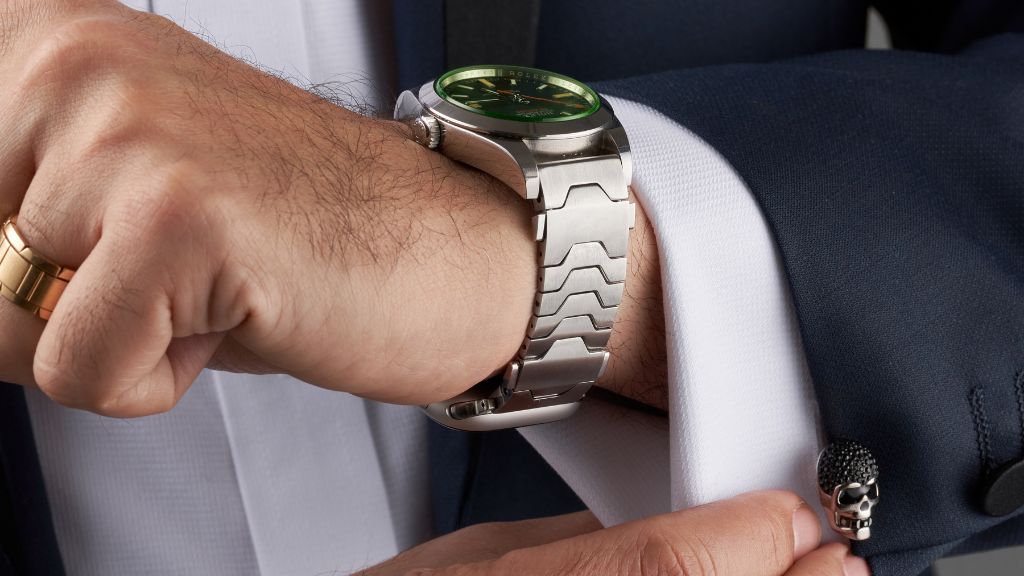
The real revolution is not about risk, it is about freedom: composing your wrist your way, a mechanical watch and a connected one together, elegantly and safely. That is what Smartlet was built for, the system awarded a Bronze Medal at Concours Lepine 2025 and selected for CES 2026. Explore the Smartlet One collection and decide for yourself.


