


Sony Wena discontinued in 2026: Smartlet is the best alternative

Founder & CEO, Smartlet · CentraleSupélec engineer · Concours Lépine 2025, Awarded · CES 2026
Table of contents
- The end of Sony Wena 3: what happened and why it matters
- The rise and fall of Wena: innovation limited by proprietary design
- Why proprietary smartwatch bands face structural obsolescence
- Smartlet: the future of combining analog watches with smartwatch features
- Smartlet vs Sony Wena: feature and compatibility comparison
- Discover Smartlet: combining luxury and smart innovation cleanly
Key takeaways
| Point | Details |
|---|---|
| Sony Wena 3 services ended February 28 2026 | Core functions including initial setup and connected services were permanently terminated. |
| Proprietary design caused the failure | Wena was tied to one watch brand, one app, one vendor. When the server stopped, the product stopped. |
| Smartlet requires no server | Mechanical connector system. No app required for core function. No vendor dependency. |
| Compatible with 18-24mm lug width | Any watch in that range works with Smartlet. Rolex, Omega, Tudor, Grand Seiko, and hundreds more. |
| No vendor lock-in | If Smartlet ever discontinues, the spring bars and your watches remain intact. The system is mechanical. |
The concept of Sony Wena was fantastic. You keep your watch, your dial, your movement – the very elements you’ve saved for and grown to love. You keep the weight, the balance, and the feel of your timepiece, familiar and comforting. You simply change the strap into a modern piece of high tech. A simple and elegant idea, and when the third generation of Wena watches was finally launched it seemed that Sony had finally delivered on that promise.
Now, here we are on February 28, 2026 and yesterday was a very sad day for all Wena watch owners – it was then that Sony announced that they will be discontinuing their server services. The watch will continue to function as a normal step counter, but the smart wearable element that was at the heart of the innovation of Wena will no longer function.
This isn’t a review of Wena watches, but is rather a guide for what a smart strap for watch collectors needs to deliver in the future. Read on if you are a Wena fan, as you’ll understand what is required to make such technology appealing to collectors.
The end of Sony Wena 3: what happened and why it matters
Sony discontinued Wena 3 services at the end of February 2026. Core functions such as initial setup and the connections to Sony's services, including Suica payments, ended with them. Anyone who bought the band expecting a long-lived wearable was left with far less than they paid for.
So if you purchased the Wrist Watch Smart Band looking for a wearable device that you could wear for the rest of your life, you may be in for a shock. Fans of smart watches will know that some of the key features that make these devices useful and fun to wear, such as remote control, fitness tracking and displaying weather and news on your wrist will no longer be available.
What happened and why it matters
The discontinuation affected integrations too: third-party apps that relied on Sony's servers stopped working, and the firmware will no longer be updated. The band can still show some notifications and record activity, but no new functions will come.
Affected features include:
- Initial device setup and pairing
- Suica contactless payment integration
- Qrio Lock smart home connectivity
- Third-party service integrations
- Firmware updates and security patches
The structural problem with lock-in
Pihole is run on a proprietary server. This means there is only a single point of failure. And when the company behind the hardware decides to drop support for it, the outdated hardware becomes impossible to keep running. Which in turn means the pihole server can no longer run.
The New Wena 3 Smart Watch Band Is A Bad Idea Watch collectors buy watches in the hopes that they will wear them for years to come. Wearability is a primary concern for almost all collectors. When one purchases a watch they generally assume it will last for many years. Lifespan is a core part of the philosophy of mechanical watch collecting.
A new proprietary smartwatch band, which effectively cuts off a watch from smart functionality after a few years, completely undermines that principle. As we wrote a few weeks ago here at AB, proprietary watch parts are a terrible idea for collectors. They seem to be hostile to traditional watchmaking skills, and the longevity of a watch, and also integrate modern technologies in a poor way.
The rise and fall of Wena: innovation limited by proprietary design
The Wena smartwatch is a wearable device, presented by Sony as a wristband that can be used as a strap for an analog watch. The crowdfunding campaign for the device started on Makuake in December 2015. The analog watch face is retained, while the wristband is transformed into a full featured smartwatch. In 2019, the new Wena Pro version of the product was launched in the UK, with a price of £399. The device features push notifications, fitness tracking and NFC for contactless payments.
Wena 3 was the third generation of Sony's smart straps, with a small display in the clasp and Suica payments. It brought technology to a mechanical watch without changing the watch, but Wena 3’s proprietary band system limited choice and upgrades, which contributed to its decline.
It was a very innovative product with however a limited choice of straps, and limited possibilities for upgrades, which also contributed to the decrease in demand for the Wena 3. Wena 3’s proprietary band systemLimited user choice and upgradeability, contributing to its decline.
Key limitations that seeded the downfall:
- Compatibility restricted to 18mm, 20mm, and 22mm lug widths only
- No support for Apple Watch or other standalone smartwatches
- Missing GPS function even in the Pro model
- Closed ecosystem dependent on Sony’s servers for core features
- Limited third-party integration compared to open platforms
Walkman was closed design you
The Walkman was a closed design, and you could, not replace individual components of the Walkman. So when Sony decided to drop the product, it was no longer supported or maintenance, and it became obsolete right away. Now that I have been shut down, I can only function as a basic pedometer without any network access. The vendor lock-in that makes closed system design so popular in consumer electronics is a bad idea.
Closed systems win initial battles, but will always lose the war Proprietary systems may gain the short term victory, but ultimately the open system always wins out. Everyone that is interested in Smart watches will eventually come to the realization that combining traditional mechanical watch making with digital technology will require an open and modular system that will be far less dependent on individual manufacturers. The lesson of Wena is a warning to all those who put a whole lot of faith in a particular platform as this can be shut down by a single manufacturer.
Why proprietary smartwatch bands face structural obsolescence
One of the defining characteristics of closed, locked down devices is that users are forced to rely on third party servers and foreign operating systems to do the work that the device itself is supposed to do. And so when the device is no longer supported by the manufacturer, all of that functionality is cut off. Smartphone users are used to this fate, but it is less acceptable in a watch, which is arguably the only wearable product that users care about surviving for years.
Vendor server is part of the service that hosts and runs the application. So there is a single point of failure. This might be a problem in case of a change of heart, financial difficulties or a business decision to retire an unprofitable product line.
In this case, when the company decided to withdraw an un-used product line, all remaining un-activated smart bands became worthless as it is no longer possible to set-up an un-activated device when the vendor server is closed. An example of this is that none of the Wena 3 pre-ordered from 1st of February 2026 will be able to be activated for use with their smart bands.
What was wrong Wena
So what was wrong with the Wena W? Where should we start? Well for one, the inter-operability was a major issue. While you can copy a few bits of data over to the phone app and get a general idea of what your fitness levels are like, there’s zero inter-operability with other smartwatches or operating systems. The example strap we had would only fit onto an analog watch with a lug width of 19,20 or 22mm. No smartwatches, such as the Apple Watch, or Samsung Galaxy Watch for that matter, would be compatible with the module. You’re really only left with two choices with this product – either use the fairly restricted functionality provided by Wena, or trade in the module and swap it out for a fully-functioning smartwatch. Samsung Galaxy Watch, or other popular smartwatch ecosystems. Users faced a binary choice: use Wena’s limited features or switch entirely to a standalone smartwatch. This rigidity prevented the flexibility that modern consumers expect.
Key risks of proprietary smartwatch bands:
- Server dependency eliminates device function when support ends
- Closed ecosystems prevent integration with newer technology
- Firmware updates stop, leaving security vulnerabilities unpatched
- Replacement parts become unavailable as manufacturing ceases
- Resale value drops to zero once discontinuation is announced
Proprietary devices are built to last for just about as long as it takes for a company to generate a profit. When a company decides to make a change in their business model the consumer is left with a piece of legacy technology that is no longer supportable or upgradable, and is therefore left disconnected from the ever evolving systems that make up our connected world.
Why Open or Modular Standards Matter Any product you purchase today should be based on an open or modular standard. The standards-based products are those that use universal connectors, open communication protocols, and are completely independent of any single company. Modular designs mean that rather than having to purchase an entire product because a single component has reached the end of its life, a user is able to purchase upgrades or replacement parts for individual components, rather than having to buy the whole product again.
Smartlet: the future of combining analog watches with smartwatch features
Smartlet allows simultaneous wear of a luxury analog watch and a smartwatch. Created by French inventor and watch aficionado David Ohayon, Smartlet starts from the same observation as Wena: heritage watches are being left in the drawer because people need to wear a connected watch. With its patented modular strap in SS316L steel or Grade 2 titanium, the wearer can switch between watches easily.
Sony Wena failed because it was tied to one watch, one ecosystem, one vendor. Smartlet fits any watch from 18mm to 24mm. The strap changes. The watch stays.

The alternative that avoids the same trap
Smartlet supports lug widths 18-24 mm on the analog side, which covers Omega, Tudor, Rolex, Seiko, Grand Seiko, Citizen and Orient references with standard spring bars. On the smartwatch side, it works with the Apple Watch, the Samsung Galaxy Watch, the Google Pixel Watch, Garmin models with standard spring bars, the Fitbit Charge 5/6 and the Whoop 5.0 / MG. That breadth avoids the vendor lock-in that doomed Wena.
This watch head system is made of modules using standard spring bars, therefore no adjustment needs to be made to the watch itself. It can be fitted to most analog watches as well as smartwatches. Hence, your investment is always valuable as you are always able to switch to a new watch head whenever technology advances.
The Wena Sozo watch head system combines the watch head (mechanical parts) with the electronic module. In this system, it is possible to change the mechanical components, but the electronic component cannot be changed. The Smartlet allows the mechanical parts, and the electronic part to be separated from each other, so that each part can be updated or changed when necessary.
Available versions and pricing:
- Classic: 299 EUR in SS316L steel
- Shadow: 399 EUR with black coating
- Titanium: 549 EUR in Grade 2 titanium
Smartlet uses SS316L, the same steel family as Omega Speedmaster cases, resistant to corrosion, and Grade 2 titanium, a lighter metal: at the same volume, titanium weighs about 4.5 g/cm3 against 7.9 g/cm3 for 316 steel. Smartlet won the Bronze Medal at the Concours Lepine 2025 and was presented at CES 2026.
Both materials are made to last as long as the mechanical watches they carry.
Smartlet is reversible and requires no permanent modification. Standard spring bar attachment means any watchmaker can assist if needed.
The possibility of having athedual-watch braceletApproach offers users an innovative alternative to the traditional limitations of mass-produced products. By allowing watches to be connected to the Smartlet, it becomes possible to adjust and link watches in a way that is not possible using standard attachment systems. Smartlet bridges analog and smartwatch gapWithout forcing compromises. Thedual-watch braceletApproach lets youconnect watches with SmartletIn ways proprietary systems never allowed.
| Feature | Smartlet | Sony Wena 3 |
|---|---|---|
| Lug width compatibility | 18-24mm | 18mm, 20mm, 22mm only |
| Smartwatch support | Apple Watch, Samsung, Garmin, Fitbit, Whoop, Google Pixel | None |
| Display | Uses smartwatch screen | 3-line OLED on clasp |
| GPS | Via paired smartwatch | No |
| ECG | Via paired smartwatch | No |
| Server dependency | None | Total |
| Product longevity | Modular, indefinite | Ended February 2026 |
Isn’t about engineering
This isn’t about engineering. Wena was made with care. The design of the band was a very philosophical exercise in the futility of attempting to do what is fundamentally impossible. Trying to integrate proper electronics into a band made by a company, which has a primary business in watches and make a profit from the fact that all accessories other than leather/band made of very cheap materials become obsolete in a couple of years.
Smartlet starts from the opposite premise. It is a simple mechanical strap. The “smartwatch” is your own watch, your watch that you have bought without any conditions, freely. And if next year Apple decides to “up-grade” its Watch, you can easily change the Smartlet connector. Nothing breaks. Nothing wears out. Nothing becomes obsolete. And that is the true innovation here, an innovation that is not at the mercy of manufacturer whims.
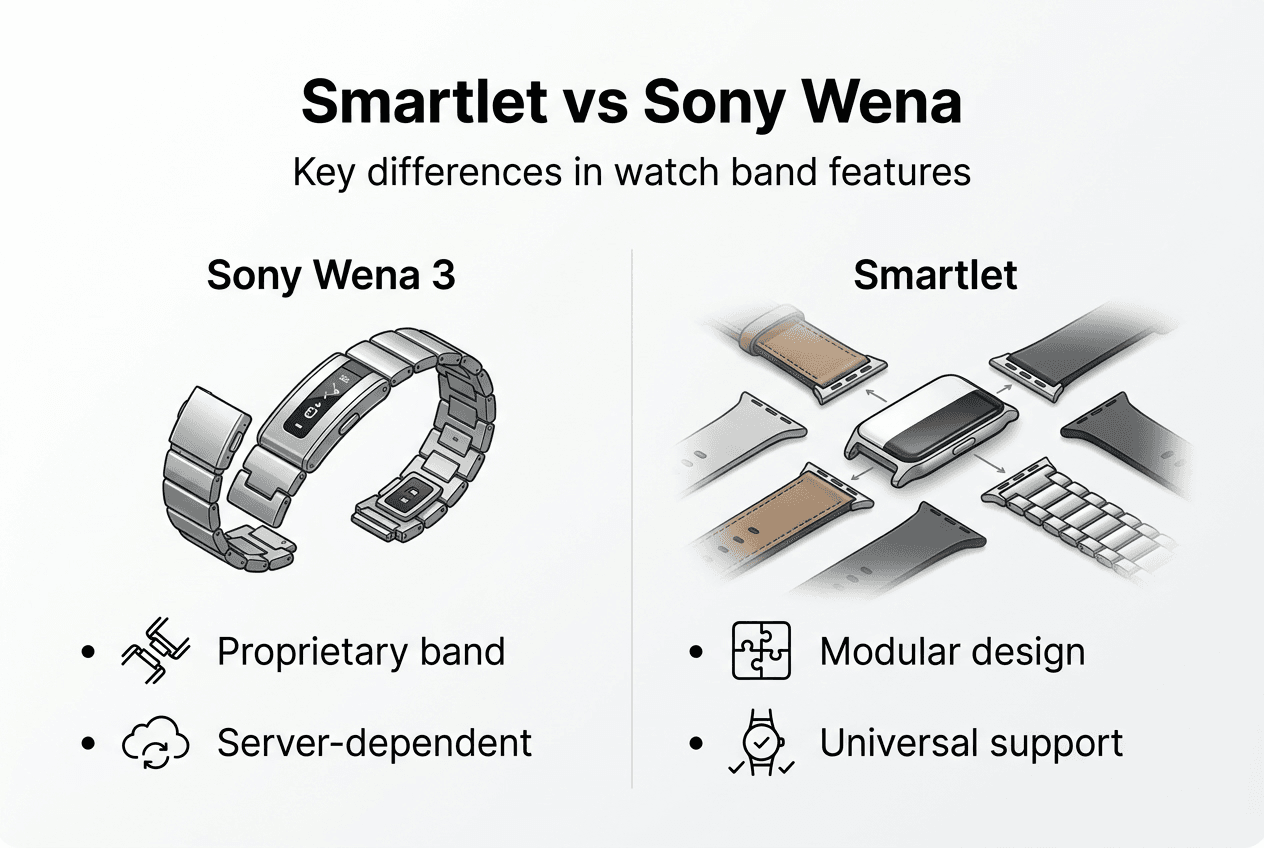
Smartlet vs Sony Wena: feature and compatibility comparison
Smartlet offers broader compatibility because its philosophy is different. Wena turned a watch band into a connected device; Smartlet holds two complete watches on one wrist, a mechanical watch on top and a smartwatch underneath, so either one can be replaced on its own.
One is a fashion watch with heart rate and activity monitoring. The other is a high tech wearable device using a different technology platform. The Band was provided by Wena and was proprietary to their band and this watch.
When the company behind the electronics stopped supporting it, the Wena could no longer carry on as it stood. The Smartlet takes the opposite approach: each watch keeps its own electronics, or none at all, and the bracelet simply holds them, so either one can be replaced as technology evolves. Two watches, one wrist.
Terms compatibility there world
In terms of compatibility there is a world of difference between the two watches. The Wena watch is limited to the Sony universe and won’t work with the Apple Watch, Samsung or any other smartwatch. The Smartlet on the other hand works with any analog watch with a lug width of 18-24mm and is compatible with all current major smartwatch platforms.
So, as we have seen with Wena, almost every of its functions and almost every of its connectivity features required the use of the Sony servers. Well, those have been shut down by Sony, and now all those functions are lost. The good thing for us is that the Smartlet does not need any servers at all, because it is not electronic. All connectivity will be made possible through the Smartlet’s own platform.
Key comparison points:
- Wena Pro: custom band, restricted lug widths, no widespread smartwatch compatibility, server-based; expected to become obsolete by 2026
- Smartlet is a modular strap that fits watches with a lug width of 18 to 24mm. It is compatible with most of the leading smartwatch brands.
Both designs show different options that we have to work with. The Wena design includes some of the smart features we mentioned before like push-notifications and mobile payments directly on the strap, but may mean that the whole service could be lost. The Smartlet smart watch lets you use both the features of an analog watch and those of a smart watch at the same time. The analog watch is here to provide the time keeping feature – its main purpose. The smart watch is then there to provide the connectivity features.
Smartlet is easy to set up and adjust, and leaves room for future watches on either side. The double watch strap concept allows a change of configuration at any time, and the double-sided time approach suits collectors who refuse to choose between heritage and technology.
| Aspect | Sony Wena 3 | Smartlet |
|---|---|---|
| Design | Proprietary integrated band | Modular strap with standard watch adapters |
| Analog watch compatibility | 18mm, 20mm, 22mm only | 18-24mm universal |
| Smartwatch compatibility | None | Apple Watch, Samsung, Garmin, Fitbit, Whoop, Google Pixel |
| Server dependency | Total (setup, services, updates) | None (mechanical adapter) |
| Longevity | Ended February 2026 | Indefinite (modular upgrades) |
| Customization | Fixed band design | Swap any compatible watches |
| Price | 36,300 JPY (~$330) | 299 EUR-549 EUR |
Discover Smartlet: combining luxury and smart innovation cleanly
One of the great conundrums for watch enthusiasts is wanting a beautiful mechanical watch on the wrist at all times, along with a connected device for messages and everything else. Sony tried to answer it with Wena and did a decent job, but the product never became mainstream. The Smartlet modular watch strap takes a different route: one metal link bracelet holds both timepieces on one wrist, keeping the mechanical watch intact while adding modern connectivity. The other options, from hybrid watches to caseback trackers, are compared in can you make an analog watch smart?.
However I believe they and a host of other watch designers have finally been trumped by Smartlet, who’ve created a high tech watch strap that uses ingenious engineering to make it look like you’re wearing, not just one proper timepiece, but two, where one is actually a very decent sounding connected watch.modular watch strapUses precision engineering to hold both timepieces on one wrist, preserving the aesthetic of luxury watchmaking while delivering modern connectivity.
Smartlet comes in three finishes: Classic, Shadow and Titanium. Use the watch compatibility guide to confirm your watch's lug width and that it uses standard spring bars; it covers brands from Seiko and Grand Seiko to Omega and Rolex.
The setup can change with your collection: Smartlet One accessories include additional watch adapters for other watches, a second set of bracelet sides in another finish, and the Clasp, which closes the bracelet when only one watch is worn.
Swap between dress watches and dive watches, change smartwatch bands, or reconfigure entirely based on your daily needs. This flexibility ensures your investment adapts as your collection grows.
You were a Wena user and understood something that the rest of the world does not: there is no need to get rid of your traditional watch in order to have a smartwatch. And that you would like to keep both your traditional and your smartwatch. That is exactly what we came up with at Smartlet, and it is here to stay. Our servers do not go down.
Recommended
- Smartlet One review: the end of compromise - traditional watches and connected tech, united on a single wrist
- Wear a Smartwatch with Your Seiko
- Smartlet, the bracelet that combines a classic and connected watch on the same wrist
- Smartlet: the bracelet that combines a classic and connected watch on the same wrist
- Wear a smartwatch with your Grand Seiko
- How smartwatch sensors work: orientation guide
Featured Articles
No people found
We couldn’t find anything with that term. Please try again.


