


Warum mechanische Uhren überleben: gegen Quarz und Smartwatches

Gründer & CEO, Smartlet – Ingenieur der CentraleSupelec – Concours Lépine 2025, Ausgezeichnet – CES 2026
Inhaltsverzeichnis
- Von der Krise zur Wiedergeburt: die Quarzrevolution und die mechanische Antwort
- Wert neu definieren: Handwerkskunst, Tradition und emotionale Tiefe
- Smartwatches und die neue Welle: Nutzen versus Tradition
- Sammlerharmonie: Mechanisches und Smartes am Handgelenk vereinen
- Was die meisten Tech-Debatten übersehen: warum beide Uhren wichtig sind
- Mechanische Tradition und smarte Innovation nahtlos vereint
- Häufig gestellte Fragen
Wichtigste Erkenntnisse
| Punkt | Details |
|---|---|
| Handwerkskunst vor Funktionalität | Mechanische Uhren haben überlebt, indem sie zu Symbolen für Handwerkskunst, Tradition und Status wurden – nicht nur als Werkzeuge zur Zeitmessung. |
| Smartwatches und Quarz im Vergleich | Quarz demokratisierte die Präzision, Smartwatches fügten Funktionalität hinzu – doch beide zwangen die Mechanik dazu, ihren bleibenden Wert neu zu definieren. |
| Sammler schätzen beides | Heutige Enthusiasten kombinieren mechanische Uhren und Smartwatches, um Tradition, Emotion und moderne Technologie nebeneinander zu genießen. |
| Langlebigkeit und Nachhaltigkeit | Mechanische Uhren können Generationen überdauern und vermeiden Elektroschrott – sie bieten einen Wert, der den digitalen Verschleiß überdauert. |
Mechanische Uhren sollten eigentlich tot sein. Gleich zweimal. Zunächst hätte ein winziger Quarzkristall in den 1970er Jahren beinahe eine gesamte Industrie ausgelöscht. Dann drohte ein leuchtender Touchscreen am Handgelenk, die gesamte Kategorie überflüssig zu machen. Und dennoch stehen wir im Jahr 2026 vor der Tatsache, dass mechanische Uhren 82,5 % des Schweizer Exportwerts ausmachen, während sie weniger als 20 % der versandten Einheiten darstellen. Das ist kein bloßes Überleben. Das ist eine vollständige Neuerfindung.
Von der Krise zur Wiedergeburt: die Quarzrevolution und die mechanische Antwort
Die Quarzkrise war kein langsamer Niedergang. Es war ein Zusammenbruch. Zwischen 1970 und den frühen 1980er-Jahren sank die Schweizer Produktion von 84 Millionen Einheiten auf rund 30 Millionen, und zwei Drittel der Arbeitsplätze in der Schweizer Uhrenindustrie verschwanden schlichtweg. Japanische Hersteller wie Seiko und Casio konnten Quarzwerke weitaus günstiger und präziser produzieren als jedes mechanische Kaliber. Für einen Verbraucher, der einfach nur die Uhrzeit wissen wollte, war die Wahl offensichtlich.
| Merkmal | Mechanisch | Quarz |
|---|---|---|
| Genauigkeit | +/-5 bis 30 Sek./Tag | +/-15 Sek./Monat |
| Produktionskosten | Hoch | Niedrig |
| Stromquelle | Kinetisch/Handaufzug | Batterie |
| Marktauswirkungen (1970er Jahre) | Kurz vor dem Zusammenbruch | Dominantes Wachstum |
| Verfügbarkeit | Unbegrenzt haltbar bei richtiger Pflege | Begrenzt |
Die Reaktion der Branche ließ nicht sofort auf sich warten. Viele Schweizer Häuser schlossen ihre Pforten. Legenden verschwanden. Einen Wendepunkt markierte die Gründung der SMH (heute Swatch Group) im Jahr 1983, die die Swatch als verspieltes, erschwingliches Quarzprodukt auf den Markt brachte. Dieser Schritt war strategisch durchdacht. Indem Swatch den Massenmarkt übernahm, wurden renommierte Marken wie Omega und Longines freigestellt, um etwas zu verfolgen, das Quarz niemals replizieren konnte: Handwerkskunst, Geschichte und Prestige.
„Die Quarzkrise zwang die Schweizer, eine Frage zu stellen, die alles veränderte: Wenn wir weder beim Preis noch bei der Präzision mithalten können, was verkaufen wir eigentlich?"
Die Antwort prägte die nächsten vier Jahrzehnte der Uhrmacherkunst. Schweizer Marken investierten massiv in die Haute Horlogerie und präsentierten aufwendig dekorierte Werke, die durch Saphirglasboden sichtbar waren. Limitierte Editionen und Markengeschichten wurden zu zentralen Marketingpfeilern. Sammler begannen, mechanische Uhren als Wertanlage zu betrachten – nicht nur als Gebrauchsgegenstände. Bei Auktionshäusern stiegen die Preise für vintage Mechanikuhren Jahr für Jahr.
Diese Neuerfindung schuf eine völlig neue Wertkategorie. Der Einfluss des Doppeluhren-Armbands auf die heutige Sammlerkultur ist eine direkte Folge jenes strategischen Schwenks: Wenn man die Konkurrenz funktional nicht übertreffen kann, definiert man neu, was Funktion überhaupt bedeutet. Dual-Watch-Armband-Aufprall
Wert neu definieren: Handwerkskunst, Tradition und emotionale Tiefe
Im Jahr 2023 machten mechanische Uhren 82,5 % des Schweizer Exportwerts aus, obwohl sie weniger als 20 % der Gesamtstückzahl ausmachten. Diese Zahl ist bemerkenswert. Sie bedeutet, dass ein einziges Segment Premiumpreise erzielt, die keine volumenorientierte Quarzmarke erreichen kann. Der Grund liegt in der Emotion, nicht in der Technik.
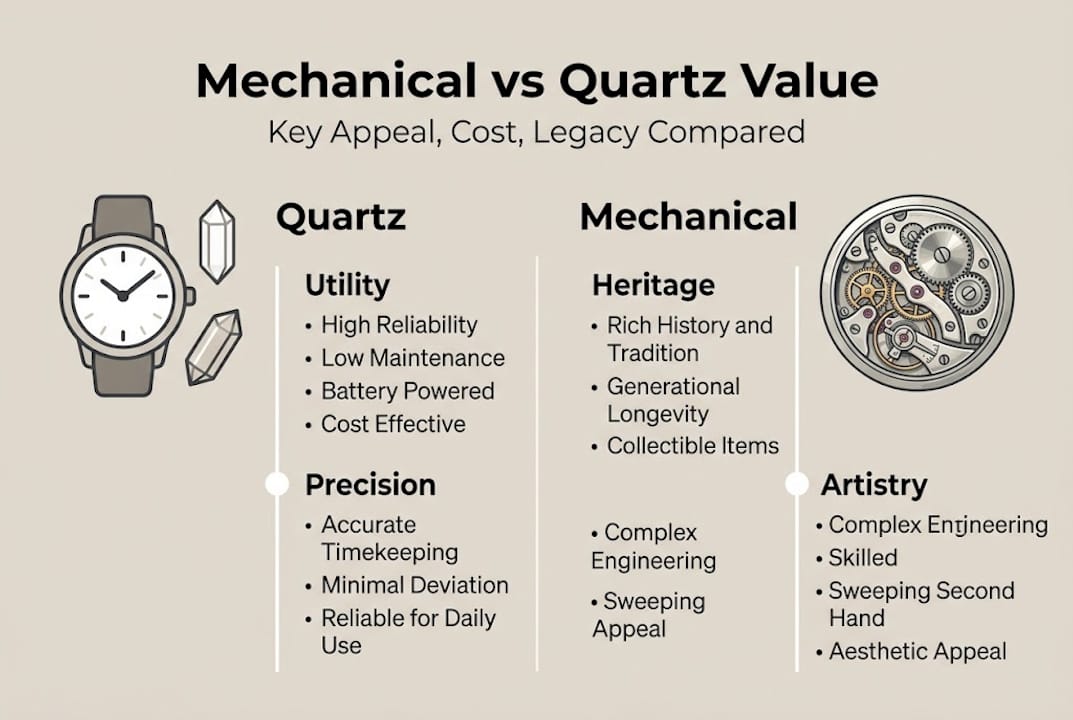
| Wertdimension | Quarz | Mechanisch |
|---|---|---|
| Hauptvorteil | Funktionalität, Präzision | Tradition, Handwerkskunst |
| Sammlerinteresse | Niedrig bis mittel | Hoch und wachsend |
| Wiederverkaufswert | Verliert schnell an Wert | Wird oft geschätzt |
| Emotionale Verbindung | Minimal | Tiefgründig und persönlich |
| Reparierbarkeit | Begrenzt | Unbefristet mit Service |

Eine mechanische Uhr belohnt Geduld. Sie aufzuziehen, den Rotor spüren zu lassen, den gleichmäßigen Lauf des Sekundenzeigers zu beobachten statt seines Taktens: Diese Rituale verbinden den Träger mit dem Objekt. Sie wird zum Begleiter, nicht zum Gadget. Viele Sammler beschreiben das Erben der Automatikuhr ihres Großvaters als den Moment, in dem sie sich in die Uhrmacherkunst verliebt haben. Kein Quarzstück, so präzise es auch sein mag, kann diesen emotionalen Transfer replizieren.
Wenn Sie eine mechanische Uhr als langfristige Anschaffung in Betracht ziehen, fragen Sie den Verkäufer nach der Servicehistorie. Ein dokumentierter Wartungsnachweis steigert sowohl den ideellen als auch den Wiederverkaufswert, und ein gut gepflegtes Uhrwerk kann tatsächlich Generationen überdauern.
Patek Philippes berühmte Kampagne „You never actually own a Patek Philippe, you merely look after it for the next generation" ist kein Zufall. Sie deutet den Kauf als Verantwortung gegenüber der nächsten Generation um – nicht als bloßen Konsum. Diese Positionierung, verbunden mit der Kombination klassischer und moderner Lösungen für zeitgenössische Sammler, zeigt, wie sich die Uhrenbranche weiterentwickelt, ohne ihre Wurzeln zu vergessen. klassisch und smart vereint
Smartwatches und die neue Welle: Nutzen versus Tradition
Apple allein verkauft jährlich rund 200 Millionen Smartwatches – eine Stückzahl, die die gesamte Schweizer Uhrenindustrie in den Schatten stellt. Dennoch bricht der Markt für mechanische Uhren diesmal nicht ein. Denn Smartwatches und mechanische Uhren konkurrieren nicht um dasselbe.
Smartwatches überzeugen durch Echtzeit-Gesundheitsüberwachung, Benachrichtigungen, Navigation und digitale Alltagshelfer. Software-Updates erweitern den Funktionsumfang kontinuierlich. Mechanische Uhren hingegen bieten generationenübergreifende Langlebigkeit bei fachgerechter Wartung, keinerlei Software-Obsoleszenz, einen hohen Sentimentalwert sowie Sammlerwert und ein haptisches Analogerlebnis, das einen auf wohltuende Weise entschleunigt.
Eine mechanische Uhr ähnelt eher einer Kathedrale als einem Taschenrechner. Sie wurde gebaut, um zu überdauern, zu begeistern und Bedeutung über die Zeit hinweg zu tragen. Eine Smartwatch ist ein leistungsstarkes Alltagswerkzeug. Beide haben ihren Platz im Leben eines Sammlers verdient.
Tragen Sie Ihre Smartwatch beim Sport und an arbeitsreichen Tagen, wenn Benachrichtigungen und Gesundheitsdaten wirklich wichtig sind. Wechseln Sie für Abendessen, Reisen und besondere Anlässe zu Ihrer mechanischen Uhr, wenn es auf Ausstrahlung und Eleganz ankommt. Sie müssen sich nicht für eine Seite entscheiden.
Wer sich mit der Frage Smartwatch oder Analoguhr beschäftigt, stößt oft auf dieselbe Erkenntnis: Der Kontext entscheidet, welche Uhr an einem bestimmten Tag die bessere Wahl ist. Die interessantere Frage ist, wie hybride Lösungen entstehen, die beiden Ansprüchen gleichzeitig gerecht werden. Smartwatch oder analogHybridlösungen
Sammlerharmonie: Mechanisches und Smartes am Handgelenk vereinen
Der Aufstieg von Hybridmodellen und Dual-Wear-Armbändern spiegelt einen echten kulturellen Wandel wider. Gen Z und Millennials, die mit Smartphones aufgewachsen sind, treiben gleichzeitig eine leidenschaftliche Analog-Renaissance voran. Sie streamen Musik und tracken ihren Schlaf – und jagen gleichzeitig Vintage-Seikos hinterher und sparen für Einstiegs-Schweizer-Mechaniken. Der scheinbare Widerspruch ist keiner. Es ist Personalisierung.
Ein praktischer Ansatz zur Integration beider in Ihre Sammlung und Ihren Alltag:
- Analysieren Sie Ihren Uhrenbedarf je nach Kontext. Ermitteln Sie, welche Situationen Funktionalität erfordern und in welchen Erbe und Stil Vorrang haben. Prüfen Sie Ihren Uhrenbedarf nach Anlass.
- Bauen Sie um ein mechanisches Kernstück herum. Wählen Sie ein mechanisches Uhrwerk, das Sie wirklich bewegt – etwas, das Sie mit Stolz jahrzehntelang tragen würden. Dies wird Ihr Ankerstück. Rund um ein zentrales mechanisches Element aufbauen.
- Wählen Sie eine Smartwatch nach rein funktionalen Gesichtspunkten. Versuchen Sie nicht, Ihre Smartwatch so stilvoll zu gestalten, dass sie Ihre mechanische Uhr ersetzen könnte. Lassen Sie sie zweckmäßig sein und hervorragend in dem, was sie tut. Wählen Sie eine Smartwatch für maximale Funktionalität.
- Entdecken Sie Dual-Wear-Lösungen. Modulare Riemenadapter ermöglichen es Ihnen nun, beide Uhren gleichzeitig zu tragen – ganz ohne dauerhafte Veränderungen an einer der beiden Uhren.
- Engagieren Sie sich in Sammler-Communities. Foren, Instagram-Accounts und Uhrentreffen verbinden Sie mit anderen, die dasselbe Integrationsproblem auf kreative Weise gelöst haben.
Jenseits praktischer Überlegungen wandelt sich die Denkweise von Sammlern hin zur Nachhaltigkeit. Eine mechanische Uhr ist wohl eines der nachhaltigsten Luxusobjekte, die man besitzen kann: reparierbar, aufrüstbar und darauf ausgelegt, ihren Besitzer zu überdauern. Dieses Wertesystem spricht jüngere Sammler, die bewusst konsumieren, zutiefst an. Das von Smartlet entwickelte Doppelarmband-Konzept zeigt, wie das gleichzeitige Tragen beider Uhren zu etwas Elegantem statt Ungelenkem verfeinert werden kann. Zwei-Riemen-Konzept
"Die anspruchsvollsten Sammler von heute sind nicht diejenigen, die neue Werkzeuge ablehnen. Es sind diejenigen, die sie zu ihren eigenen Bedingungen einsetzen, ohne das zu verändern, was sie lieben."
Was die meisten Tech-Debatten übersehen: warum beide Uhren wichtig sind
Die meisten Debatten stellen dies als Wettbewerb dar. Alt gegen Neu. Tradition gegen Innovation. Doch diese Sichtweise verfehlt die emotionale Logik, die Sammler wirklich antreibt. Sammler besitzen beides – Smartwatches für den Alltag und mechanische Uhren für besondere Anlässe und Emotionen. Dieses Verhalten sagt uns alles.
Die Quarzkrise hätte die mechanische Uhrmacherei beinahe zerstört, weil Quarz auf demselben Terrain konkurrierte: erschwingliche Zeitanzeige. Smartwatches begehen diesen Fehler nicht. Sie bieten etwas völlig anderes und schärfen damit paradoxerweise das Argument, warum eine mechanische Uhr von Bedeutung ist. Wenn eine Smartwatch für 500 EUR die Gesundheit überwachen und den Kaffee bezahlen kann, wird eine mechanische Uhr für 5.000 EUR ganz offensichtlich nicht aus praktischen Gründen gekauft. Sie wird wegen ihrer Bedeutung gekauft.
Innovation erweitert die Wertschätzung, anstatt sie zu ersetzen. Indem Smartlet es Ihnen ermöglicht, Ihre Uhren ohne Kompromisse gemeinsam am Handgelenk zu tragen, beweist es, dass die Zukunft der Uhrmacherkunst keine Entweder-oder-Entscheidung ist. Die nächste Generation von Sammlern wird die Tradition nicht aufgeben. Sie wird mit ihr komponieren. Verbinden Sie Ihre Uhren
Mechanische Tradition und smarte Innovation nahtlos vereint
Der modulare Riemenadapter Smartlet ist aus gebürstetem SS316L-Stahl und Titan der Klasse 2 gefertigt und über einen Standard-Federsteg mit jeder Uhr zwischen 18 und 24 mm Stegbreite kompatibel. Keine Modifikation an der Uhr erforderlich. Smartlet wurde mit der Bronzemedaille beim Concours Lépine 2025 ausgezeichnet und auf der CES 2026 präsentiert. Drei Versionen: Classic (299 EUR), Shadow (399 EUR) und Titanium (549 EUR). Smartlet ModularmbandKlassischSchattenTitan
Entdecken Sie die gesamte Auswahl an Uhren-Accessoires oder überprüfen Sie die Smartwatch-Kompatibilitätsleitfaden um Ihre ideale Konfiguration zu finden. Nicht wählen. Komponieren.
Empfohlen
- Mechanische Uhr vs. Smartwatch: Beides tragen – ohne Kompromisse
- Das Uhrenarmband im Jahr 2026 ist das, was der Sneaker 1993 war
- Balancing Apple Watch EKG und mechanisches Prestige gelöst
- Smartwatch vs. vernetzter Ring: Warum Displays und Sensoren entscheidend sind
- Alle kompatiblen mechanischen Uhrenmarken
Empfohlene Artikel
No people found
We couldn’t find anything with that term. Please try again.


