


Le VO2 max sur smartwatch est-il assez précis pour s'entraîner sérieusement ?

Fondateur & PDG, Smartlet - Ingénieur CentraleSupelec - Concours Lépine 2025, Lauréat - CES 2026
Table des matières
- Comment les montres connectées estiment le VO2 max : la science derrière les chiffres
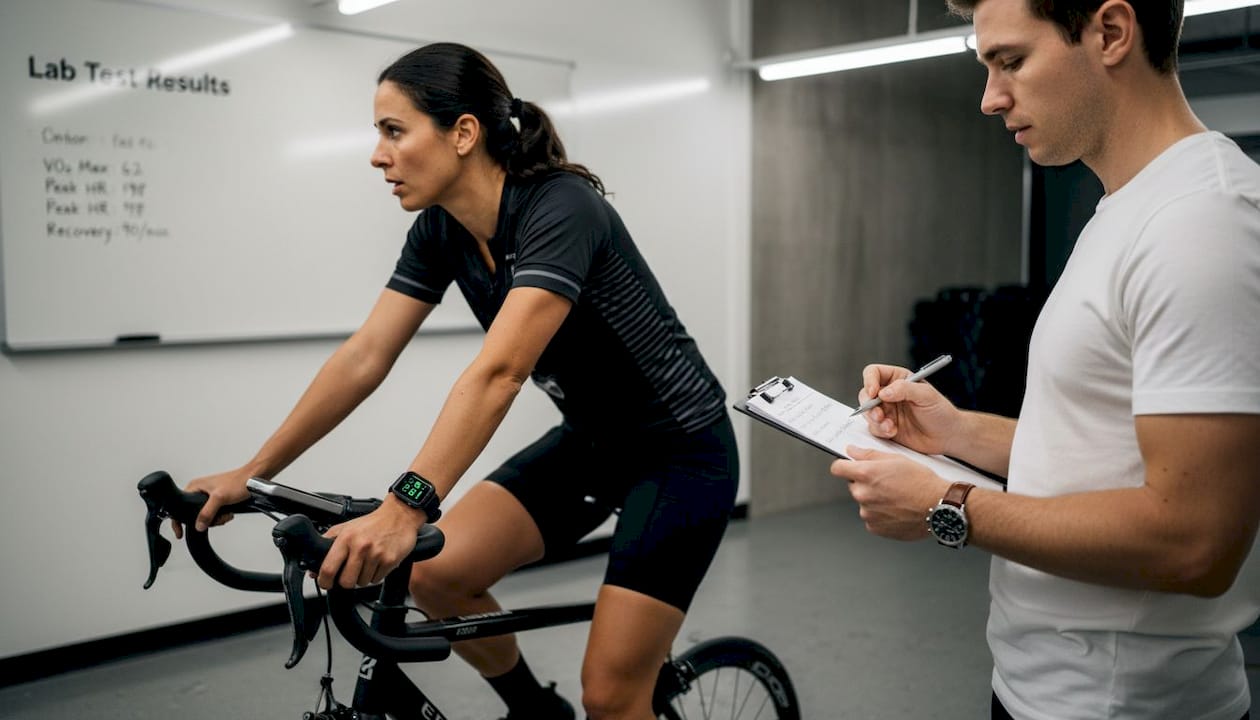
- How accurate are smartwatch VO2 max estimates compared to lab testing?
- Qui peut se fier aux mesures de VO2 max d'une montre connectée, et qui ne le devrait pas ?
- Comment maximiser la précision et la valeur d'entraînement du VO2 max de votre montre connectée
- La vérité qui dérange : courir après les chiffres absolus passe à côté de l'essentiel
- Améliorez votre entraînement et votre style avec des solutions de montre connectée modulaires
- Foire aux questions
Points clés
| Point | Détails |
|---|---|
| La VO2 max est fondée sur des données probantes | Les estimations des montres connectées reposent sur des algorithmes validés et ne sont pas de simples arguments marketing. |
| Idéal pour suivre les tendances | Pour la plupart des utilisateurs, les tendances de la VO2 max fournissent des informations exploitables sur la condition physique, même si les valeurs absolues peuvent varier. |
| La précision dépend du type d'utilisateur | Les athlètes modérés et récréatifs obtiennent des données fiables, tandis que les athlètes de performance font face à des taux d'erreur plus élevés. |
| Le matériel et la technique comptent | Des données d'entrée précises, des sangles pectorales et des séances répétées permettent d'optimiser la valeur de VO2 max de votre montre. |
| Luxe et performance peuvent s'allier | Grâce à des solutions modulaires, vous pouvez profiter à la fois d'un attrait esthétique et de métriques avancées dans votre parcours fitness. |
La plupart des athlètes sérieux et des collectionneurs supposent que le VO2 max affiché sur une montre connectée est soit un chiffre marketing habile, soit une estimation approximative sur laquelle il ne vaut pas la peine de se fier. La réalité est plus nuancée et, franchement, plus encourageante. Les montres connectées estiment le VO2 max à l'aide d'algorithmes sous-maximaux basés sur la fréquence cardiaque, le GPS, le dénivelé et les données personnelles de l'utilisateur, plutôt qu'en reproduisant un test sur tapis roulant en laboratoire. Cette distinction est d'une importance capitale dans la façon dont vous interprétez et utilisez ce chiffre.
Comment les montres connectées estiment le VO2 max : la science derrière les chiffres
La VO2 max est le volume maximal d'oxygène que votre corps peut consommer par kilogramme de poids corporel par minute lors d'un effort intense. Les tests en laboratoire la mesurent directement à l'aide d'un chariot métabolique et d'un protocole d'effort maximal. Les montres connectées empruntent une autre voie, en utilisant des protocoles sous-maximaux pour estimer votre consommation maximale théorique d'oxygène.
Plutôt que de vous pousser à l'épuisement, les montres connectées mesurent votre réponse cardiaque par rapport à votre allure et à votre vitesse GPS sur au moins 15 minutes de course en extérieur. L'algorithme extrapole ensuite votre consommation maximale théorique d'oxygène. Garmin s'appuie sur des méthodes propriétaires développées par Firstbeat Analytics, l'une des références les plus respectées en physiologie des objets connectés. Firstbeat Analytics
Voici ce dont l'algorithme a besoin pour fonctionner correctement :
- Un profil personnel précis : l'âge, le poids et la fréquence cardiaque au repos influencent tous la référence du modèle. Profil personnel précis :
- Intensité suffisante : vous devez atteindre environ 70 % de votre fréquence cardiaque maximale pendant la course. Intensité suffisante :
- La cohérence du GPS : les courses en extérieur sur terrain plat ou prévisible fournissent à l'algorithme des données de vitesse plus précises. Cohérence GPS :
- Durée : les sessions de moins de 15 minutes produisent des estimations peu fiables. Durée :
- Qualité du capteur : les capteurs optiques au poignet (PPG) génèrent davantage de bruit qu'une ceinture thoracique, notamment lors des efforts à haute intensité. Qualité du capteur :
Comprendre précision des capteurs de la montre connectée est essentielle. Les capteurs optiques de fréquence cardiaque fonctionnent en projetant de la lumière à travers la peau et en mesurant les variations du flux sanguin. Ils sont pratiques, mais sensibles aux artefacts de mouvement, notamment lors d'intervalles rapides ou de musculation. Une ceinture thoracique contourne entièrement ce problème en lisant directement les signaux électriques du muscle cardiaque.
| État | Impact sur l'estimation du VO2 max |
|---|---|
| Course GPS en extérieur, 15 min ou plus | Les plus fiables |
| Tapis de course avec capteur de pas | Fiabilité modérée |
| Courte séance en intérieur | Peu fiable |
| Poignet FC uniquement, haute intensité | Signal plus bruyant |
| Sangle pectorale couplée | Meilleure qualité de signal |
Mettez à jour votre poids, votre âge et votre fréquence cardiaque maximale dans les paramètres de votre appareil. Associez-le à une ceinture thoracique lors des trois ou quatre premières séances afin de fournir à l'algorithme les données de départ les plus précises possible.
How accurate are smartwatch VO2 max estimates compared to lab testing?
La métrique de référence utilisée par les chercheurs est le MAPE, ou erreur absolue moyenne en pourcentage. Un MAPE plus faible indique une meilleure précision. Une autre mesure clé est le CCI, le coefficient de corrélation intraclasse, qui reflète la cohérence entre la montre et le laboratoire sur plusieurs sujets. Un CCI supérieur à 0,80 est généralement considéré comme solide.
Garmin et Firstbeat revendiquent une précision de 95 % par rapport aux conditions de laboratoire, avec une erreur inférieure à 3,5 ml/kg/min dans des environnements contrôlés. Des recherches indépendantes situent le MAPE réel entre 5 % et 10 %, ce qui est raisonnable pour un appareil porté au poignet. L'Apple Watch a tendance à sous-estimer le VO2 max avec un biais constant d'environ 9,7 ml/kg/min, un écart suffisamment important pour influencer les décisions relatives aux zones d'entraînement si l'on s'y fie sans recul. Garmin et Firstbeat revendiquent une précision de 95 %L'Apple Watch a tendance à sous-estimer le VO2 max
| Appareil | MAPE typique vs. laboratoire | Biais connu | Idéal pour |
|---|---|---|---|
| Garmin Fenix / Forerunner | 5 à 10 % | Légère surestimation chez les athlètes | Suivi des tendances et conseils de zone |
| Apple Watch Series 9+ | 12 à 18 % | Sous-estime d'environ 9,7 ml/kg/min | Tendances générales en matière de santé |
| Polar Vantage V3 | 6 à 9 % | Minimal chez les utilisateurs récréatifs | Athlètes récréatifs et amateurs |
| Test de laboratoire (chariot métabolique) | 0 % (référence) | None | Précision absolue |
"Les métriques VO2 max des montres connectées ne remplacent pas les tests en laboratoire. Leur véritable intérêt réside dans le suivi de l'évolution de la condition physique au fil du temps, et non dans la précision d'un chiffre isolé."
Une étude MDPI de 2024 sur les métriques de condition physique portables a montré que, bien que les valeurs absolues variaient de manière significative selon les appareils, les tendances directionnelles sur quatre semaines ou plus étaient cohérentes et statistiquement significatives pour toutes les marques testées.
Si votre Garmin affiche 52 ml/kg/min, n'utilisez pas ce chiffre pour vous vanter ou pour définir des zones d'entraînement rigides. En revanche, s'il passe de 52 à 56 après huit semaines d'entraînement structuré, cette progression est significative et mérite d'être prise en compte.
Qui peut se fier aux mesures de VO2 max d'une montre connectée, et qui ne le devrait pas ?
Les adultes pratiquant une activité récréative ou ayant un niveau d'entraînement modéré obtiennent les meilleurs résultats, avec un MAPE généralement compris entre 3 % et 7 %. Pour quelqu'un qui court trois à cinq fois par semaine et suit sa progression physique générale, ce niveau de précision est véritablement utile. Vous pouvez vous fier à la tendance, ajuster votre charge d'entraînement en conséquence, et avoir la certitude qu'une progression soutenue à la hausse reflète une réelle adaptation. Adultes pratiquant une activité récréative ou modérément entraînés
Les athlètes d'élite et de haut niveau font face à une réalité bien différente. Les algorithmes sont construits autour de moyennes populationnelles, et les individus très entraînés se situent souvent en dehors de ces distributions. Un triathlète compétitif avec un VO2 max réel de 72 ml/kg/min pourrait obtenir des valeurs allant de 65 à 77, selon l'appareil et le jour. Utiliser cette plage pour définir des allures d'intervalles précises pourrait en réalité nuire à la planification des performances.
Voici un aperçu rapide de qui devrait utiliser quoi :
- Les utilisateurs soucieux de leur santé et les coureurs occasionnels : utilisez le VO2 max comme principal baromètre de forme physique. Les tendances mensuelles sont fiables et motivantes. Les utilisateurs soucieux de leur santé et les coureurs occasionnels :
- Athlètes amateurs s'entraînant pour des compétitions : Combinez les tendances de VO2 max avec smartwatch d'entraînement sensibilisation. Évitez d'utiliser des valeurs absolues pour prédire avec précision l'allure de course.
- Athlètes de performance et entraîneurs : Considérez la VO2 max de votre smartwatch comme une donnée complémentaire. Validez-la avec un test en laboratoire au moins deux fois par an.
- Les passionnés de montres de luxe qui utilisent des modèles avancés comme la Garmin Fenix 8 bénéficient d'une fiabilité métrique solide associée à une esthétique haut de gamme. Les données de tendance sont fiables ; les chiffres absolus sont indicatifs. Les passionnés de montres de luxe utilisant des modèles haut de gamme :
Si vous portez votre montre connectée en continu plutôt que seulement pendant vos entraînements, l'appareil collecte des données de variabilité de la fréquence cardiaque au repos qui affinent progressivement son modèle de VO2 max. Le port continu améliore véritablement la précision prédictive de l'algorithme au fil du temps.
Comment maximiser la précision et la valeur d'entraînement du VO2 max de votre montre connectée
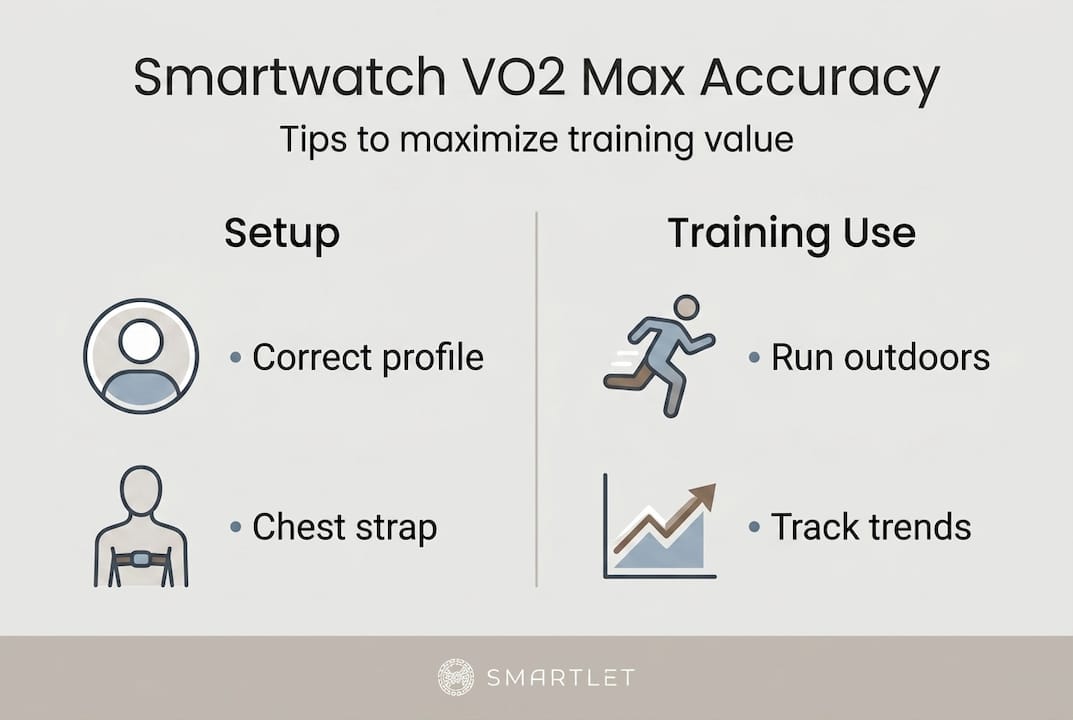
Le facteur le plus déterminant pour obtenir des mesures fiables n'est pas l'appareil lui-même. C'est la qualité des données que vous lui fournissez. Une fréquence cardiaque maximale précise, un poids corporel correctement renseigné et des sorties régulières en plein air avec GPS constituent la base d'une estimation fiable.
- Mettez à jour votre profil avant de commencer : Définissez votre poids actuel, votre âge et une fréquence cardiaque maximale précise. Utilisez la formule 208 moins 0,7 fois votre âge comme estimation de départ, puis affinez-la après un effort intense.
- Associez-le à une ceinture cardio-thoracique pour vos séances d'étalonnage. Faites-le lors des deux à quatre premières sessions en extérieur. Cela fournit à l'algorithme un signal de fréquence cardiaque net, sans interférence du bruit optique. Associez-le à une ceinture thoracique pour vos courses d'étalonnage :
- Courez régulièrement en plein air. Visez au moins trois sorties par semaine avec suivi GPS, à une intensité modérée, soit environ 70 % de votre fréquence cardiaque maximale, pour une durée de 20 minutes ou plus. Courez régulièrement en plein air :
- Portez votre montre en continu. Cela permet une collecte passive de données pendant le repos, le sommeil et les activités quotidiennes, ce qui améliore la précision du suivi de la VFC et affine le modèle sous-jacent. Portez votre montre en continu :améliorer la précision du suivi de la VRC
- Suivez sur une période d'au moins quatre semaines. Les lectures en session unique ne sont que des instantanés. C'est la tendance sur quatre semaines qui révèle les véritables enseignements. Suivre sur une période minimale de quatre semaines :
Pour les collectionneurs et les sportifs qui recherchent à la fois l'esthétique et la fonctionnalité, le défi est bien concret. Porter simultanément une montre mécanique et une montre connectée sans un ensemble encombrant et peu pratique a longtemps rimé avec compromis. Conseils d'optimisation pour smartwatch pointent de plus en plus vers des solutions modulaires qui vous permettent de composer votre configuration de poignet plutôt que de choisir entre elles.
- Portez votre montre connectée au poignet non dominant pour des mesures de fréquence cardiaque plus stables.
- Évitez les sangles lâches pendant l'entraînement ; le capteur optique nécessite un contact constant avec la peau.
- Après des séances de haute intensité, attendez deux à quatre heures avant d'obtenir une mise à jour de votre VO2 max.
Utilisez les données de VO2 max pour analyser les tendances sur l'ensemble des blocs d'entraînement, et non pour atteindre des seuils numériques précis. Une tendance à la hausse soutenue sur quatre semaines vaut plus que n'importe quelle mesure isolée, quelle que soit sa valeur.
La vérité qui dérange : courir après les chiffres absolus passe à côté de l'essentiel
La communauté santé et performance a tendance à se focaliser sur les valeurs absolues de VO2 max de la même façon que les collectionneurs de montres s'obsèdent sur le diamètre du boîtier au dixième de millimètre près. Ces deux habitudes génèrent davantage d'anxiété que de discernement. Un VO2 max de 51 contre 53 ml/kg/min, compte tenu d'une marge d'erreur de mesure de 5 à 10 %, ne vous apprend presque rien d'exploitable. Ce qui est réellement instructif, c'est d'observer cette valeur progresser régulièrement au fil d'une saison d'entraînement.
Le véritable cadeau de cette technologie, c'est la motivation et la régularité. Lorsque votre montre reflète de véritables progrès physiologiques, elle renforce l'habitude de s'entraîner régulièrement. Cette boucle de rétroaction est le véritable mécanisme d'amélioration. Surveillance cardiaque par smartwatch à ce niveau, l'accessibilité transforme véritablement la façon dont les gens prennent en charge leur propre santé.
Pour ceux qui accordent de l'importance à la fois à la précision technique et à la performance sportive, la question n'a jamais été de savoir s'il fallait se fier à un seul chiffre. Elle était de savoir si l'outil soutient une vie menée selon les exigences que nous nous imposons. C'est le cas. Utilisez-le avec discernement.
Porter la montre connectée aussi régulièrement que possible et activer toutes ses fonctions est le facteur le plus important pour générer de bonnes données pour l'algorithme.
Si vous souhaitez obtenir des données de VO2 max cohérentes et fiables, votre configuration est aussi importante que vos efforts. Porter votre montre connectée en permanence et correctement est le meilleur moyen de fournir à l'algorithme les données dont il a besoin pour vous être vraiment utile.
Pour les athlètes amateurs, utilisez les tendances de VO2 max pour définir vos zones d'entraînement. Pour les athlètes de haut niveau, validez périodiquement ces données avec un test en laboratoire au moins deux fois par an. guide de compatibilité des montres connectéesAssociations de montres connectées RolexClassiqueOmbreTitane
Recommandé
- Entraînement au marathon et suivi par montre connectée : les données qui font la différence entre ceux qui franchissent la ligne et les autres
- Intégrer la surveillance de la VRC et les montres mécaniques
- Surveillez la VFC et coachez avec assurance grâce à Smartlet
- Comment la surveillance cardiaque par smartwatch sauve des vies : données mondiales
- Compatibilité Garmin Forerunner avec Smartlet
Articles stars
No people found
We couldn’t find anything with that term. Please try again.


