


Unlock body temperature trends for early illness detection

TL;DR:
- Wearable devices can detect illness signs up to three days before symptoms appear using temperature and heart data.
- Individual baseline and trend analysis are crucial, as absolute temperature readings vary per person and environment.
- Combining temperature with other metrics like HRV and heart rate improves early illness prediction accuracy.
Your wearable can flag an incoming illness up to three days before you feel a single symptom. That is not a marketing claim, it is increasingly supported by real physiological data from devices worn daily by athletes and collectors alike. Body temperature trends, combined with heart rate and recovery signals, form one of the most accurate early-warning systems available today. The challenge is understanding what the data actually means, how to read it with confidence, and how to keep wearing the timepiece you love without interrupting your health tracking for even one night.
Table of Contents
- How your body temperature really works: Baselines and daily rhythms
- Wearables vs. watches: How modern devices track temperature trends
- What temperature trends can predict: From early illness to chronic conditions
- Interpreting trends: When to trust, question, or act on your data
- Why the best-equipped watch lovers see temperature trends differently
- Seamlessly connect smart tracking with classic style
Key Takeaways
| Point | Details |
|---|---|
| Personal baseline matters | Tracking your own average body temperature gives earlier and more meaningful insights than generic population norms. |
| Early warnings possible | Wearables can alert you up to three days before you notice any symptoms if you understand your temperature trends. |
| Context is key | Not every temperature jump signals illness, factors like alcohol and stress also cause changes, so trends always require context. |
| Smart and stylish coexist | Health tracking doesn’t require sacrificing luxury watch style; modular solutions blend both seamlessly. |
How your body temperature really works: Baselines and daily rhythms
Most people think 98.6°F (37°C) is “normal.” In practice, that number is more of a population average than a personal truth. Body temperature fluctuates with your circadian rhythm throughout the day, hitting its lowest point around 4 AM and peaking near 6 PM. That swing can span nearly 1°F in a single day, for a healthy person doing nothing unusual.
What matters even more is that individual baselines vary significantly. Two equally healthy people can have resting temperatures that differ by up to 0.5°C (roughly 0.9°F). This is why “am I running a fever” is not really the right question. A better question is: “Am I running above my normal?”
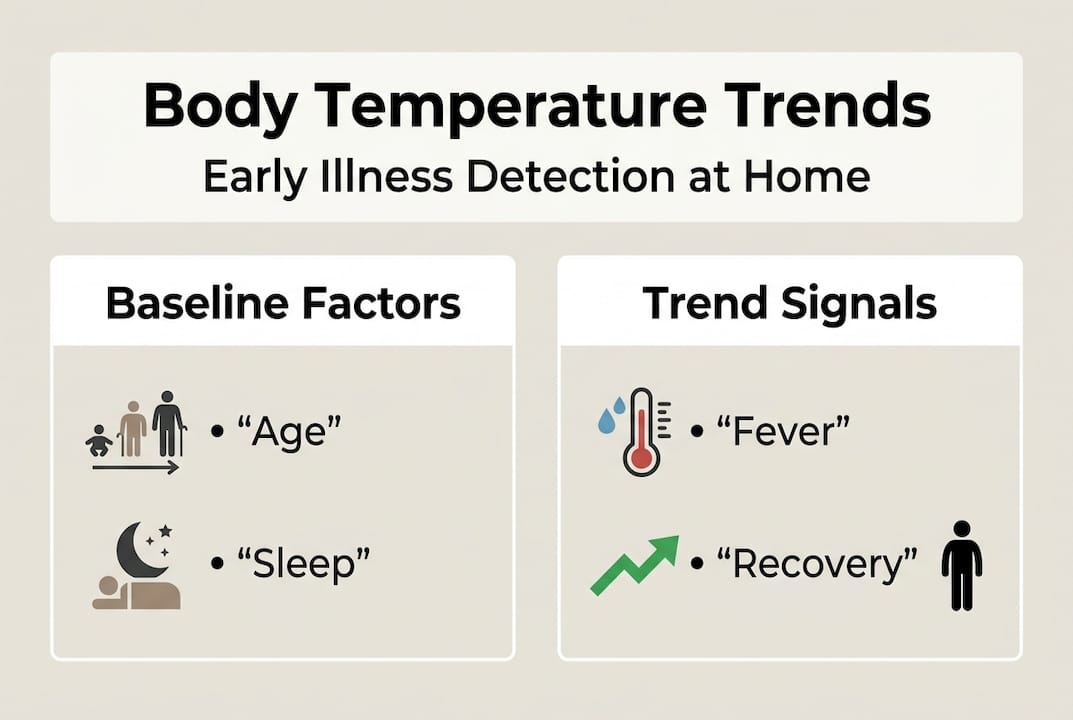
Measurement method also changes everything. Here is a quick comparison:
| Method | Typical baseline range | Reliability for trend tracking |
|---|---|---|
| Rectal | 97.9°F to 100.4°F | Highest accuracy, impractical daily |
| Oral | 97.2°F to 99.9°F | Good for spot checks |
| Skin (wrist/finger) | 88°F to 95°F (peripheral) | Best for trend patterns over time |
Skin temperature, the type tracked by most wearables, runs cooler than core body temperature. It is also more responsive to environmental changes. That variability is exactly why devices measure relative change rather than absolute readings.
Key facts worth knowing:
- Your temperature nadir (lowest point) occurs around 4 AM, your peak near 6 PM
- Individual “normal” can differ by up to 0.5°C across healthy adults
- Skin temperature at the wrist or finger is peripheral, not core, and changes faster with environment
- Devices like wearable tech fashion products track deviation from your baseline, not a population norm
Statistic callout: Research shows that the difference between your coolest and warmest moment of the day can exceed 0.9°F, even in perfect health, which is why single-reading snapshots tell you almost nothing about illness.
Your personal baseline, calculated over multiple nights of sleep data, is the only meaningful reference point. Everything else is noise.
Wearables vs. watches: How modern devices track temperature trends
Not all devices measure temperature the same way, and the differences matter for accuracy and lifestyle fit.
The Oura Ring Gen 3 measures skin temperature at the finger, a location with higher blood vessel density and lower motion artifact than the wrist. The result is more stable nightly readings. Apple Watch Series 10 and Fitbit Sense 2 use wrist-based sensors, which are more affected by arm movement, bedding pressure, and room temperature. Garmin Fenix 8 adds wrist skin temperature to a broader health suite, combining it with HRV and respiration for a fuller picture.
Where each device sits on your body affects the quality of its data:
| Device | Sensor location | Strengths | Limitations |
|---|---|---|---|
| Oura Ring Gen 3 | Finger | High signal stability, low motion noise | No display, requires phone |
| Apple Watch Series 10 | Wrist | Sleep tracking, ecosystem integration | Motion/environment variability |
| Fitbit Sense 2 | Wrist | Accessible price, solid trend graphs | Less granular than Oura |
| Garmin Fenix 8 | Wrist | Multi-metric fusion, athlete-focused | Bulkier form factor |
Wearables like Oura and Apple Watch track distal skin temperature and aggregate data across nights to establish a personal trend. Most devices need 5 to 21 nights of consistent wear before the algorithm has enough data to flag meaningful deviations.
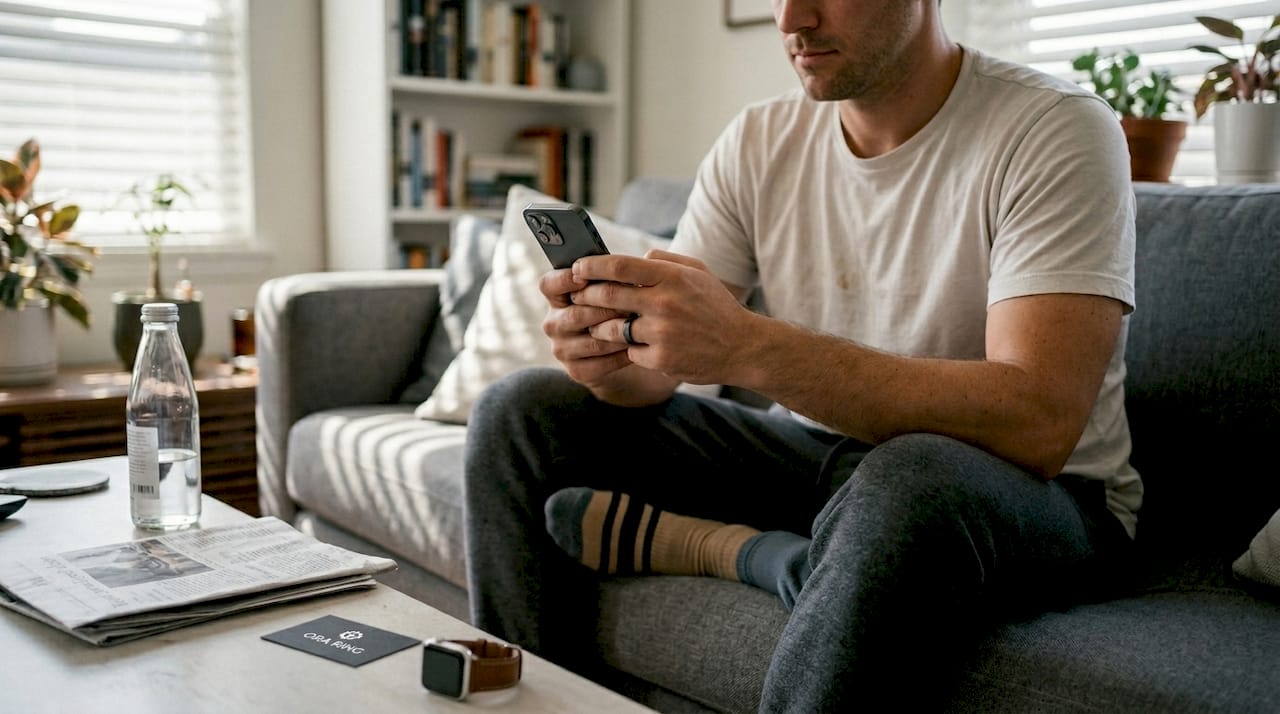
This is where the comparison between a smartwatch vs connected ring becomes practical rather than theoretical. A ring sits more securely at night, reducing confounders. A smartwatch wins on display and daytime context. But both require continuous wear to build a useful baseline.
And that is the critical point most reviews miss: data without continuity is useless. If you swap your wearable out to wear your Rolex Submariner on a Saturday, your baseline has a gap. Miss enough nights, and the device resets its trend window.
Pro Tip: For HRV monitoring with watches, the same continuity rule applies. Pairing your health tracker with a modular adapter, so both your smartwatch and mechanical watch stay on the same wrist setup, eliminates tracking gaps without compromising your style.
What temperature trends can predict: From early illness to chronic conditions
The practical value of temperature tracking becomes real when you see what it can catch early.
For acute illness, the signal is clearest. A sustained skin temperature rise of 1 to 2°F, combined with elevated resting heart rate and reduced HRV, can predict illness 1 to 3 days before any symptom appears. This pattern has been observed with COVID-19, influenza, and bacterial infections.
Here is how the early prediction sequence typically unfolds:
- Night 1: Resting heart rate ticks up 3 to 5 BPM above baseline with no obvious cause
- Night 2: Skin temperature rises 0.5 to 1.5°F above your personal baseline
- Night 3: HRV drops noticeably; readiness score falls sharply
- Day 3 to 4: First physical symptoms appear, fatigue, sore throat, mild fever
For watch heart monitoring, this cascade is already well-documented. Temperature adds an earlier and often more specific signal.
For chronic conditions, the picture is more nuanced. Diabetes, for instance, affects peripheral circulation and can produce subtle but consistent temperature deviations over weeks. Multi-feature fusion combining temperature, HRV, and respiration rate significantly outperforms single-metric approaches for long-term monitoring.
“Wearables are most powerful not as standalone fever detectors, but as multi-signal health monitors that track change over time.”
For athletes, early detection also means smarter training decisions. A rising temperature trend the morning after a hard session may indicate immune suppression, not incoming illness, context from HRV and stress monitoring sharpens that interpretation. If you want to complement wearable data with objective confirmation, health screening test kits can provide rapid at-home verification when your device flags something unusual.
Interpreting trends: When to trust, question, or act on your data
Data without context creates anxiety. The goal is informed action, not panic at every notification.
Not every temperature rise means illness. Several lifestyle factors can push your skin temperature above baseline without any infection involved:
- Alcohol consumption (even moderate) raises peripheral temperature for hours
- Acute psychological stress triggers temperature elevation
- Travel across time zones disrupts your circadian baseline
- Poor or fragmented sleep produces higher-than-normal readings
- Heavy exercise within 2 to 3 hours of sleep elevates wrist skin temperature
Non-illness factors like alcohol, stress, and poor sleep can produce false-positive alerts that look identical to early illness patterns in raw data.
The solution is trend-based reading, not single-night reading. One elevated night means almost nothing. Three or four consecutive elevated nights, especially when combined with heart rate and HRV signals, warrant real attention.
For reliable interpretation:
- Prioritize sleep-phase data. Wrist readings taken during light activity are unreliable. Overnight tracking is the gold standard.
- Check confounders first. Before assuming illness, review the past 48 hours: alcohol, stress, diet, sleep quality, environment.
- Look for multi-metric agreement. Temperature + elevated resting HR + reduced HRV together are far more meaningful than temperature alone.
- Avoid acting on a single night. Algorithms need pattern, not a single data point.
Pro Tip: Some health insurers reward smartwatch use with premium discounts or incentive programs. Consistent wear not only improves your data accuracy, it may also reduce your insurance costs.
Statistic callout: Apple’s own guidance notes that wrist temperature sensors can vary by up to several degrees based on environmental conditions, which is why relative deviation from your baseline (not the absolute number) is the only reliable health signal.
Why the best-equipped watch lovers see temperature trends differently
Here is something the mainstream health-tech conversation misses: watch collectors and high-performance athletes interpret this data through a fundamentally different lens than the average user.
For most people, a health alert triggers worry. For someone who tracks recovery scores before a race or manages a training block around readiness data, a temperature deviation is just another variable to factor in. It informs, not alarms.
Discretion matters here. The goal is not to be tethered to a screen. It is to have the right information, quietly, at the right time, then carry on with the day wearing what you actually love. This community values baseline accuracy above all, because micro-adjustments based on solid data are more valuable than frequent alerts based on poor data.
The overlooked move is cross-referencing readiness or strain scores with your temperature trend. When both are off, you rest. When temperature is up but readiness is high, you investigate confounders first. This produces a genuinely individualized daily action plan, something no generic wellness app delivers.
Exploring wearable fashion trends in this context is not vanity, it reflects a real performance philosophy. Looking sharp and performing sharply are not in conflict. They are the same standard.
Seamlessly connect smart tracking with classic style
Putting these insights into practice means not sacrificing one priority for another. Smartlet was built precisely around that principle.
With Smartlet’s patented modular watch strap adapter, you wear your health-tracking wearable and your mechanical watch simultaneously, on the same wrist, at the same time. No tracking gaps. No baseline interruptions. No compromise on what your wrist says about who you are. Check the smartwatch compatibility guide to find your device’s fit, and the watch brand compatibility page to confirm your timepiece. Engineered in SS316L steel and titanium grade 2, the Smartlet adapter is built to the same standard as the watches it supports. Classic at 299 EUR. Shadow at 399 EUR. Titanium at 549 EUR. Don’t choose. Compose.


