


Smartwatch strategies for bankers and traders: gain market edge

Founder & CEO, Smartlet - CentraleSupelec engineer - Concours Lepine 2025, Awarded - CES 2026
Table of Contents
- Why smartwatches are entering finance: the new reality
- Smartwatch functions for market hours: instant information, real advantage
- Balancing tradition and innovation: how to wear both without compromise
- Health tracking as a trading edge: managing stress and performance
- A fresh outlook: the next evolution of wristwear in finance
- Discover the perfect solution for dual-wear performance
- Frequently asked questions
Key takeaways
| Point | Details |
|---|---|
| Smartwatch adoption rising | Younger bankers and traders are increasingly choosing smartwatches for real-time information and practicality. |
| Market hour functions | Smartwatches supply instant alerts, tracking, and notifications that improve effectiveness during trading. |
| Dual-wear solutions | Bankers can preserve luxury watch aesthetics while gaining smartwatch functionality with modular straps or hybrid setups. |
| Health tracking edge | Monitoring stress and vital metrics gives traders an advantage in making calm, data-driven decisions. |
| Prestige vs performance | The tradition-versus-tech debate is shifting: it is possible to achieve both style and smart support. |
The mechanical watch has long been a signal on Wall Street. A Patek Philippe at a closing dinner, a Royal Oak at a roadshow pitch. These are not accessories, they are statements. Yet a quiet shift is underway. About half of finance firm employees now wear smartwatches daily, not to replace their Rolex, but because the markets do not slow down when you are in a deal room. This guide breaks down how investment bankers and traders are using smartwatch technology to gain a measurable information edge while keeping their mechanical watches exactly where they belong: on their wrist.
Why smartwatches are entering finance: the new reality
The finance world has never been quick to abandon tradition. If you have spent years building a collection of mechanical timepieces, the idea of strapping on an Apple Watch to a client meeting can feel like a step backward. The lines between high-end timepieces and the smartwatch on your wrist are becoming increasingly blurred as technology integrates into daily professional life. classic vs smartwatch debate
The clearest indicator of this shift comes from junior bankers and interns. Apple Watch and Fitbit are now standard among this cohort during work hours, chosen primarily for practicality. Junior analysts need to stay connected through rapid market events without pulling out a phone in the middle of a meeting. A discreet wrist notification handles that. Smartwatches like Apple Watch or Fitbit
Senior bankers tell a different story. A managing director at a bulge bracket firm is far more likely to wear a Lange or a Patek than a Samsung Galaxy Watch. Even among senior professionals, a secondary wrist device is becoming more common, worn on the opposite wrist or integrated through hybrid solutions. It is often those with the biggest budgets who are most eager to use multiple methods of tracking time.
Several cultural and practical forces are driving adoption:
- Bloomberg alerts on the wrist. Being first to see a rate change or a breaking headline is not a luxury in trading. It is a requirement. Bloomberg alerts on the wrist.
- Discretion in meetings. Checking a phone in a client meeting reads as disrespectful. A quick glance at a wrist alert does not. Discretion in meetings.
- Health consciousness. Burnout is a real risk in high-performance finance environments, and wearables are helping professionals track it before it happens. Health consciousness.
- Cost and practicality for juniors. A junior analyst earning a first-year salary is not buying an AP Royal Oak. A smartwatch gives them functionality and style within budget. Cost and practicality for juniors.
- Digital integration. Trading platforms, calendar management, and communication tools are all wrist-accessible, which reduces friction during market hours. Digital integration.
"The smartwatch is the tool. The mechanical watch is the statement. In finance, you need both."
The reality is that wearing both watches is becoming less eccentric and more expected, particularly for professionals who split their time between trading floors, roadshows, and boardrooms. wearing both watches
Smartwatch functions for market hours: instant information, real advantage
Understanding why smartwatches are popular is only useful if you understand what they actually do during a trading session or a roadshow. This is where the practical value becomes concrete.
Real-time market monitoring, price alerts, portfolio tracking, and notifications are the four pillars of smartwatch utility for finance professionals. These functions sound basic until you are three hours into a roadshow in a different time zone and your equities book is moving.
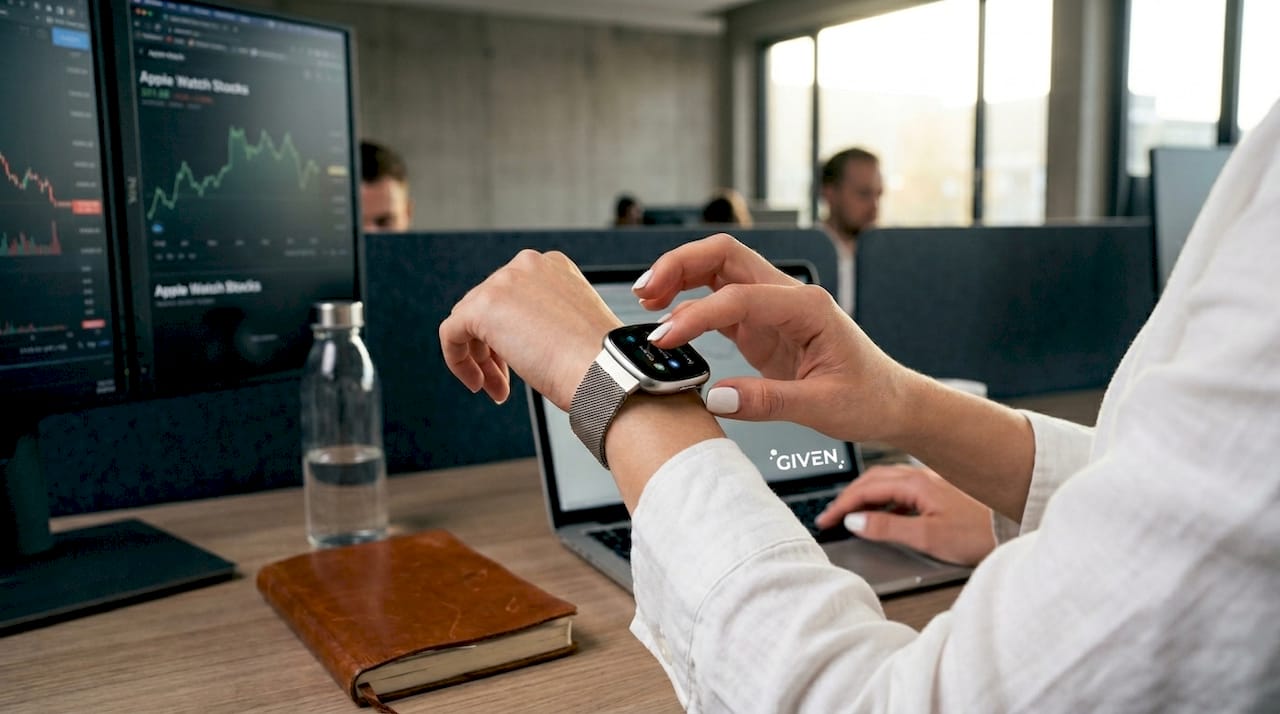
The Apple Watch Stocks app provides real-time stock tracking, price alerts, and watchlist notifications directly on your wrist. Combined with Bloomberg's native app, which pushes breaking news, yield moves, and market opens directly to supported smartwatches, you have a compact information terminal that never requires you to break eye contact with a client or a counterparty. Apple Watch Stocks app
Here is how specific smartwatch functions map across three core finance scenarios:
| Function | Trading floor | Roadshow | Deal room |
|---|---|---|---|
| Price alerts and watchlists | Critical: catch entries and exits instantly | Useful: monitor market while pitching | Moderate: track macro context during negotiation |
| Bloomberg and news alerts | Essential: first-mover info advantage | Essential: stay current between meetings | High: track relevant sector moves |
| Calendar and meeting notifications | Moderate: manage session breaks | Critical: navigate tight roadshow schedules | High: manage multi-party timelines |
| Heart rate and stress monitoring | High: prevent emotional decision-making | Moderate: manage energy across time zones | Useful: maintain composure in high-stakes moments |
| Communication alerts (calls, messages) | Low priority: focus mode preferred | High: coordinate logistics in real time | Moderate: manage deal team updates |
The Apple Watch market features extend beyond stocks into ECG monitoring and sleep tracking, both of which are increasingly valued by professionals who understand that their cognitive performance is a tradeable asset. For Rolex wearers specifically, smartwatch compatibility with Rolex straps and adapters has made dual wear a seamless choice rather than a compromise. Apple Watch market featuressmartwatch compatibility with Rolex
Additional functions that matter in active market environments:
- Custom vibration alerts. Set silent notifications for specific ticker thresholds so you receive the signal without disturbing anyone around you.
- Voice-to-text messaging. Send quick messages to your desk or trading team without typing.
- Time zone displays. Useful during international roadshows where London, New York, and Tokyo windows all matter simultaneously.
- Payment and access. NFC payments and building access via wrist reduce friction during fast-paced days.
Configure your smartwatch to push only tier-one alerts during market hours. Reserve full notification access for breaks. Information overload at the wrong moment is as costly as missing a move entirely.
Balancing tradition and innovation: how to wear both without compromise
Acknowledging that smartwatches offer real advantages does not mean abandoning the mechanical watch tradition. The question is not which to choose. It is how to wear both watches without compromising either function or aesthetics.
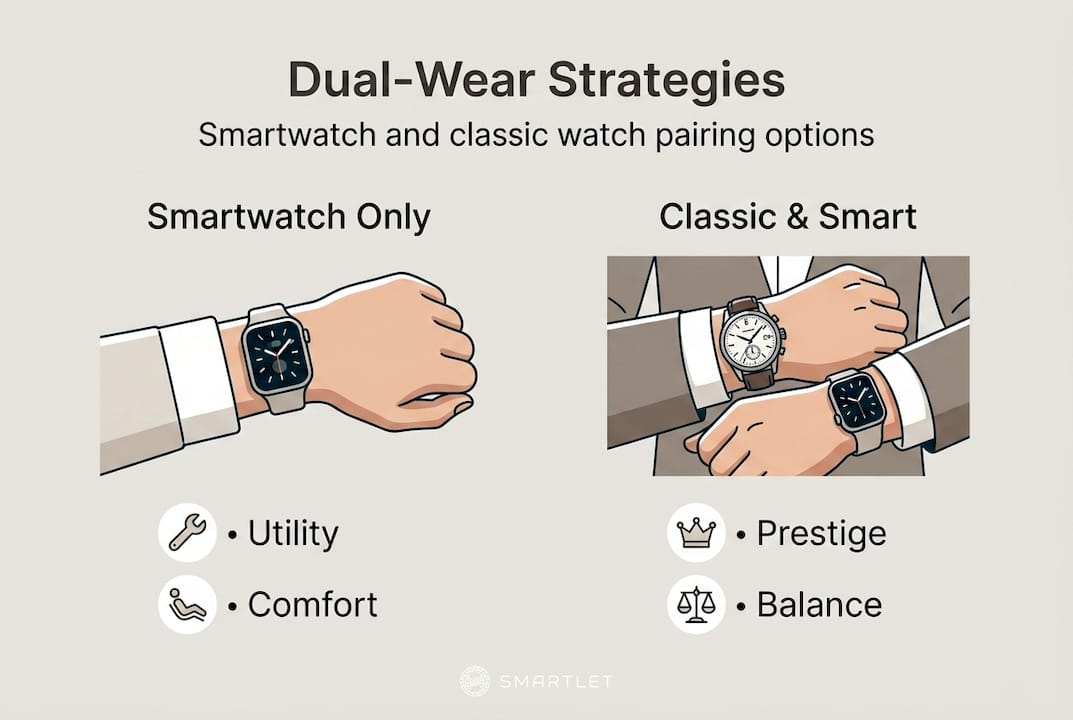
The current landscape of dual-wear strategies reflects the diversity of professionals using them. Junior bankers favor smartwatches for cost and utility, seniors default to mechanical prestige pieces, and a growing hybrid segment wears smart bands or rings alongside their luxury watch. Each approach involves a trade-off.
Here is how the main options compare:
| Strategy | Prestige impact | Functionality | Comfort | Cost |
|---|---|---|---|---|
| Smartwatch only | Low to moderate | High | High | Low to moderate |
| Mechanical watch only | High | Low | High | High |
| Two separate wrists | Moderate (context-dependent) | High | Moderate | High |
| Modular strap adapter (same wrist) | High (preserves luxury piece) | High | High | Moderate |
| Smart ring plus mechanical | High | Moderate | High | Moderate |
The modular strap solution, such as the one pioneered by Smartlet's dual-watch bracelet concept, stands out because it requires no modification to your existing timepiece and does not force a choice between appearances. The luxury watch remains the visual centerpiece, the smartwatch component provides the connectivity. Smartlet's dual-watch bracelet
Here is a practical approach to implementing dual wear without common mistakes:
- Define your priority by context. Trading floor sessions call for maximum connectivity. Client dinners call for maximum discretion. Adjust your setup accordingly. Define your priority by context.
- Choose a solution that requires zero modification. Never alter a luxury watch case or strap permanently for the sake of a smart adapter. Any good dual-wear system connects via standard spring bars. Choose a solution that requires zero modification.
- Match metal finishes. If your Submariner is in Oystersteel, your adapter should be in steel or titanium, not black plastic. Visual coherence matters in professional settings. Match metal finishes.
- Test the weight balance. A dual-wear setup should feel natural on the wrist. Grade 2 titanium components help reduce added weight substantially. Test the weight balance.
- Maintain your mechanical watch's service schedule. Smart adapters that connect via spring bars put no additional stress on the case, but stay disciplined about regular servicing for your mechanical piece. Maintain your mechanical watch's service schedule.
The classic and smartwatch solutions conversation is no longer theoretical. At CES 2026, the precision engineering behind dual-wear wrist systems was presented to a global audience, confirming that this is a serious product category, not a novelty. classic and smartwatch solutions
Avoid wearing your smart adapter on the same side as a bracelet-style mechanical watch. Use the modular system specifically with strap configurations to maintain a clean, professional wrist profile.
Health tracking as a trading edge: managing stress and performance
The trading floor is one of the most physiologically demanding work environments in professional life. Cortisol spikes during volatile sessions, decision fatigue sets in by afternoon, and poor sleep compounds over weeks of high-pressure work. Smartwatches are becoming tools that traders use to manage this systematically.
Health monitoring including heart rate and stress levels directly supports high-pressure trading decisions by helping professionals recognize when their physiological state is interfering with their judgment. An elevated heart rate before entering a position is information. A stress score that has been rising for three consecutive days is a warning.
Nearly half the finance workforce now uses smartwatches specifically to track heart rate alongside market notifications. This is not wellness culture bleeding into finance. It is performance optimization using available data.
Key health metrics that traders and bankers monitor actively:
- Heart rate (HR). Elevated resting heart rate during a session often correlates with stress-driven decision-making. Monitoring this helps you know when to step back. Heart rate (HR).
- Heart rate variability (HRV). HRV measures the variation between heartbeats. Low HRV consistently indicates that your nervous system is under strain, which directly degrades cognitive performance. Heart rate variability (HRV).
- Stress score. Algorithms on devices like Garmin and Apple Watch compile physiological signals into a composite stress score, offering a real-time read on your readiness state. Stress score.
- Sleep quality. A single poor night before a major earnings event can cost you clarity at the worst possible moment. Tracking sleep helps you manage the inputs to your performance. Sleep quality.
- Blood oxygen (SpO2). Useful for frequent travelers who move across time zones for roadshows. Altitude and disrupted sleep affect cognition in measurable ways. Blood oxygen (SpO2).
For HRV monitoring integration specifically, wearables provide data that was previously only available in clinical settings. The wrist sensor HRV insights now accessible through consumer devices are granular enough to guide recovery decisions between trading sessions. HRV monitoring integrationwrist sensor HRV insights
"Your ability to read the market depends directly on the state of the person reading it. Health data gives you a second input stream, and it is one most of your competitors are ignoring."
Practical health benefits that translate directly to trading performance:
- Catching the early signs of burnout before they become a liability
- Reducing impulsive trades tied to stress-induced emotional states
- Managing energy distribution across multi-day roadshows
- Tracking recovery quality after high-intensity market sessions
- Building a personal baseline so you can recognize deviation before it affects performance
Monitor your HRV trend over a rolling seven-day window, not just single-session readings. A consistent downward trend is a more reliable signal of accumulated fatigue than any single high-stress day.
A fresh outlook: the next evolution of wristwear in finance
There is a prevailing tension in finance culture around smartwatches that deserves honest examination. The smartwatch has been labeled a buy-side bro signal by some in traditional banking circles, implying that wearing one signals a certain pragmatism over prestige. At the same time, dealmakers who need instant information access increasingly rely on wrist-based connectivity to stay competitive.
Here is the uncomfortable truth: the idea that luxury and utility must conflict is a framework that was built in a different era. The mechanical watch as a pure status symbol made complete sense when information moved slowly and presence was the primary indicator of power. Markets now move at millisecond speeds. Prestige still matters, it is just no longer sufficient on its own.
What we are seeing is not a competition between two categories of watch. It is a redefinition of what effective, professional wristwear looks like in 2026. The question has shifted from which watch do you wear to how does your wrist serve your performance. That is a fundamentally different conversation, and it is one the most forward-thinking professionals in finance are already having.
The classic vs smartwatch debate will not be settled by one side winning. It will be resolved by solutions that make the debate irrelevant. When you can wear your Patek to a deal signing and still receive a Bloomberg alert without reaching for your phone, the argument collapses on its own. Prestige and performance are not opposites. They are both non-negotiable. The tools to support both simultaneously already exist.
The cultural rethinking matters as much as the technology. Finance is a profession that respects excellence in craft, whether that is a perfectly structured debt deal or a flawlessly finished Swiss movement. The same standard of excellence now applies to how professionals equip themselves for market hours. That is not a compromise. That is progress.
Discover the perfect solution for dual-wear performance
Smartlet's patented modular watch strap adapter was engineered in brushed SS316L steel and Grade 2 titanium, and connects to any watch with an 18 to 24mm lug width via standard spring bar. No modification. No trade-off. modular watch strap
Whether you want to pair your smartwatch with a Rolex Submariner, explore full Rolex smartwatch compatibility, or check the full brand compatibility guide for your specific collection, Smartlet provides the precision engineering to make dual wear a daily reality. Three versions available: Classic at 299 EUR, Shadow at 399 EUR, and Titanium at 549 EUR. Bronze Medal at Concours Lepine 2025. Presented at CES 2026. Rolex Submarinerbrand compatibility guideClassicShadowTitanium
Featured Articles
No people found
We couldn’t find anything with that term. Please try again.


