


Warum Spezialeinheiten Uhren umdrehen: taktische Gründe

Gründer & CEO, Smartlet - CentraleSupelec-Ingenieur - Concours Lepine 2025, ausgezeichnet - CES 2026
Inhaltsverzeichnis
- Ursprünge und grundlegende taktische Gründe für invertierte Uhren
- Unterschiedliche Anwendung: wann und warum invertieren Spezialeinheiten ihre Uhren?
- Uhrentechnologie und Funktionen: wie moderne Uhren die Notwendigkeit der Inversion beeinflussen
- Praktische Anwendung: wie man eine Uhr für taktische Aufgaben auswählt und trägt
- Was die meisten Leitfäden über die invertierte Uhrenmethode übersehen
- Verbessern Sie Ihr taktisches Uhrensystem
- Häufig gestellte Fragen
Wichtigste Erkenntnisse
| Punkt | Details |
|---|---|
| Heimlichkeit vor Stil | Eine Uhr zu invertieren geht um Vermeidung von Erkennung, nicht um Mode. |
| Situative Strategie | Die Inversionsmethode wird verwendet, wenn Missionen oder Umgebungen dies erfordern, nicht als pauschale Regel. |
| Auswirkungen moderner Technologie | Matte Oberflächen und entspiegelte Gläser reduzieren, eliminieren aber nicht den Fall für Inversion. |
| Passen Sie Ihre Mission an | Die Entscheidung zur Inversion sollte Ihrer Aktivität, Uhrentyp und praktischem Bedarf für Heimlichkeit und Schutz entsprechen. |
Eine Uhr mit dem Zifferblatt nach innen zu drehen und die meisten Menschen denken, es ist eine Stilwahl. Das ist es nicht. Die invertierte Uhrenmethode, die von Einheiten wie der SAS, Delta Force und SEAL Team 6 praktiziert wird, ist eine bewusste taktische Entscheidung, die auf einem Kernbedarf aufgebaut ist: die Zeit ablesen, ohne Ihre Schießposition zu unterbrechen oder Ihre Position zu signalisieren. Dieser Leitfaden behandelt die wahren Ursprünge der Methode, die operative Logik dahinter, wie moderne Uhrentechnologie die Gleichung verändert, und was taktische Profis und Enthusiasten direkt auf ihre eigenen Systeme anwenden können.
Ursprünge und grundlegende taktische Gründe für invertierte Uhren
Die Praxis, eine Uhr mit dem Zifferblatt nach innen zu tragen, geht mindestens auf den Ersten Weltkrieg zurück, als Soldaten begannen, ihre Taschenuhren zu drehen, um Lichtreflexionen zu vermeiden und ihre Hände freizumachen. Die Gewohnheit setzte sich in Eliteeinheiten durch: die britische SAS, die US Delta Force und SEAL Team 6.
Der Kerngrund ist einfach und praktisch: Ein Soldat in einer liegenden Schießposition oder beim Greifen eines Gewehrs in verschiedenen Winkeln kann sein Handgelenk nicht leicht nach außen drehen, um die Zeit zu überprüfen. Die invertierte Uhr ermöglicht das Ablesen des Zifferblatts ohne Armbewegung. In einer Feldumgebung kann selbst eine kleine Bewegung ein inakzeptables Risiko darstellen.
Viele Spezialeinheiten-Operatoren drehen ihre Uhren um, um ihre Position nicht preiszugeben. Aber der Hauptgrund ist ergonomisch: Sie können die Zeit immer noch ablesen, ohne Ihren Arm zu bewegen. Die Heimlichkeits- und Schutzvorteile verstärken die Methode, aber der Zeitablese-Vorteil ist das, was sie universell macht.Spezialeinheiten invertieren Uhren
Die primären taktischen Gründe für die Inversionsmethode:
- Heimlichkeit und Reflexionskontrolle: Ein Standard-Zifferblatt fängt Umgebungslicht ein und kann während einer Nachtoperation oder eines verdeckten Vorgehens reflektieren und möglicherweise eine Position preisgeben.Heimlichkeit und Reflexionskontrolle:
- Physischer Schutz: Im Nahkampf oder dichtem Gelände ist das Zifferblatt der anfälligste Teil der Uhr. Nach innen gerichtet schützt es das Glas und das Zifferblatt vor direktem Aufprall.Physischer Schutz:
- Ergonomische Zeitüberprüfung: Das Ablesen der Zeit während eines Gewehrgriffs oder beim Kriechen erfordert null Handgelenkdrehung, wenn das Zifferblatt nach innen zeigt. Geschwindigkeit und Diskretion bleiben erhalten.Ergonomische Zeitüberprüfung:
- Reduziertes Hängenbleiben: Taktische Umgebungen beinhalten Ausrüstung, Gurte und enge Räume. Eine nach innen gerichtete Lünette bleibt weniger wahrscheinlich an Ausrüstung hängen.Reduziertes Hängenbleiben:
Die Bedeutung der Uhr-Ergonomie in operativen Kontexten wird in zivilen Diskussionen oft zu vereinfacht. Operatoren in mehreren Bereichen haben über Jahrzehnte praktische Lösungen für das Armbanduhr-Problem entwickelt.Uhr-Ergonomie in operativen Kontexten
"Bei hochriskanten taktischen Operationen ist jede zusätzliche Bewegung sinnlos und sogar gefährlich. Die invertierte Uhr eliminiert diese Variable vollständig."
Es geht nicht darum, Tradition zu respektieren. Es geht darum, Verhalten an die Anforderungen der Umgebung anzupassen.
Unterschiedliche Anwendung: wann und warum invertieren Spezialeinheiten ihre Uhren?
Nicht jeder Soldat oder jede Einheit invertiert seine Uhr. Es hängt ganz von der Mission, der Umgebung und der Uhr selbst ab. Einige Uhren eignen sich besser zur Inversion als andere.
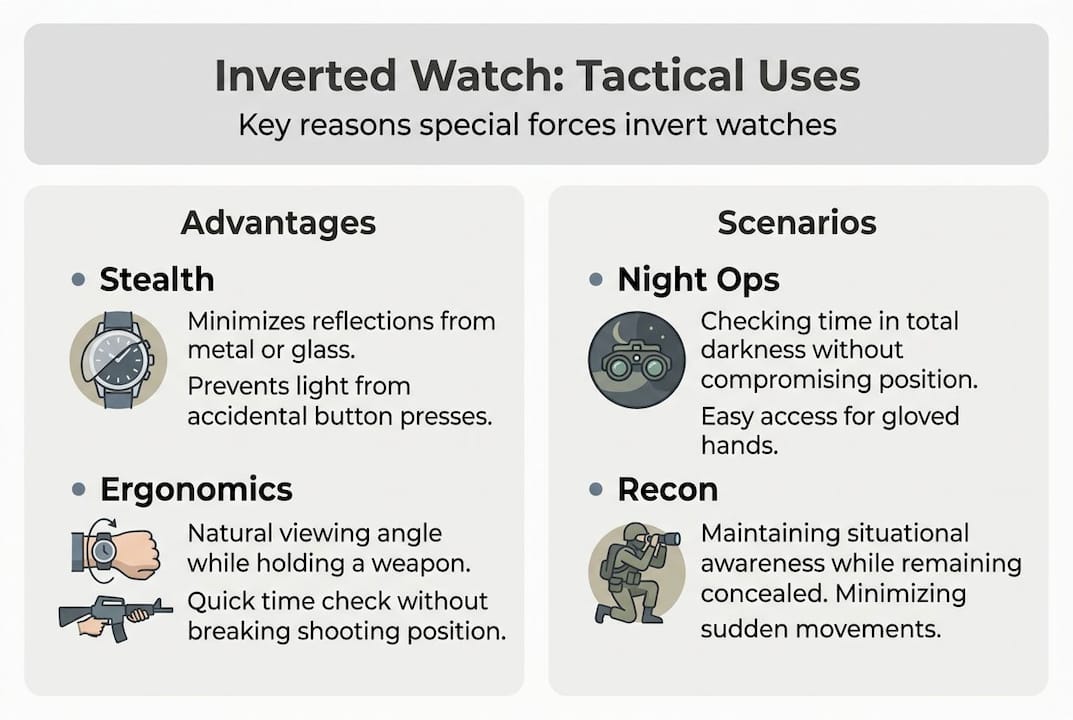
Ein Aufklärungsoperator, der sich nachts bewegt, nachdem sich der Feind niedergelassen hat, hat einen starken Fall für Inversion. Derselbe Operator, der tagsüber eine städtische Absperrung und Durchsuchung durchführt, würde wahrscheinlich feststellen, dass eine Standardausrichtung völlig ausreichend ist.
| Szenario | Standardtragen | Invertiertes Tragen |
|---|---|---|
| Verdeckte Nachtoperation | Hohes Blendungsrisiko, schlechte Ergonomie | Optimal: keine Reflexion, schnelles Ablesen |
| Städtische Tagespatrouille | Vollständig funktionsfähig, keine Probleme | Für die meisten Aufgaben unnötig |
| Liegende Schießposition | Erfordert Handgelenkdrehung | Sofortiges Ablesen, keine Bewegung erforderlich |
| Raues Gelände-Bewegung | Zifferblatt dem Aufprall ausgesetzt | Zifferblatt vor Steinen und Ausrüstung geschützt |
| Nahkampf | Lünette kann an Ausrüstung hängenbleiben | Reduziertes Hängenbleiben-Risiko |
Spezialeinheiten mischen analoge und digitale Werkzeuge je nach Missionsprofil. Die Inversionsentscheidung folgt der gleichen Logik: situativ, nicht universell.Uhrenmarken, die von Spezialeinheiten verwendet werden
Bevor Sie sich entscheiden, Ihre eigene Uhr für den Feldeinsatz zu invertieren, testen Sie Ihre Zeitablese-Geschwindigkeit in einer simulierten Schieß- oder Tiefposition. Wenn Sie das Zifferblatt invertiert schneller ablesen können, ist das Ihre Antwort. Wenn nicht, funktioniert Standardtragen gut für Ihren Kontext.
Uhrentechnologie und Funktionen: wie moderne Uhren die Notwendigkeit der Inversion beeinflussen
Technologie hat die invertierte Methode nicht eliminiert, aber sie hat die Rechnung verändert. Entspiegelte Beschichtungen und digitale Anzeigen reduzieren die Notwendigkeit der Inversion in einigen Szenarien, während der ergonomische Fall dafür in anderen stark bleibt.
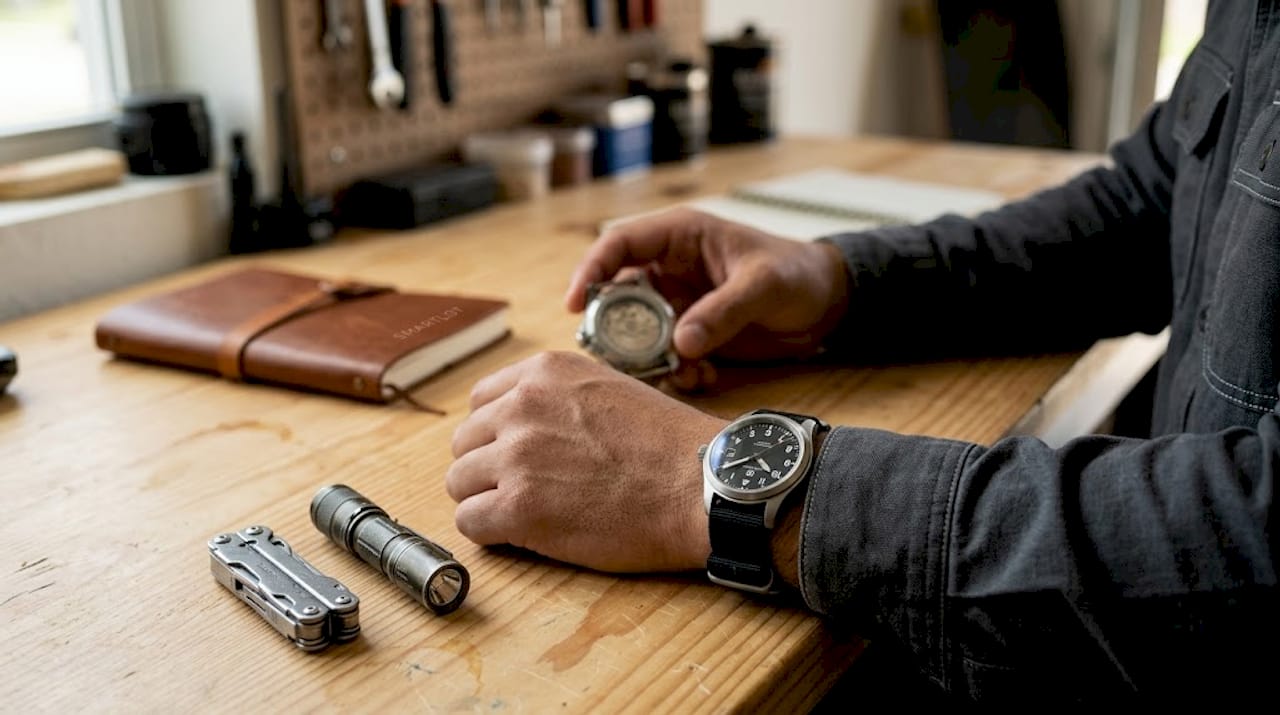
Entspiegelte Saphirkristalle reduzieren Blendung, ohne dass der Operateur die Uhr drehen muss. Matte Gehäusefinishes auf Uhren wie der Hamilton Khaki Field bekämpfen Reflexion an der Quelle. Digitale Anzeigen mit einstellbarer Hintergrundbeleuchtung fügen eine weitere Ebene der Lichtkontrolle hinzu.
| Funktion | Taktischer Vorteil | Auswirkung auf Inversionsbedarf |
|---|---|---|
| Entspiegelter Kristall | Reduziert Blendung ohne Inversion | Senkt Notwendigkeit in Szenarien mit moderatem Risiko |
| Matte oder PVD-Gehäusefinish | Eliminiert Oberflächenreflexion | Reduziert reflexionsgesteuerte Inversion |
| Digitale Anzeige mit Hintergrundbeleuchtung | Kontrollierte Beleuchtung | Reduziert Lichtkontroll-Risiko |
| Analoges Zifferblatt mit leuchtenden Zeigern | Im Dunkeln lesbar | Inversion hilft immer noch für Ergonomie |
| Robuster Kristall (Saphir) | Kratzerbeständig und schlagfest | Reduziert schutzgesteuerte Inversion |
Praktische Überlegungen bei der Auswahl einer Uhr für taktische Verwendung:
- Kristallwahl ist wichtig: Saphir ist kratzerbeständig, kann aber unter hartem Aufprall brechen. Mineralkristall ist flexibler und widerstandsfähiger gegen Aufprallschäden. Passen Sie den Kristall an Ihre Umgebung an.Kristalltyp:
- Grad-2-Titan ist viel leichter als Stahl und äußerst korrosionsbeständig, was es ideal für längeren Feldeinsatz macht, ohne die Ermüdung, die Stahl im Laufe der Zeit ansammelt.Gehäusematerial:
- Stegbreite und Riemenkompatibilität: Eine Uhr, die mehrere Riementypen akzeptiert, gibt Ihnen mehr Flexibilität bei der Trageweise und Positionierung für verschiedene Aufgaben.Stegbreite und Riemenkompatibilität:
- Wasserdichtheit: Mindestens 200m für ernsthaften Feldeinsatz, besonders in amphibischen oder nassen Umgebungen.Wasserdichtheit:
Erkundung von militärischen taktischen Uhren und ihren spezifischen Funktionen hilft zu klären, welche Technologie das operative Risiko wirklich reduziert. Die taktischen Uhrenfunktionen die am meisten zählen, sind diejenigen, die Ihre Signatur reduzieren.
"Wählen Sie das richtige Werkzeug für die Aufgabe. Das beste Werkzeug ist das, das Ihr besonderes Problem löst, auch wenn diese Antwort je nach Kontext variiert. Spezialoperationen-Doktrin."
Praktische Anwendung: wie man eine Uhr für taktische Aufgaben auswählt und trägt
Es gibt einen echten Unterschied zwischen Wissen und Handeln. Die Inversion der Uhr bietet Vorteile in Heimlichkeit, Schutz und Ergonomie, aber nur wenn sie korrekt ausgeführt wird und aus den richtigen Gründen.
Ein schrittweiser Ansatz zur Bewertung Ihres eigenen Systems:
- Definieren Sie zunächst Ihren primären Anwendungsfall. Training, Jagd, Feldübungen oder operativer Dienst: Jeder bestimmt, welche anderen Faktoren wichtig sind.Definieren Sie Ihren primären Anwendungsfall.
- Testen Sie Ihr Zeitablesen in Position: Nehmen Sie eine liegende, kniende oder stehende Haltung ein, halten Sie Ihre Feuerwaffe und lesen Sie Ihre Uhr so schnell wie möglich in beiden Ausrichtungen ab. Vergleichen Sie die Ergebnisse. Die schnellere Ausrichtung ist Ihre Antwort.Testen Sie Ihr Zeitablesen in Position.
- Bewerten Sie Ihre Umgebung: Outdoor-Hochglanz-Bedingungen begünstigen Inversion. Dunkelheit-Innenraum-Bedingungen reduzieren ihre Bedeutung.Bewerten Sie die Lichtverhältnisse Ihrer Umgebung.
- Überprüfen Sie die Reflexivität Ihrer Uhr, indem Sie Ihre Hand in der Sonne über den Kristall und das Gehäuse fahren. Eine starke Reflexion ist ein praktisches Argument für Inversion.Überprüfen Sie die Reflexivität Ihrer Uhr.
- Riemenflexibilität ist wichtig: Ein sehr steifer Riemen verursacht Unbehagen während der Inversion. Nylon oder Gummi passt sich natürlicher an die innere Handgelenkposition an.Bewerten Sie Ihren Riemen.
Ergonomische Tipps, die es wert sind, befolgt zu werden:
- Positionieren Sie die Uhr leicht versetzt zum Unterarm statt direkt auf dem Handgelenksknochen. Dies reduziert Druck während der Liegearbeit.
- Halten Sie den Riemen fest, aber nicht zu eng. Eine lockere Uhr verschiebt sich während der Bewegung und verfehlt den Zweck der Inversion.
- Wählen Sie eine Riemenbreite, die genau Ihrer Stegbreite entspricht. Adapter mit nicht standardisierten Breiten erzeugen Instabilität und schlechte Passform.
Vermeiden Sie die Inversion einer Uhr mit einem dicken, starren Metallarmband. Metallarmbänder graben sich während der Liegeposition in das innere Handgelenk ein und erzeugen Geräusche. Ein hochwertiger Nylon- oder Gummiriemen ist die richtige Wahl für die Feldinversion.
Für diejenigen, die sowohl eine mechanische Uhr als auch eine Smartwatch tragen, eröffnet die innere Handgelenkposition Dual-Uhr-Konfigurationen, bei denen jede Uhr gleichzeitig eine andere Funktion erfüllt.Tragen von mechanischer Uhr und Smartwatch zusammen
Was die meisten Leitfäden über die invertierte Uhrenmethode übersehen
Die invertierte Uhr wird zu oft als Ehrenzeichen statt als funktionale Wahl diskutiert. SOF-Operatoren konzentrieren sich auf Missionseffektivität, nicht auf Tradition oder Stil. Die Methode funktioniert, wenn sie funktioniert. Wenn nicht, verwenden sie sie nicht.
Bei schlechten Lichtverhältnissen mit einer matten, entspiegelten Uhr bietet Inversion keinen echten Wert. Bei hellem Tageslicht mit einem Gewehr und dem Bedarf nach einer stillen Zeitüberprüfung ist es die offensichtliche Lösung.
Der Fehler, den viele Enthusiasten machen, ist die Annahme der Methode als Symbol für Expertise statt als funktionales Werkzeug. Operatoren invertieren ihre Uhren nicht, um Erfahrung zu signalisieren.
Ein gutes taktisches Uhrensystem geht nicht darum, wie authentisch es aussieht. Es ist jede Konfiguration, die Ihnen hilft, Ihre tatsächlichen Anforderungen zu erfüllen.moderne taktische Uhrenauswahl
Bei Smartlet ist die innere Handgelenkposition kein militärisches Artefakt. Es ist eine funktionale ergonomische Lösung, die für Uhrenenthusiasten durch einen präzisions-modularen Adapter angepasst wurde.
Verbessern Sie Ihr taktisches Uhrensystem
Das Verständnis der invertierten Uhrenmethode ist der erste Schritt. Der nächste ist der Aufbau eines Systems, das diese Logik tatsächlich umsetzt.
Der patentierte modulare Riemenadapter von Smartlet ermöglicht es Ihnen, Ihre mechanische Uhr und Ihre Smartwatch gleichzeitig am gleichen Handgelenk zu tragen, ohne eine der beiden Uhren zu modifizieren. Entwickelt aus gebürstetem SS316L-Stahl und Grad-2-Titan ist die innere Handgelenkposition, die Operatoren seit Jahrzehnten verwenden, jetzt als bewusste zivile Konfiguration verfügbar.Smartlet modulare RiemenKlassische Version
| Konfiguration | Reflexionsrisiko | Ergonomie in Position | Uhrenschutz |
|---|---|---|---|
| Standard-Uhr, nach außen | Hoch | Schlecht in Lage oder Gewehrgriff | Zifferblatt freiliegend |
| Invertierte Uhr, inneres Handgelenk | Niedrig | Ausgezeichnet | Zifferblatt geschützt |
| Smartlet Dual-Setup, inneres Handgelenk | Niedrig | Ausgezeichnet | Beide Uhren geschützt |
Empfohlene Artikel
No people found
We couldn’t find anything with that term. Please try again.


