


Your watch speaks: decoding collector signals on your wrist

En resumen:
- Watches communicate personality and values through movement, originality, condition, and wear signals.
- Authenticity, provenance, and proper signals build trust and credibility among collectors.
- Modular adapters enable simultaneous wear of mechanical and smart devices, balancing prestige and functionality.
Before you open your mouth in a boardroom, at a watch fair, or across a dinner table, your wrist has already made a statement. Seasoned collectors scan a watch the way a sommelier reads a label — movement type, condition, originality, and provenance all register in seconds. This is not vanity. It is a semiotic language, a system of non-verbal signals that communicates taste, discipline, and values long before conversation begins. Understanding how that language works — and how to speak it intentionally — changes everything about how you present yourself.
Índice
- What collectors notice first: reading wrist signals
- Heritage, provenance, and authentic signals: more than surface style
- The hybrid dilemma: fitness tracking and luxury coexistence
- How dual-identity professionals blend luxury and technology
- What most guides miss: signal layering and intentionality
- Blend prestige and performance on your wrist
- Preguntas frecuentes
Puntos clave
| Punto | Detalles |
|---|---|
| Watch signals shape perception | Movement, originality, and condition reveal collector taste and methodology before you speak. |
| Provenance signals credibility | Boxes, papers, and authentic wear distinguish true enthusiasts from casual owners. |
| Hybrid watches offer compromises | Fitness tracking in hybrids is often less usable than in dedicated devices. |
| Dual-identity solutions exist | Modular straps and wrist combos cater to both luxury and tech needs. |
| Intentional layering attracts peers | Curating signals on your wrist can foster meaningful recognition among collectors. |
What collectors notice first: reading wrist signals
Having established that your watch speaks louder than words, let’s break down precisely what seasoned collectors notice during that critical first impression.
The collector’s eye moves fast. Within moments, a trained enthusiast has already formed a detailed opinion based on a handful of specific cues. According to Country Life, collectors read a watch’s language before hearing a single word from its owner, with movement type, condition, originality, and strap wear acting as instant signals of taste and methodology.
Here is what that scanning process actually looks at, in order of priority:
- Movement type: A manual-wind movement signals intentionality and ritual. You chose to wind it each morning. An automatic movement suggests practical commitment to the craft. A quartz movement in an otherwise serious collection raises questions.
- Dial and case originality: Refinished dials, replaced hands, or non-original bezels are immediately noticed. Original patina is respected. Over-polished cases suggest a collector who values appearance over authenticity.
- Strap and bracelet condition: A worn leather strap on the right watch signals real use and genuine attachment. A pristine bracelet on a “tool watch” hints at display-only ownership.
- Documentation discipline: Box and papers, visible service stickers, or even a casual mention of servicing history communicate that you approach ownership with care.
“The watch on your wrist is a biography. Every scratch, every choice of strap, every missing link in a bracelet tells a story that experienced collectors can read fluently.”
Knowing these signals lets you elevate casual style with intention rather than accident. The difference between a well-worn Submariner on a faded NATO strap and a mint example on its original bracelet is not just aesthetic. It communicates entirely different ownership philosophies.
For collectors navigating the dual-identity space, understanding this framework also clarifies why a Cartier Tank and Apple Watch combination requires careful thought. Each piece sends its own signal. The question is whether those signals reinforce or contradict each other.
Pro Tip: Before wearing any watch to a collector-heavy event, ask yourself what story it tells on its own. The strap choice, condition, and context all modify the message your timepiece sends without a single word.
Heritage, provenance, and authentic signals: more than surface style
Once collectors have scanned core features, subtler details emerge — provenance and lived-in authenticity that separates true enthusiasts from casual owners.

Provenance is where collecting gets serious. Authentic engagement with watchmaking is distinguished from opportunistic purchasing by the presence of provenance signals: original dials, box and papers, and service history. How the watch is worn matters equally. Realistic wear versus display-only ownership communicates volumes.
This distinction matters in social contexts beyond collecting circles. Research on vestimentary signals in negotiation environments consistently shows that accessories perceived as “authentic” rather than performative generate greater trust and credibility. When a watch looks genuinely used and specifically chosen — rather than recently acquired for status — it reads as a signal of real expertise.
Here is a practical comparison of how signals land differently depending on authenticity:
| Signal | Authentic collector | Display-only owner |
|---|---|---|
| Dial condition | Original, honest patina | Refinished or “too perfect” |
| Box and papers | Present, accessible to discuss | Absent or uncertain |
| Service history | Known and documented | Unknown |
| Strap/bracelet | Shows real wear or thoughtful change | Pristine regardless of watch age |
| Movement knowledge | Specific and detailed | Brand-name only |
| Wear context | Worn in relevant settings | Preserved for occasions |
The statistics among serious collectors reinforce this pattern. Communities like Watchuseek and RedBar consistently reward exclusivity and loyalty to a watch’s original specification over modification or “improvement.” Members who can speak to their watch’s service intervals, regional dial variants, or production dates earn recognition that no amount of spending can shortcut.
What this means practically: if you own a genuinely interesting piece, learn its history. Know its reference number, its production decade, and its quirks. That knowledge transforms a watch from an object into a conversation, and it signals a depth of engagement that collectors recognize and respect.
For those managing both a mechanical collection and health monitoring needs, finding this balance between ECG capability and mechanical prestige is a genuine strategic challenge, not just a style question.
The hybrid dilemma: fitness tracking and luxury coexistence
With heritage signals addressed, a practical dilemma surfaces: as collectors evolve, so does their desire to blend mechanical heritage with modern utility, especially health tracking. How is this balance achieved, or compromised?
Hybrid watches were designed to resolve this tension. They look like traditional dress or sport watches but carry fitness and notification functions beneath the surface. The promise is real. The execution, however, is frequently incomplete.
Testing reveals that even when a hybrid is marketed as “health-first,” fitness tracking can be bare bones compared to dedicated devices. Micro-UI constraints, such as tiny displays that wash out in sunlight and metric-by-metric paging, can make hybrids genuinely frustrating during training. The Withings ScanWatch 2 is a well-regarded example. It succeeds aesthetically but loses ground to a dedicated Apple Watch or Garmin when serious biometric tracking is required.
Here is how most collectors currently navigate their choices:
- Assess your actual fitness tracking needs. Are you monitoring basic steps and sleep, or do you rely on VO2 max, continuous ECG, and training load analytics? The gap between these use cases is enormous.
- Research hybrid limitations honestly. Most hybrids excel at passive monitoring: heart rate, sleep stages, step count. Active workout tracking with real-time metrics is where they consistently underperform.
- Consider the display trade-off. A hybrid’s analog face preserves the collector aesthetic. But if you need to check intervals during a run, a small subdial is not sufficient.
- Factor in biomarker sensor evolution. The gap between hybrid and dedicated tracker is closing, but it is not yet closed for serious athletes.
- Evaluate dual-wear or modular options. Some collectors find that wearing both devices, configured intelligently, solves the problem more cleanly than any hybrid compromise.
| Característica | Reloj híbrido | Dedicated fitness tracker |
|---|---|---|
| Aesthetic | Traditional, collector-appropriate | Sporty, tech-forward |
| Step and sleep tracking | Bien | Excelente |
| Continuous ECG | Limited or absent | Available on premium models |
| Real-time workout metrics | Poor to moderate | Excelente |
| Duración de la batería | Weeks to months | Days to one week |
| Collector signal | Positive | Neutral to negative |
| HRV monitoring | Básico | Advanced |
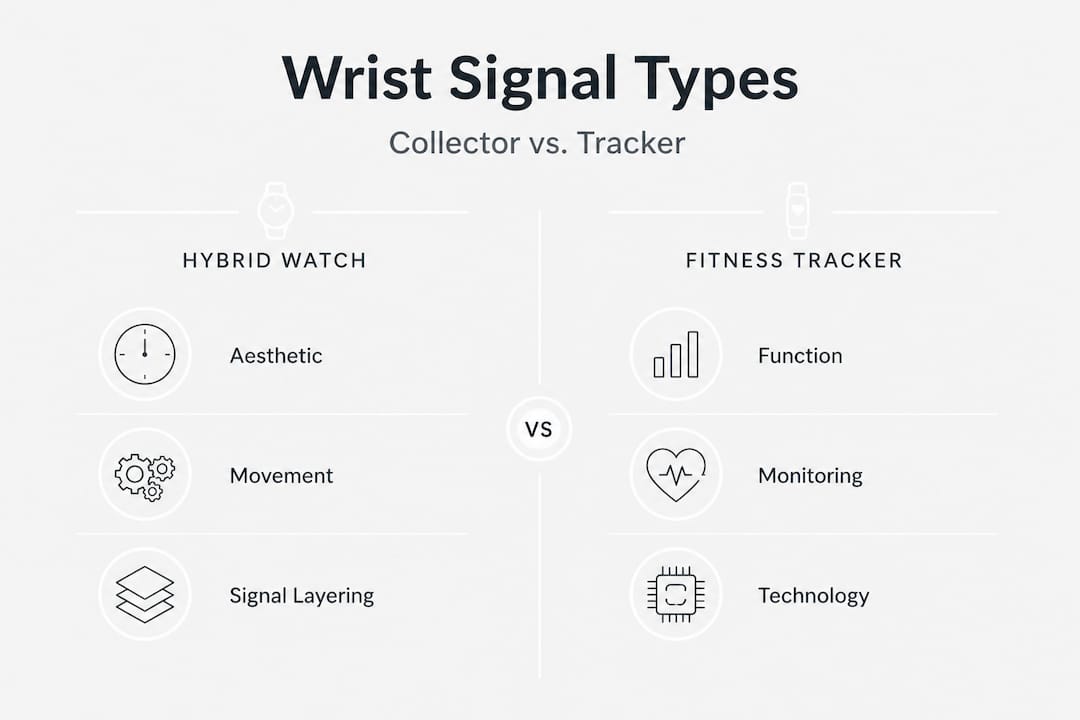
Understanding HRV monitoring in relation to mechanical watches is increasingly relevant for collectors who treat health data with the same seriousness they bring to horology. The data gap between a hybrid and a proper smartwatch is real, and it matters if you actually use the metrics.
Pro Tip: Don’t assume “hybrid” means “best of both worlds.” Evaluate what percentage of your fitness tracking is passive versus active, then choose accordingly. Many collectors discover they need a dedicated tracker after all, and that realization opens the door to smarter dual-wear strategies.
How dual-identity professionals blend luxury and technology
With hybrid devices addressed, let’s look at how professionals consciously curate their wrist for both prestige and tech functionality, making collector signaling a daily strategy.
Dual-identity professionals — attorneys who train for marathons, surgeons who collect vintage Patek Philippe, executives who track HRV daily — face a genuine wrist management challenge. The collector signals that earn respect in one room can undermine credibility in another if handled carelessly.
The same collector cues (movement preference, documentation discipline, and wear and condition signals) can be interpreted differently depending on whether the wearer is signaling tool and heritage competence or engineering and chronometry knowledge. Context shifts the meaning. A Rolex Milgauss reads differently in a physics lab than in a law office. A Speedmaster Professional reads differently at a motorsport event than at a formal dinner.
Common approaches that dual-identity professionals use to manage this complexity:
- Alternating by context: Wear the mechanical piece for client meetings and high-stakes social events. Switch to the fitness tracker for gym sessions and commutes. Simple, but requires carrying both devices.
- Inner-wrist placement: Position the smartwatch on the inner wrist, keeping the mechanical watch as the visible face of your wrist. This preserves the collector signal while maintaining full fitness functionality. Smartlet’s modular adapter was designed specifically for this approach.
- Modular strap systems: Use a single adapter that allows both watches to occupy the same wrist simultaneously without modification to either timepiece.
- Dedicated context rules: Set a personal policy. Mechanical only before noon, fitness tracker during workouts, back to mechanical for evening engagements.
The combination of an Apple Watch and a Rolex is one of the most searched dual-wear configurations for good reason. These two devices represent the clearest expression of the dual-identity professional: heritage and precision on one side, connected health on the other.
Choosing between smartwatch and ring-based sensors is another layer of this decision. Some collectors prefer rings precisely because they remove the visual conflict on the wrist. But rings sacrifice the real-time display functionality that many professionals rely on during the day.
For those committed to versatile minimalist accessories as a broader style philosophy, the modular approach aligns naturally. One wrist. Both tools. No compromise on either signal.
Pro Tip: Think of your wrist configuration as a context-specific communication strategy, not a permanent choice. The most sophisticated collectors adapt their setup to the room they are entering, just as they would adapt their vocabulary or their posture.
What most guides miss: signal layering and intentionality
Most articles about watch collecting and personal style treat signal management as a binary: wear the luxury piece or wear the smart device. What they consistently overlook is the concept of signal layering — the deliberate combination of visual cues, heritage references, and technology signals to create a richer, more nuanced identity statement.
Intentional wearers don’t just balance style and function. They curate ownership stories. A collector who wears a 1960s Longines manual-wind on a period-correct bracelet alongside an Apple Watch Ultra positioned on the inner wrist is not making a contradiction. He is making a statement about range: historical knowledge, aesthetic discipline, and contemporary engagement with health data. That combination is read differently by different audiences, and a sophisticated collector knows exactly what each audience will see.
Most guides oversimplify this. They either tell you to pick one aesthetic lane or suggest that hybrid watches resolve everything. Neither is true. The real opportunity lies in understanding that comparing screens and sensors across devices is only part of the equation. The other part is social semiotics: what does the combination communicate, and to whom?
Signal layering works when it is intentional and coherent. It fails when it appears accidental. A luxury piece worn with a visible fitness tracker on the outer wrist can look like indecision. The same two devices configured with purpose and placement sends a very different message. Collectors who understand this distinction are already ahead of the conversation.
The hard truth is that most people who own both a fine mechanical watch and a smartwatch have not thought carefully about how the two interact as a system of signals. They just wear what feels comfortable. That is fine for personal use, but it leaves significant social capital on the table in professional and collector contexts where those signals genuinely matter.
Approach your wrist as a strategic canvas. Layer signals consciously. Consider your audience before each configuration decision. That is not overthinking — that is the same level of care you already bring to your watches themselves.
Blend prestige and performance on your wrist
The insights in this article point toward a clear practical need: a way to wear your mechanical watch and your fitness tracker simultaneously, without visual conflict or technical compromise.
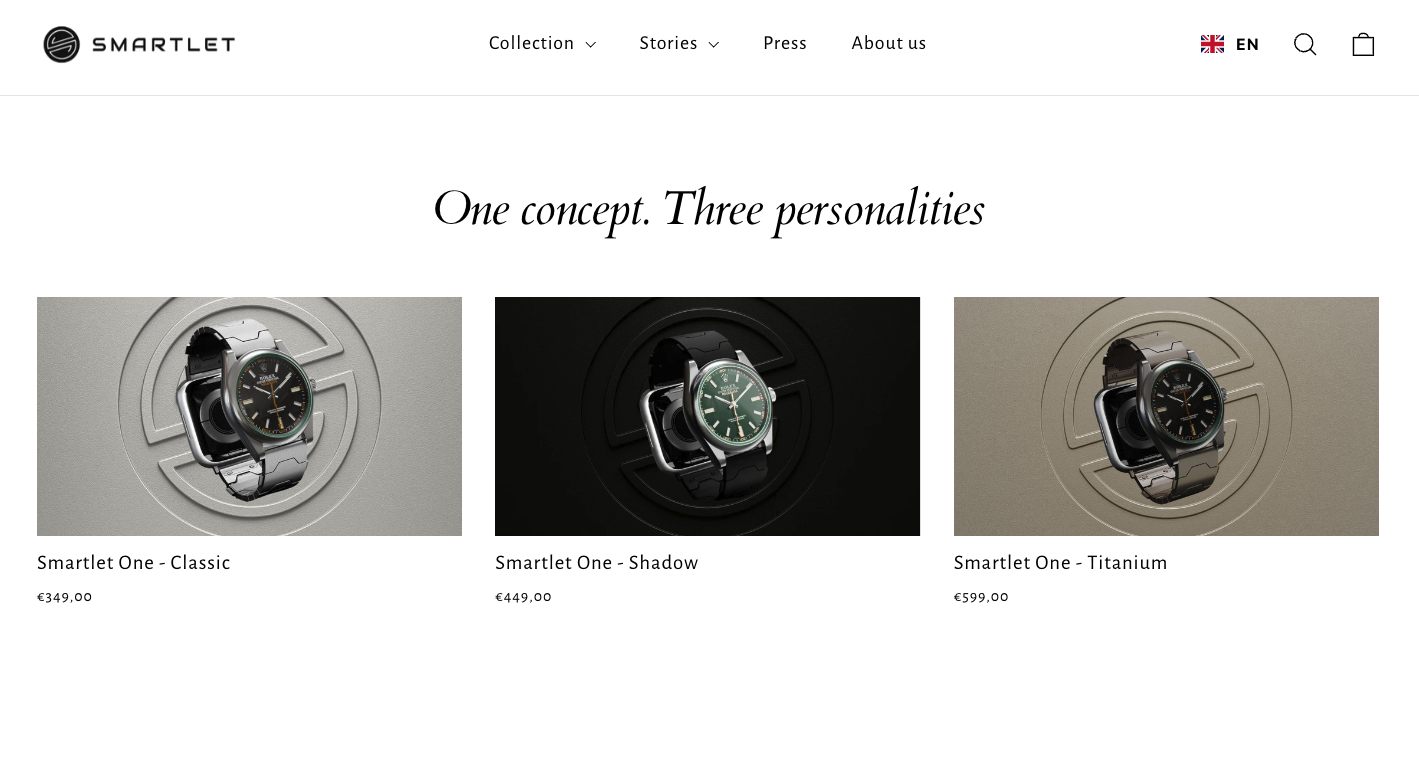
Smartlet was built for exactly this situation. Founded by David Ohayon, a watch collector who refused to accept the trade-off, Smartlet’s patented modular strap adapter lets you wear both watches on the same wrist at the same moment. Engineered in SS316L steel (the same grade as Omega Speedmaster cases) and Grade 5 titanium, it fits any watch with 18 to 24mm lug width via a standard spring bar. No modifications. No compromises. Check whether your specific combination works with the Smartwatch compatibility guide, or explore how the system works with popular collector favorites like the Smartwatch with Rolex Submariner configuration. Available in Classic (349 EUR), Shadow (449 EUR), and Titanium (599 EUR). Don’t choose. Compose.
Preguntas frecuentes
What does a collector notice about a watch first?
Collectors quickly assess movement type, originality, condition, and documentation to gauge taste and expertise, often forming a detailed impression before any conversation begins.
How important is provenance for watch collectors?
Provenance — original dials, box, papers, and service history — is essential for credibility and signals authentic engagement with watchmaking rather than opportunistic purchasing.
Are hybrid watches good for fitness tracking?
Hybrid watches cover passive monitoring well, but fitness tracking is often bare bones compared to dedicated devices, with micro-display constraints limiting real training usefulness.
How can I wear both a mechanical watch and fitness tracker?
Modular strap adapters like Smartlet’s allow both devices to occupy the same wrist simultaneously, preserving the mechanical watch’s collector signal on the outer wrist while the fitness tracker sits discreetly on the inner wrist.
What is the meaning of “signal layering” in watch collecting?
Signal layering is the deliberate combination of heritage, luxury, and technology cues on your wrist to shape how different audiences perceive your taste, discipline, and range of expertise.


