Consultants' watches: Credibility, presence, and health data

Consultant checks mechanical watch in office
Consultants' watches: credibility, presence, and health data
する

デイビッド・オハヨン

Smartlet 創業者兼CEO - セントラル・スーペルエック(CentraleSupelec)出身 - 2025年ルパンコンクール受賞 - CES 2026

主なポイント

ポイント 詳細
Credibility matters Traditional watches play a crucial role in projecting discipline and focus during strategy meetings.
Data-driven health Smartwatches deliver valuable health insights for consultants who prioritize personal well-being.
No need to compromise New frameworks and products help professionals seamlessly combine presence and data monitoring.
Context influences choice Most consultants use both watch types depending on the occasion and workflow needs.

Walk into any McKinsey, BCG, or Bain strategy meeting, and you will notice something consistent: the consultants at the table are almost never checking their phones. Instead, they glance at their wrists. That watch on a senior consultant's wrist is not a coincidence. It is a deliberate signal, a tool, and increasingly, a health monitoring device all at once. For today's strategy professionals, the question is no longer simply "which watch should I wear?" It is "how do I manage 12-hour days of intense client work while keeping both my professional image and my personal health data intact?"

The role of watches in executive presence

There is a reason mechanical watches are practically a uniform in elite consulting culture. Firms like McKinsey, BCG, and Bain have long cultivated a culture where every visible detail, from the cut of a suit to the thickness of a watch bezel, communicates something about your judgment, your attention to detail, and your relationship with quality.

Consultants and executives in professional settings strongly prefer traditional mechanical watches over smartwatches precisely because they project credibility, discipline, and focus. This is not fashion. It is professional communication in its most subtle form. When a partner at a top-tier firm wears a vintage Patek Philippe or an Omega Speedmaster into a boardroom, the client reads it as a statement: 'I take decisions with care and permanence.'

A traditional mechanical watch signals something a smartwatch simply cannot replicate:

  • Long-term thinking: a mechanical watch is built to outlast its owner. It communicates a preference for durability over trendiness. Long-term thinking.
  • Craftsmanship awareness: appreciating fine mechanics speaks to an eye for precision, a quality every client wants in their strategy advisor. Craftsmanship awareness.
  • Distraction-free presence: no notification banners, no glowing screens. The consultant is entirely present. Distraction-free presence.
  • Visual discipline: the watch is understated, purposeful, and consistent with a professional wardrobe. Visual discipline.

"Traditional watches signal timeless judgment, craftsmanship, and presence without distractions from notifications, unlike smartwatches which appear casual and fragment attention."

This perception carries real consequences. A consultant's ability to command trust in a strategy session can hinge on these subtle, non-verbal signals. Sliding a glance at an Apple Watch mid-presentation communicates impatience. Checking a Rolex Submariner or a JLC Reverso reads entirely differently.

In client-facing meetings, the mechanical watch is not just an aesthetic preference. It is part of the performance. And there are deep historical reasons why mechanical watches continue to thrive even in the age of connected devices: they carry meaning that digital tools cannot manufacture. classic vs. smartwatchmechanical watches continue to thrive

Smartwatches and health data: balancing modern needs

Now consider what a consultant's body goes through over a 12-hour client day. Early morning flights, back-to-back workshops, a working lunch that is barely a pause, an evening debrief over dinner. The physical and cognitive demands are significant. Stress spikes, sleep quality deteriorates across travel weeks, and sustained high performance depends increasingly on self-awareness about personal health metrics.

Consultant uses smartwatch in airport lounge, illustrating how health monitoring fits into a professional travel routine

For a consultant managing a 4-month engagement on minimal sleep and high pressure, a real-time view of HRV or resting heart rate trends is not a luxury. It is performance intelligence.

The benefits are concrete:

  • Continuous heart rate monitoring catches early signs of burnout or stress escalation before they affect performance.
  • Sleep quality tracking helps consultants optimize recovery during intense project sprints.
  • Step counts and activity reminders counteract the sedentary nature of long client meetings and travel.
  • Stress indicators flag when recovery strategies, breathing exercises or a short walk, are needed during the day.
  • Notification management can filter urgent alerts without requiring phone checks during sensitive client moments.

The challenge, however, is that bringing a smartwatch into a formal strategy meeting changes the energy. Clients notice. A glowing screen or a fitness tracker aesthetic interrupts the visual grammar of authority that consultants work hard to maintain. smartwatches and professional environments

Wearing a smartwatch into a client meeting

Switch it to silent mode with the screen set to "only wake on raise" with a minimal watch face. Even so, consider whether the visual impression serves your professional goals in that specific context.

The solution is not to abandon health monitoring. It is to find a way to wear both watches without making a visible compromise.

Why consultants rarely choose one: the credibility vs. data dilemma

The truth is, most experienced consultants have quietly resolved this dilemma through context-switching. They wear a smartwatch during workouts and travel, then switch to a traditional watch the moment they step into client-facing environments. But this is an imperfect solution. Switching watches takes time, creates friction, and means that during your most physically and cognitively demanding moments, you have no health data at all.

Here is a direct comparison that clarifies the trade-offs:

機能 Traditional mechanical watch スマートウォッチ
Professional credibility Very high 軽度から中等度
Health data tracking なし Continuous and detailed
Distraction risk in meetings Very low 中程度から高い
Client perception Authoritative and focused Casual or tech-oriented
Durability and longevity Decades with servicing 2 to 4 years typically
Suitability for boardroom 素晴らしい Situational

The two watch categories are genuinely complementary, not competitive. The decision is not about which is better in the abstract. It is about which tool serves the specific moment.

Here is the practical decision-making process many senior consultants follow:

  1. Identify the day's primary context. Review the day's schedule to establish whether it is a full day of internal work or client-facing meetings. This determines which watch takes priority on the wrist. Identify the day's primary context.
  2. Assess the client relationship. With a long-standing, informal client, a smartwatch may be acceptable. With a new C-suite contact, a traditional watch signals respect and seriousness. Assess the client relationship.
  3. Plan health monitoring windows. If health data matters, identify moments in the day, morning, lunch, travel, where a connected device can operate without affecting presence.
  4. Consider the meeting format. A two-hour strategy workshop allows less tolerance for device distractions than an informal working session. Consider the meeting format.
  5. Default to presence over data. In doubt, prioritize the professional signal. You can catch up on health data in transition time. Default to presence over data.

The dilemma of uniting traditional and connected watches on a single wrist is one that the watch industry is beginning to take seriously. The concept of a dual-watch bracelet challenges assumptions that have governed how professionals dress and monitor their health for decades.

Frameworks and solutions: wearing both without compromise

Most advice on this topic is anecdotal. There are no empirical benchmarks specifically on consultants' watch-wearing habits. The preferences we observe come from professional culture, business etiquette writing, and the lived experience of people inside these firms.

What we do have is innovation that closes the gap between the two watch worlds. The most practical frameworks consultants can use today include:

  • Situational switching with a system: keep both watches accessible and build the habit of switching based on the morning's calendar review. This takes about 30 seconds and preserves both goals. Situational switching with a system.
  • Dual-wear solutions. Purpose-built connectors allow a traditional watch and a smartwatch to share the same wrist simultaneously, each maintaining its full function without modifying either device.
  • Minimal smartwatch faces: configure your connected watch to display only analog-style faces and disable all visible notifications. This reduces the contrast between the two aesthetics significantly. Minimal smartwatch faces.
  • Smart ring alternatives: for some consultants, a smart ring offers health monitoring functions with zero visual impact on professional presence. Smart ring alternatives.

Here is a practical view of when each approach applies:

Situation Smartwatch appropriate? Dual-wear solution works?
C-suite board presentation いいえ Yes, discreetly
Internal team workshop Situational はい
Client dinner いいえ はい
Airport or travel はい はい
Morning workout はい はい
長距離フライト はい はい
Positioning when wearing both watches simultaneously

Position the traditional watch face outward toward the room. The smartwatch sensor side sits against your wrist, collecting data continuously without broadcasting its presence.

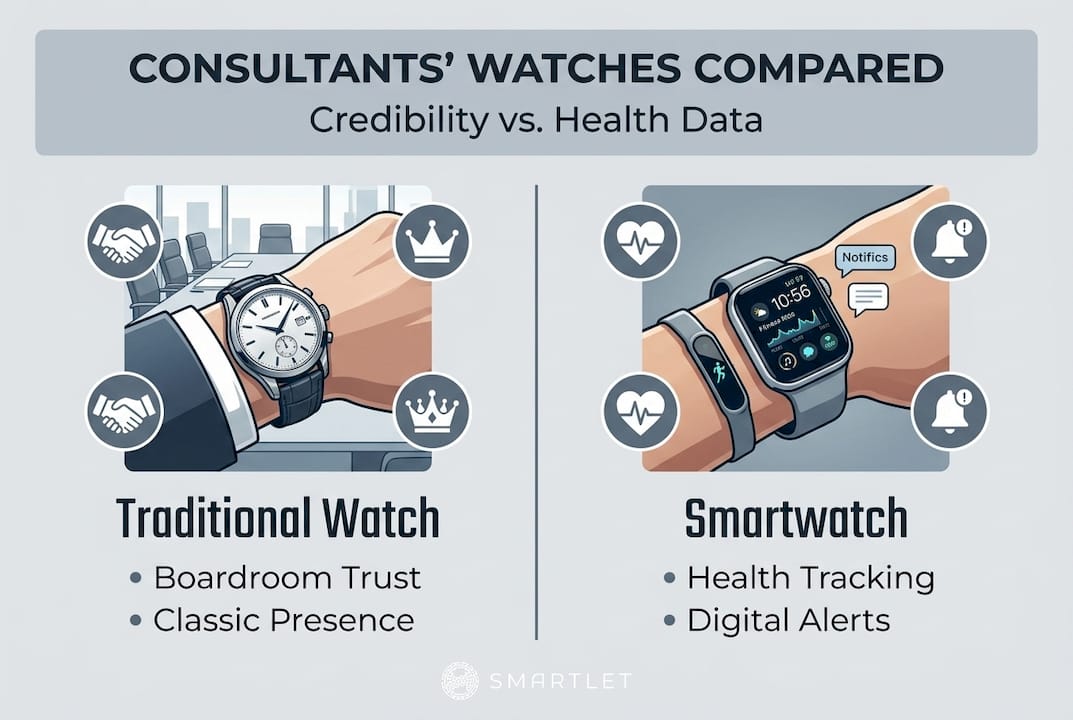
Infographic contrasting traditional watches and smartwatches for professional consultants

For those who collect fine timepieces, the appeal of wearing vintage and smartwatches together is particularly strong. A vintage Omega or Cartier Tank carries history and character, while the connected device underneath tracks the biometrics your performance depends on. wearing vintage and smartwatches together

A contrarian perspective: why presence still trumps data in the boardroom

Here is the uncomfortable truth that most productivity-focused advice avoids: in a high-stakes boardroom, your health data does not close deals. Your presence does.

In the specific context of a strategy meeting with a skeptical CFO or a newly appointed CEO, what actually moves the needle is how you make that person feel about your judgment and your discipline.

A traditional watch communicates both silently. It says: 'I pay attention to craft. I make considered choices. I am not distracted.' Most professionals focus on the visible outputs of presence without recognizing that the foundation is built on subtle, consistent signals across months and years.

The classic or smartwatch question is not actually about watches. It is about understanding your audience, managing context, and choosing the signal that serves the moment. In the boardroom, presence wins. Outside it, data wins.

The classic or smartwatch question is therefore not actually about watches. It is about understanding your audience, managing context, and choosing the signal that serves the moment. In the boardroom, presence wins. Outside it, data wins. The real innovation is building a professional toolkit that does not force you to choose between the two.

Next steps: make your watch work for you

For consultants who want to stop choosing between credibility and health data, the right solution is already available. Smartlet's patented modular strap adapter, engineered in brushed SS316L steel and Grade 2 titanium, lets you wear your traditional watch and your connected device on the same wrist at the same time. No modification to either watch. No friction. No compromised image.

Smartlet modular adapter - the dual-wear solution for consultants who need both credibility and health data on the same wrist

Check the watch compatibility guide to confirm your watches fit, then explore the Classic adapter to find the version that matches your setup. If you wear a Rolex Submariner, find a tailored configuration that shows exactly how a smartwatch pairs with a Submariner without altering the watch in any way. Three versions available: Classic (349 EUR), Shadow (449 EUR), and Titanium (599 EUR). Don't choose. Compose.

よくある質問

Yes, many use smartwatches for health tracking during daily life and travel, but switch to classic watches for formal meetings where professional credibility is the priority. The context determines the choice.

Traditional watches signal credibility and discipline while smartwatches can appear casual and introduce the risk of visible notifications that fragment attention in formal settings. In a client-facing meeting, every visible detail contributes to the professional impression.

Do consultants ever switch to smartwatches?

Yes, many use smartwatches for health tracking during daily life and travel, but switch to classic watches for formal meetings where professional credibility is the priority. The context determines the choice.

There are no empirical benchmarks specifically on consultants' watch-wearing habits. All evidence is anecdotal, drawn from business etiquette writing and executive presence guidance rather than formal research.

No, there are no empirical benchmarks specifically on consultants' watch-wearing habits. Most evidence is anecdotal, drawn from business etiquette writing and executive presence guidance rather than formal research.

Can consultants have the health benefits of smartwatches and the credibility of traditional watches?

Yes. Purpose-built dual-wear adapters like Smartlet let both watches share a single wrist, simultaneously and discreetly. No modification to either watch, no compromised image.