Blutdruckmessung am Handgelenk: nicht-invasiver Leitfaden und Trends

TL;DR:
- Die Blutdrucktechnologie am Handgelenk macht Fortschritte, eignet sich aber hauptsächlich für die Trendüberwachung.
- Kalibrierung, Bewegungsartefakte und regulatorische Lücken begrenzen die klinische Genauigkeit von Handgelenk-Blutdruckmessgeräten.
- Zukünftige Durchbrüche zielen auf kalibrierungsfreie, personalisierte Blutdruckmessung am Handgelenk ab.
Viele Menschen gehen davon aus, dass sie mit einer Smartwatch am Handgelenk klinisch zuverlässige Blutdruckwerte erhalten. Diese Annahme ist verständlich, aber noch nicht korrekt. Die nicht-invasive Blutdruckmessung am Handgelenk macht schnelle Fortschritte, mit FDA-zugelassenen Geräten, Luxusdesign-Integration und KI-gestützten Sensoren, die 2026 neu definieren, was möglich ist. Aber Kalibrierungsanforderungen, Bewegungsartefakte und Lücken in klinischen Richtlinien bedeuten, dass die Technologie fest in die Kategorie "Trendüberwachung" fällt, nicht in "Ersatz für die Manschette Ihres Arztes". Dieser Leitfaden erklärt, wie die Technologie funktioniert, welche Geräte Ihre Aufmerksamkeit verdienen, und wie Sie die Blutdruckmessung am Handgelenk intelligent neben den Uhren nutzen, die Sie lieben.
Inhaltsverzeichnis
- Wie nicht-invasive Blutdruckmessung am Handgelenk funktioniert
- Genauigkeit, Kalibrierung und klinische Grenzen
- Aktuelle Geräte: Luxus plus Smart, FDA-Status und Trends 2026
- Herausforderungen, Fallstricke und die Zukunft der Handgelenk-Blutdrucktechnologie
- Unsere Einschätzung: Was Luxusuhr-Liebhaber und Gesundheitssuchende wissen sollten
- Luxus trifft Gesundheit: Lösungen für das moderne Handgelenk
Wichtigste Erkenntnisse
| Punkt | Details |
|---|---|
| Mehrere Blutdruckmethoden am Handgelenk | PPG, PAT und Micro-Cuff-Ansätze treiben nicht-invasive Blutdruckmessgeräte am Handgelenk an. |
| Kalibrierung erforderlich für Genauigkeit | Die meisten Blutdruckmessgeräte am Handgelenk benötigen regelmäßige Kalibrierung mit einer Oberarm-Manschette, um zuverlässig zu bleiben. |
| FDA-zugelassen für Trendüberwachung | Geräte wie die Samsung Galaxy Watch8 sind zur Verfolgung von Trends autorisiert, aber nicht zur klinischen Diagnose. |
| Luxus trifft Gesundheit im Design | Die heutige Top-Blutdrucktechnologie am Handgelenk liefert Gesundheitseinblicke neben Luxus-Smartwatch-Ästhetik. |
| Kalibrierungsfreie Technologie bleibt schwer fassbar | Trotz Fortschritten ist eine wirklich kalibrierungsfreie Blutdrucklösung am Handgelenk noch in Entwicklung. |
Wie nicht-invasive Blutdruckmessung am Handgelenk funktioniert
Die Blutdruckmessung am Handgelenk basiert auf drei primären Methoden: Photoplethysmographie (PPG), Pulslaufzeit (PAT) und Micro-Cuff-Oszillometrie. Jede verfolgt einen grundlegend anderen Ansatz zur Erfassung von Herz-Kreislauf-Daten von Ihrem Handgelenk, und jede hat ihre eigenen Stärken und Kompromisse.
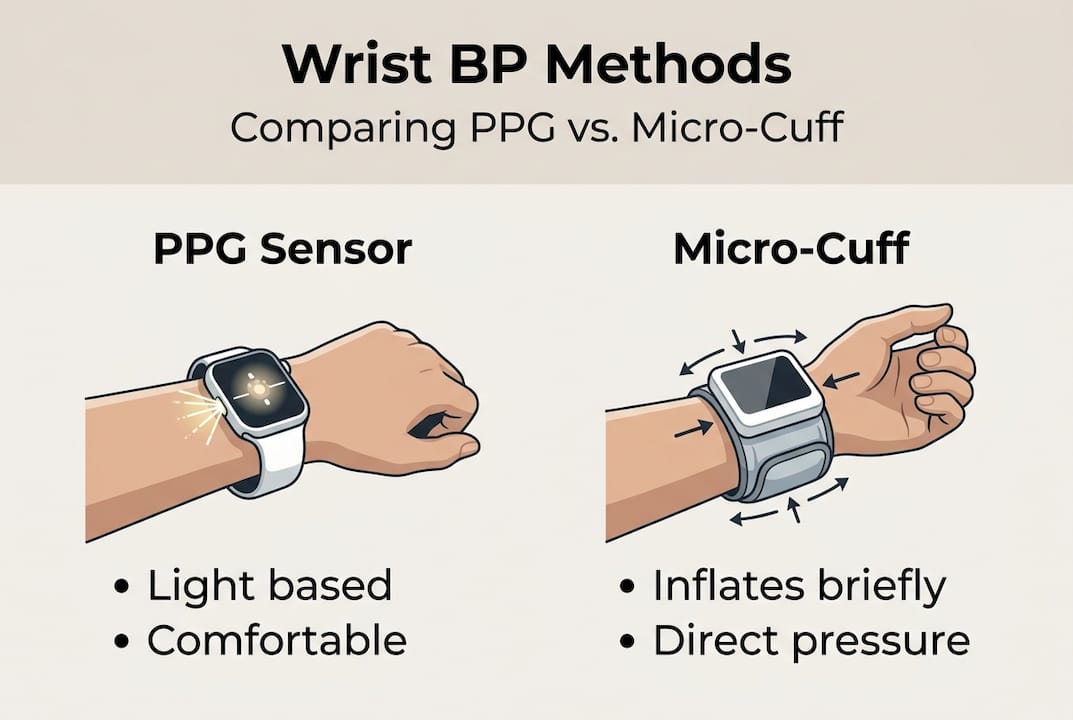
PPG (Photoplethysmographie) ist die häufigste Methode in Mainstream-Smartwatches. Ein Sensor leuchtet Licht in die Haut und misst, wie viel von Blutgefäßen absorbiert wird. Mit jedem Herzschlag ändert sich das Blutvolumen im Handgelenk, und diese winzigen Schwankungen werden in Herz-Kreislauf-Daten übersetzt. Es ist passiv, kontinuierlich und erfordert keine Aufblähung, was es ideal für Komfort und Diskretion macht. Die Einschränkung ist, dass PPG allein ohne ein mathematisches Modell, das auf Ihre Physiologie kalibriert ist, keine echte Blutdruckzahl erzeugen kann.
PAT (Pulslaufzeit) misst die Zeitverzögerung zwischen einem elektrischen Signal vom Herzen (über EKG) und der Druckwelle, die das Handgelenk erreicht. Da der Blutdruck beeinflusst, wie schnell diese Pulswelle reist, kann die Zeitmessung systolische und diastolische Werte schätzen. Diese Methode ist präziser als reines PPG, hängt aber immer noch von individueller Kalibrierung und Modellgenauigkeit ab.
Oszillometrie (Micro-Cuff) kommt dem traditionellen Oberarm-Monitor am nächsten. Eine kleine Manschette am Handgelenk bläst sich kurz auf, erkennt arterielle Oszillationen beim Druckabbau und berechnet einen Messwert. Geräte wie die Wellue und TimoHealth Uhren verwenden diesen Ansatz. Es ist die klinisch vertrauteste Methode, fügt aber Volumen hinzu und erfordert periodisches Aufblasen.
Nach primären Methoden für nicht-invasive Blutdruckmessung am Handgelenk stellen diese drei Methoden die aktuelle Landschaft für manschettenlose Handgelenk-Überwachung dar, jede mit unterschiedlichen Genauigkeitsprofilen. Laufende Forschung in Handgelenk-Blutdrucktechnologie verfeinert weiterhin Sensorfusions-Techniken, die PPG-, PAT- und Beschleunigungsmesserdaten für bessere Genauigkeit kombinieren.
Wichtigste Stärken und Einschränkungen auf einen Blick:
- PPG: Kontinuierlich, passiv, komfortabel, aber kalibrierungsabhängig
- PAT: Präziser mit EKG-Fusion, erfordert aber duale Sensoren und Kalibrierung
- Micro-Cuff: Klinisch vertraute Oszillometrie, aber sperriger und intermittierend
- Alle drei: Noch nicht für eigenständige klinische Diagnose validiert
| Methode | Wie es funktioniert | Kalibrierung erforderlich | Komfort |
|---|---|---|---|
| PPG | Änderungen der Lichtabsorption | Ja | Hoch |
| PAT | EKG + Pulszeitsteuerung | Ja | Mittel |
| Micro-Cuff | Handgelenk-Aufblähungs-Oszillometrie | Manchmal | Niedrig |
Pro-Tipp: Wenn Sie bereits ein Smartwatch zur Herzüberwachung verwenden, suchen Sie nach Geräten, die PPG mit EKG kombinieren, um eine bessere Blutdruckschätzgenauigkeit als nur PPG zu erhalten.
Genauigkeit, Kalibrierung und klinische Grenzen
Nachdem wir die Technologie kennen, lassen Sie uns bewerten, wie genau und klinisch nützlich die Blutdruckmessung am Handgelenk wirklich ist.
Genauigkeit ist dort, wo die Begeisterung für die Blutdruckmessung am Handgelenk auf die Realität trifft. Kalibrierung ist erforderlich für die meisten manschettenlose Handgelenk-Geräte, um aussagekräftige Messwerte zu erzeugen. Samsungs Galaxy Watch8 beispielsweise erfordert, dass Benutzer gegen einen traditionellen Oberarm-Monitor kalibrieren, bevor die BP-Funktion aktiviert wird. Das Aktiia Hilo Band verwendet einen ähnlichen anfänglichen Kalibrierungsprozess. Ohne ihn fehlen dem zugrunde liegenden Algorithmus die personalisierten Referenzpunkte, die er benötigt.
Oszillometrie vs. PTT kurz gefasst: Oszillometrie misst den arteriellen Druck direkt über Manschettenaufblähung, was es einfacher macht, klinisch zu validieren. PTT-basierte Methoden (einschließlich der meisten PPG- und PAT-Geräte) schätzen den Druck indirekt durch Pulswellen-Physik, was mehr Variablen einführt und stärkere individualisierte Modellierung erfordert.
Wie vergleichen sich Handgelenk-Monitore mit Oberarm-Geräten?
| Faktor | Handgelenk-Monitore | Oberarm-Monitore |
|---|---|---|
| Genauigkeit (unkalibriert) | Niedriger | Höher |
| Genauigkeit (kalibriert) | Moderat | Hoch |
| Klinische Validierung | Begrenzt | Umfangreich |
| Komfort für tägliche Nutzung | Hoch | Niedriger |
| Portabilität | Ausgezeichnet | Gut |
Die Bewegungs- und hydrostatischen Effekte auf die PPG-Genauigkeit stellen reale Herausforderungen dar, die Labor-Benchmarks oft unterschätzen. Selbst leichte Handgelenkbewegungen können einen Messwert verfälschen, und das Handgelenk, das über oder unter Herzhöhe gehalten wird, ändert den hydrostatischen Druck auf Weise, die Ergebnisse verzerren.
"Die Handgelenkposition relativ zum Herzen kann systolische Messwerte um bis zu 10 mmHg verschieben, eine klinisch signifikante Marge." Dies ist kein Fehler des Geräts. Es ist einfache Physik, die jeder Benutzer verstehen sollte, bevor er sich auf einen Handgelenk-Messwert verlässt.
Die AHA/AMA-Empfehlungen sind klar: Oberarm-Manschetten-Monitore bleiben der Goldstandard für klinische Blutdruckmessung. Handgelenk-Geräte werden noch nicht für diagnostische Zwecke empfohlen. Das heißt, sie sind wirklich wertvoll für die Verfolgung von Trends im Laufe der Zeit, die Identifizierung von Mustern und das Kennzeichnen von Änderungen, die es wert sind, weiter untersucht zu werden.
Für diejenigen, die Gesundheitstechnologie mit feiner Uhrmacherei integrieren, gilt die gleiche Logik für Apple Watch EKG Balance Überlegungen, Technologie fügt echten Wert hinzu, wenn Sie ihre Grenzen verstehen.
Pro-Tipp: Kalibrieren Sie Ihr Blutdruckmessgerät am Handgelenk immer zur gleichen Tageszeit, ruhig sitzend mit Ihrem Handgelenk auf Herzhöhe. Konsistenz in Kalibrierungsbedingungen verbessert direkt die Qualität Ihrer Trenddaten.
Häufige Fallstricke, die vermieden werden sollten:
- Messung während Bewegung oder Gehen
- Zu lockeres Tragen des Geräts
- Neukalibrierung nach einem Firmware-Update überspringen
- Direkter Vergleich von Handgelenk-Messwerten mit klinischen Manschetten-Nummern ohne Berücksichtigung der Position
Aktuelle Geräte: Luxus plus Smart, FDA-Status und Trends 2026
Genauigkeit ist wichtig, aber auch Stil und Praktikabilität. Hier ist das, was derzeit verfügbar ist.
Der Markt für Blutdruckmessgeräte am Handgelenk 2026 hat sich in drei klare Ebenen aufgeteilt: FDA-autorisierte Smartwatches, FDA-zugelassene dedizierte Bänder und oszillometrische Uhren, die klinische Vertrautheit in tragbarer Form bieten.
Top-Geräte, die man 2026 kennen sollte:
- Samsung Galaxy Watch8, FDA-autorisiert für Blutdruck-Trendüberwachung mit erforderlicher Kalibrierung gegen eine Armmanschette. Nicht für klinische Diagnose zugelassen. Starke Ökosystem-Integration, elegantes Design.
- Aktiia Hilo, FDA-zugelassenes manschettenlose Band, entworfen mit einer verfeinerten Ästhetik, die näher an einem Luxus-Armband als an einer traditionellen Smartwatch sitzt. Geräteintegration mit Premium-Materialien positioniert es gut für stilbewusste Benutzer.
- Withings ScanWatch 2, CE-gekennzeichnet in Europa, Hybrid-Analog-Digital-Design, PPG-basierte Gesundheitsüberwachung einschließlich Herz-Kreislauf-Daten. Beliebt für sein klassisches Uhrenaussehen.
- Wellue / TimoHealth Uhren, Micro-Cuff-Oszillometrie-Messwerte am Handgelenk. Trending für Benutzer, die vertraute Methodik in tragbarer Form wünschen, obwohl nicht FDA-zugelassen für Diagnose.
- Apple Watch (Serie 10 und Ultra 2), Bemerkenswert für das, was es nicht enthält: Die Blutdrucküberwachung bleibt 2026 in Apples Produktpalette abwesend, trotz anhaltender Spekulationen.
| Gerät | BP-Methode | FDA/CE-Status | Verfügbarkeit |
|---|---|---|---|
| Samsung Galaxy Watch8 | PPG + Kalibrierung | FDA-autorisiert (nur Trend) | USA, weltweit |
| Aktiia Hilo | PPG manschettenlos | FDA-zugelassen | USA, EU |
| Withings ScanWatch 2 | PPG | CE-gekennzeichnet | EU, ausgewählte Märkte |
| Wellue / TimoHealth | Micro-Cuff-Oszillometrie | Nicht für Diagnose zugelassen | USA, weltweit |
| Apple Watch Serie 10 | N/A (keine BP-Funktion) | N/A | Weltweit |
Apples Abwesenheit aus dem Blutdruck-Überwachungsbereich ist selbst ein Datenpunkt. Die regulatorische Vorsicht des Unternehmens signalisiert, dass die Validierung der Blutdruckmessung am Handgelenk eine echte Herausforderung bleibt, selbst für das weltweit am besten ausgestattete Wearable-Team.
Für Sammler, die Gesundheitsdaten mit feinen Zeitmessern integrieren, zeigen Lösungen wie Cartier Tank mit Gesundheitsverfolgung wie sich ästhetische Prioritäten und Gesundheitsdatenbedürfnisse konvergieren. Der Luxusuhr-Integrations-Trend beschleunigt sich genau deshalb, weil Verbraucher sich weigern, das eine für das andere zu opfern.
Herausforderungen, Fallstricke und die Zukunft der Handgelenk-Blutdrucktechnologie
Selbst mit stilvollen, FDA-zugelassenen Geräten bleiben reale Herausforderungen bestehen, und die Zukunft liegt in fortgeschrittenen Sensoren und Standards.
Die Kernherausforderung für die Handgelenk-Blutdrucktechnologie ist nicht Ehrgeiz. Es ist Physik und Biologie. Hydrostatischer Druck und Bewegungseffekte bleiben unter den bedeutendsten ungelösten Problemen. Wenn Ihr Handgelenk während normaler Aktivität unter Herzhöhe fällt, erhöht sich der Druck in Ihrer Speichenarterie einfach aufgrund der Schwerkraft. Die meisten Algorithmen kompensieren dies nicht vollständig in Echtzeit.
Die größten aktuellen Herausforderungen:
- Hydrostatischer Druckfehler durch Handgelenkpositionsänderungen
- Bewegungsartefakte, die die PPG-Signalqualität verfälschen
- Bevölkerungsvielfalt: Modelle, die auf begrenzte Demografie trainiert wurden, funktionieren schlechter über Alter, Hautton und Körperzusammensetzungsvariationen hinweg
- Abwesenheit eines universellen kalibrierungsfreien Standards
- Regulatorische Pfad-Unsicherheit für neue Sensor-Modalitäten
Kalibrierungsfreie Blutdruckmessung am Handgelenk bleibt der am meisten gesuchte Durchbruch der Branche. Es würde die größte Barriere für klinische Nützlichkeit beseitigen. Mehrere Startups arbeiten an Multi-Modal-Sensorfusion, die PPG-, PAT-, EKG- und sogar Tonometrie-Daten kombiniert, mit KI-Modellen, die sich im Laufe der Zeit an einzelne Benutzer anpassen. Das Potenzial ist real, aber validierte kommerzielle Produkte sind noch nicht auf dem Markt.
"Die nächste Generation von Blutdruckmessgeräten am Handgelenk wird nicht nur den Druck messen, sondern Ihre kardiovaskuläre Signatur lernen und Messwerte in Ihrem persönlichen Ausgangswert kontextualisieren." Dies ist die Richtung, die die Blutdruckmessung am Handgelenk wirklich transformativ macht, anstatt nur bequem.
Aktualisierte Validierungsstandards von Körperschaften wie IEEE und ANSI/AAMI sind in Entwicklung, die klarere Benchmarks für Gerätehersteller und Regulatoren schaffen werden. Diese regulatorische Klarheit wird schnellere, selbstbewusstere Markteinführungen für Geräte der nächsten Generation ermöglichen.
Pro-Tipp: Neugierig, wohin die Handgelenk-Sensorik über mehrere Gesundheitsmarker hinweg geht? Der Fortschritt in Glukosemessung am Handgelenk spiegelt die BP-Reise eng wider, beide bewegen sich von "vielversprechend" zu "praktisch" durch die gleiche Kombination von Sensor-Innovation und regulatorischer Reife.
Für Verbraucher heute ist der praktischste Rat einfach: Wählen Sie ein FDA-autorisiertes oder FDA-zugelassenes Gerät, kalibrieren Sie konsistent, und nutzen Sie es für das, was es gut macht, Verfolgung Ihres persönlichen Trends, nicht Ersatz für eine klinische Messung.
Unsere Einschätzung: Was Luxusuhr-Liebhaber und Gesundheitssuchende wissen sollten
Hier ist das, was wirklich wichtig ist für Luxusuhr-Fans und Gesundheitssuchende, basierend darauf, wo die Technologie wirklich steht.
Die Blutdruckmessung am Handgelenk ist wirklich nützlich, aber sie ist am nützlichsten, wenn Sie aufhören, von ihr zu erwarten, dass sie etwas ist, das sie nicht ist. Der beste Anwendungsfall heute ist Trend-Bewusstsein. Wenn Ihre Messwerte über drei Wochen hinweg konsistent ansteigen, ist das ein Signal, das es wert ist, Ihren Arzt mit einer traditionellen Armmanschette zur Bestätigung zu nehmen. Das ist echter Wert.
Der kalibrierungsfreie Durchbruch kommt. Aber er ist noch nicht hier, und die Geräte, die das Gegenteil behaupten, verdienen Skepsis, bis unabhängige klinische Validierung sie unterstützt.
Für Sammler und stilbewusste Personen ist die gute Nachricht, dass die Integration von Gesundheitstechnologie mit Luxus-Handgelenkwear noch nie so ausgefallen war. Sie müssen sich nicht von Ihrer Rolex verabschieden, um Herz-Kreislauf-Daten zu verfolgen. Lösungen wie das Dual-Watch-Armband-Konzept zeigen, dass das Handgelenk groß genug für Handwerk und verbundene Intelligenz ist. Der intelligenteste Schritt ist, Ihre BP-Smartwatch als Gesundheitsbegleiter zu behandeln, nicht als diagnostisches Gerät. Diese Rahmung macht sie wirklich kraftvoll.
Luxus trifft Gesundheit: Lösungen für das moderne Handgelenk
Möchten Sie diese Erkenntnisse in die Praxis umsetzen? Sie müssen Ihre mechanische Uhr nicht in den Ruhestand versetzen, um Ihre Herz-Kreislauf-Gesundheit effektiv zu verfolgen.
Das modulare Smartlet-Armband aus SS316L-Stahl und Titan Grad 2 ermöglicht es Ihnen, Ihre Luxusuhr und Ihre Gesundheits-Smartwatch am selben Handgelenk zur selben Zeit zu tragen. Keine Änderung an einer der Uhren. Kein Kompromiss bei Stil oder Daten. Passend für jede Uhr mit 18 bis 24 mm Bandanstoßbreite. Prüfen Sie den Smartwatch-Kompatibilitätsleitfaden, um Ihre Kombination zu finden, oder sehen Sie sich speziell die Samsung Galaxy Watch Kompatibilität an. Erhältlich als Classic (299 EUR), Shadow (399 EUR) und Titanium (549 EUR). Nicht wählen. Kombinieren.