Why 2026 watch straps are the new sneaker revolution

Collector swapping modular watch straps in café


TL;DR:

  • Watch strap culture has evolved into a collector-focused, fashion-oriented scene similar to sneaker culture.
  • Modular dual-watch straps allow simultaneous wear of mechanical and smartwatches without modifications.
  • This innovation enhances functionality, personalization, and legacy preservation for collectors.

Watch straps used to be an afterthought. Nobody argued about them, nobody collected them, and nobody built a cultural moment around them. That changed quietly between 2015 and 2026, and now it’s happening loudly. The same energy that made a pair of Air Jordans a cultural artifact in 1985 is now showing up on wrists, driven by modular engineering, collector obsession, and a very real question: why should you choose between your mechanical watch and your smartwatch? You shouldn’t. And in 2026, you no longer have to.

目次

Key Takeaways

ポイント 詳細
Watch strap revolution 2026 modular straps are redefining wristwear like sneakers did for footwear culture.
Dual-wear convenience Modern straps enable you to wear mechanical and smartwatches together comfortably and efficiently.
Engineering meets style Modular adapters preserve collector quality and bring high-performance sensor accuracy.
Pitfalls and solutions Understanding mismatches and wristwear nuances helps you avoid common dual-watch strap issues.
Collector’s mindset shift Fusing tradition and technology is a new must-have for informed collectors and enthusiasts.

From sneaker hype to watch strap innovation

Cast your mind back to 1985. Nike drops the Air Jordan 1, Michael Jordan gets fined $5,000 per game for wearing them, and suddenly a shoe becomes a statement. By the early 1990s, sneaker culture had developed its own language: limited colorways, collaboration drops, resale premiums, and a community of collectors who understood that engineering and identity were inseparable. The shoe wasn’t just footwear. It was a position.

Watch straps in 2026 are living that same arc. It started modestly around 2015 with the NATO strap revival. Collectors discovered that swapping a canvas NATO onto a vintage Submariner changed the entire personality of the watch without touching the case. Then came FKM rubber straps, which brought motorsport aesthetics and genuine performance durability into the mix. The secondary market followed. On platforms like Chrono24, premium strap resale values have climbed steadily as collectors treat straps the way sneakerheads treat limited-edition colorways.

The cultural crossover became undeniable when H. Moser & Cie. collaborated with Reebok on the Streamliner Pump watch, integrating the Pump inflation mechanism directly into a mechanical timepiece. It wasn’t a gimmick. It was a signal that wristwear and sneaker culture now share the same DNA: engineering precision, collaboration hype, and collector exclusivity.

Here’s what the two worlds have in common:

  • Limited editions and exclusivity drive both sneaker drops and high-end strap releases
  • Modular customization lets collectors express identity without permanent modification
  • Engineering credibility separates serious pieces from fashion noise
  • Community and resale culture give both categories cultural staying power

The comparison holds up technically too. Consider how the conversation has shifted:

Era Sneaker culture Watch strap culture
1985 to 1995 Air Jordan hype, Nike collaborations Leather straps, minimal variety
2000 to 2015 Resale platforms, limited drops NATO revival, rubber straps emerge
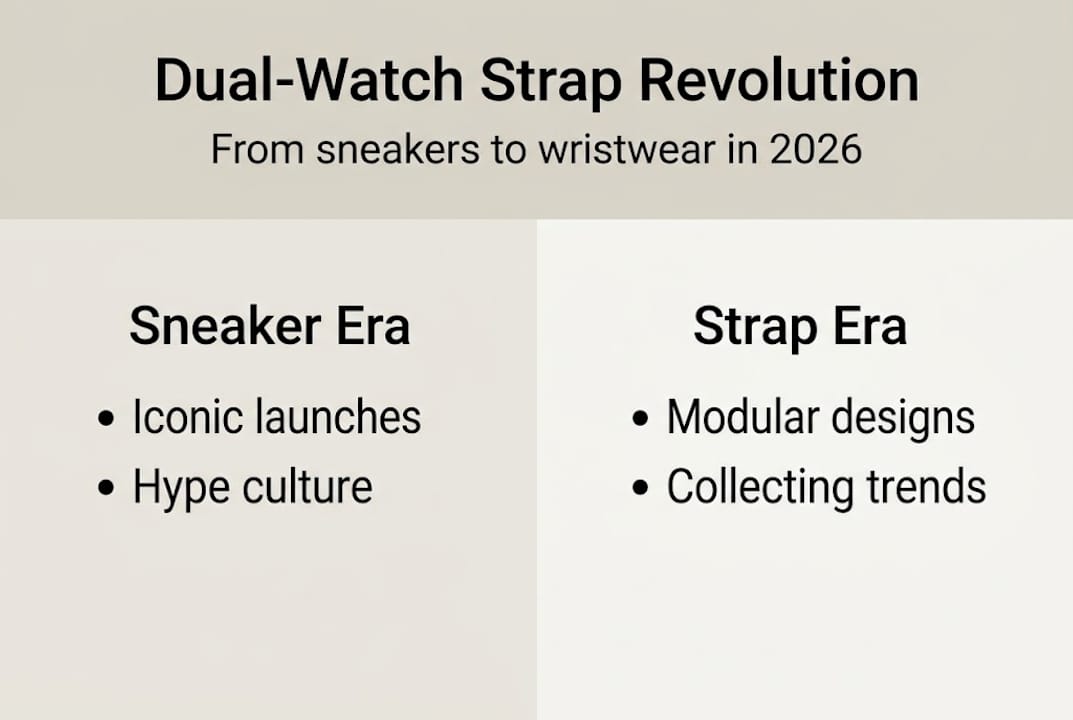
2015 to 2026 Collab fatigue, engineering focus Modular adapters, dual-watch systems

The strap is no longer the part you ignore. It’s the part that defines the entire wrist composition.

Engineering precision: The modular dual-watch strap explained

Understanding the hype is one thing. Understanding the engineering is what separates a collector from a consumer. Modular dual-watch straps work on a principle that sounds almost obvious once you hear it: instead of forcing you to choose between your mechanical watch and your smartwatch, a precision-machined adapter holds both on a single strap, on a single wrist, at the same time.

Smartlet’s patented adapter is built from SS316L steel, which is the same steel grade used in Omega Speedmaster cases, or titanium grade 5, which is lighter than steel and stronger than aluminum. The modular adapter attaches via spring bar, meaning no drilling, no gluing, no permanent alteration to either watch. Compatibility spans 18mm to 24mm lug widths, which covers the vast majority of mechanical watches from Rolex, Omega, Tudor, TAG Heuer, and Breitling.

Here’s how the setup works, step by step:

  1. Remove your existing strap using a spring bar tool (check our spring bar replacement guide if you’re new to this)
  2. Attach the Smartlet adapter to your mechanical watch using the standard spring bar
  3. Connect your smartwatch (Apple Watch, Samsung Galaxy Watch, or Garmin) via the optional connector
  4. Position the mechanical watch on top and the smartwatch on the inner wrist
  5. Adjust the strap for comfort and lock everything in place

Total setup time: under two minutes.

機能 Classic (349 EUR) Shadow (449 EUR) Titanium (599 EUR)
材料 SS316L steel SS316L steel Titanium grade 5
重量 標準 標準 Reduced
Finish Polished PVD coated Brushed titanium
互換性 18 to 24mm 18 to 24mm 18 to 24mm

Pro Tip: If you’re pairing a dress watch with an Apple Watch Ultra, position the smartwatch slightly toward the inner wrist. This keeps the mechanical piece visible at a glance and the smartwatch sensors in direct skin contact for accurate readings.

The dual-wear methods available today range from simple stacking to precision-engineered solutions like Smartlet. The difference is durability, discretion, and the fact that your Submariner stays completely unmodified.

Performance meets tradition: Wearing mechanical and smartwatches together

The practical question every collector and athlete asks is straightforward: does it actually work? Not just aesthetically, but functionally. The answer is yes, and the engineering explains why.

When the smartwatch sits on the inner wrist position, sensor accuracy for cycling and running is maintained at the same level as wearing the smartwatch alone. Heart rate, SpO2, and GPS tracking all function correctly because the sensor array maintains consistent skin contact. You’re not compromising your training data to wear a beautiful mechanical piece.

Cyclist checking dual-watch strap after ride

On the mechanical side, the benefits are equally clear. Smartlet preserves your mechanical watch completely unmodified, which means collector value stays intact. No case modifications, no aftermarket parts, no questions when you eventually sell or pass it on.

Here’s what dual-wear actually delivers for performance-driven collectors:

  • Full smartwatch functionality: HR, SpO2, GPS, notifications, and payment all work normally
  • Mechanical watch integrity: Zero modifications, zero impact on movement or case
  • Style versatility: One wrist setup transitions from boardroom to track without changing watches
  • Time savings: No decision fatigue about which watch to wear on a given day
  • Check smartwatch compatibility before purchasing to confirm your specific model is supported

The broader context matters here too. A growing number of collectors are realizing that owning both a mechanical watch and a smartwatch isn’t a contradiction. It’s a position. The mechanical piece represents craft, history, and investment. The smartwatch represents real-time data, connectivity, and health awareness. Forcing a choice between them was always a false dilemma.

Infographic comparing sneaker and watch strap culture

For more context on how collectors are navigating this, the two watches one wrist discussion has moved from niche forums to mainstream watch media in the past 18 months.

Nuances and pitfalls: What most guides miss about dual-watch straps

Most guides stop at the excitement. They show you the product, explain the concept, and leave you to figure out the edge cases on your own. That’s not useful. Here’s what actually comes up.

First, physical comfort. Wearing two watches adds mass to your wrist. For most people this is negligible after a day of wear, but if you have a smaller wrist or you’re sensitive to weight, the titanium version of Smartlet makes a meaningful difference. The inner wrist contact point can occasionally cause minor skin marks during extended high-intensity activity, similar to any watch worn tightly during exercise.

Second, proportion. Pairing a 44mm Apple Watch under a 38mm or 40mm dress watch creates a visual imbalance that looks awkward from certain angles. The sweet spot is matching a 40 to 42mm smartwatch with a 40 to 44mm mechanical piece. When proportions align, the combination looks intentional rather than improvised.

“The dual-strap approach is genuinely better than hybrid watches or double-wristing. Hybrids compromise on both smartwatch features and mechanical credibility. Double-wristing looks bulky and signals you couldn’t decide. A modular adapter is the only solution that respects both watches fully.”

Third, consider the alternatives honestly:

  • Hybrid watches: Sacrifice full smartwatch functionality and rarely satisfy serious collectors
  • Double-wristing: Two separate straps on one wrist looks unintentional and creates bulk
  • Modular dual-strap: Engineered solution, both watches fully functional, clean aesthetic

For a deeper look at how this technology is reshaping the broader industry, the dual-watch bracelet industry impact discussion is worth reading. And if you’re curious about the original design philosophy, the single strap innovation story behind Smartlet explains how David Ohayon’s frustration became a patented solution.

Our take: Why the mechanical-smartwatch fusion is a collector’s must-have

After working through the technical and practical angles, here’s the honest editorial position: dual-wear isn’t a trend. It’s a mindset shift that was overdue.

Collectors spent years treating mechanical watches and smartwatches as opposing philosophies. That framing was always wrong. One tells you the time beautifully. The other tells you about your body and your world in real time. These are complementary functions, not competing ones.

What changed the conversation practically is quick-release engineering. Smartlet’s design, which earned a Bronze Medal at Concours Lépine 2025 and was presented at CES 2026, reduces strap swap time by over 90% compared to traditional spring bar tools. That’s not a minor convenience. It’s the difference between actually switching setups daily and leaving your prized watch in the drawer.

For collectors who want to explore specific pairings, the Omega and Apple dual-wear guide is a strong starting point. The lesson from hands-on experience is simple: the watches that work best in dual-wear are the ones you already love. Don’t choose. Compose.

Upgrade your wrist game with Smartlet

If this article has shifted how you think about your wrist setup, the next step is straightforward. The Smartlet modular strap is available in three versions, Classic, Shadow, and Titanium, each engineered for a different balance of weight, finish, and price. Before you order, use the brand compatibility guide to confirm your mechanical watch and smartwatch are both supported. It takes two minutes and removes all guesswork.

https://smartlet.io

For collectors who want to personalize further, Smartlet accessories include additional connectors and strap options to match any aesthetic. Sold in the US, Canada, EU, and Japan, with patents in all three major markets. This is precision engineering built for people who refuse to compromise.

よくある質問

Is the Smartlet dual-watch strap compatible with all mechanical and smartwatches?

Smartlet fits most mechanical watches with 18 to 24mm lugs and adapts to Apple, Samsung, and Garmin smartwatches via optional connectors. Confirmed compatibility includes Rolex, Omega, Tudor, TAG Heuer, and Breitling on the mechanical side.

Does dual-wear affect smartwatch sensor accuracy?

Positioning the smartwatch on the inner wrist maintains full sensor contact, so HR, SpO2, and GPS readings stay accurate. Inner wrist placement is especially effective during cycling and running.

How difficult is it to set up a modular dual-watch strap?

Setup takes under two minutes with a spring bar tool, and quick-release design cuts swap time by over 90% compared to traditional methods. No technical expertise required.

Are there any drawbacks to wearing two watches on one strap?

Minor issues like inner wrist marks during intense activity and proportion mismatch between differently sized watches can occur. These edge cases are less problematic than hybrid watch compromises or the bulk of double-wristing.