


Los relojes de los consultores: credibilidad, presencia y datos de salud

Fundador y CEO, Smartlet - Ingeniero CentraleSupelec - Concours Lepine 2025, Galardonado - CES 2026
Tabla de contenidos
- El papel de los relojes en la presencia ejecutiva
- Smartwatches y datos de salud: equilibrando necesidades modernas
- Por qué los consultores rara vez eligen uno: el dilema de credibilidad versus datos
- Marcos y soluciones: llevar ambos sin compromisos
- Una perspectiva contraria: por qué la presencia sigue siendo superior a los datos en la sala de juntas
- Próximos pasos: haz que tu reloj funcione para ti
- Preguntas frecuentes
Conclusiones clave
| Punto | Detalles |
|---|---|
| La credibilidad importa | Los relojes tradicionales juegan un papel crucial en proyectar disciplina y enfoque durante reuniones de estrategia. |
| Datos basados en salud | Los smartwatches ofrecen información valiosa sobre salud para consultores que priorizan el bienestar personal. |
| Sin necesidad de compromisos | Nuevos marcos y productos ayudan a los profesionales a combinar sin problemas presencia y monitoreo de datos. |
| El contexto influye en la elección | La mayoría de los consultores utilizan ambos tipos de reloj dependiendo de la ocasión y las necesidades del flujo de trabajo. |
Entra en cualquier reunión de estrategia de McKinsey, BCG o Bain, y notarás algo consistente: los consultores en la mesa casi nunca están revisando sus teléfonos. En cambio, echan un vistazo a sus muñecas. Ese reloj en la muñeca de un consultor senior no es una coincidencia. Es una señal deliberada, una herramienta y, cada vez más, un dispositivo de monitoreo de salud todo en uno. Para los profesionales de estrategia de hoy, la pregunta ya no es simplemente "¿qué reloj debo llevar?" Es "¿cómo gestiono días de 12 horas de trabajo intenso con clientes mientras mantengo tanto mi imagen profesional como mis datos de salud personal intactos?"
El papel de los relojes en la presencia ejecutiva
Hay una razón por la que los relojes mecánicos son prácticamente un uniforme en la cultura de consultoría de élite. Firmas como McKinsey, BCG y Bain han cultivado durante mucho tiempo una cultura donde cada detalle visible, desde el corte de un traje hasta el grosor del bisel de un reloj, comunica algo sobre tu criterio, tu atención al detalle y tu relación con la calidad.
Los consultores y ejecutivos en entornos profesionales prefieren fuertemente los relojes mecánicos tradicionales sobre los smartwatches precisamente porque proyectan credibilidad, disciplina y enfoque. Esto no es moda. Es comunicación profesional en su forma más sutil. Cuando un socio de una firma de primer nivel lleva un Patek Philippe vintage o un Omega Speedmaster a una sala de juntas, el cliente lo lee como una declaración: 'Tomo decisiones con cuidado y permanencia.'
Un reloj mecánico tradicional señala algo que un smartwatch simplemente no puede replicar:
- Pensamiento a largo plazo: un reloj mecánico está construido para sobrevivir a su propietario. Comunica una preferencia por la durabilidad sobre la tendencia.Pensamiento a largo plazo.
- Conciencia de la artesanía: apreciar la mecánica fina habla de un ojo para la precisión, una cualidad que todo cliente quiere en su asesor de estrategia.Conciencia de la artesanía.
- Presencia sin distracciones: sin banners de notificaciones, sin pantallas brillantes. El consultor está completamente presente.Presencia sin distracciones.
- Disciplina visual: el reloj es discreto, propositivo y consistente con un guardarropa profesional.Disciplina visual.
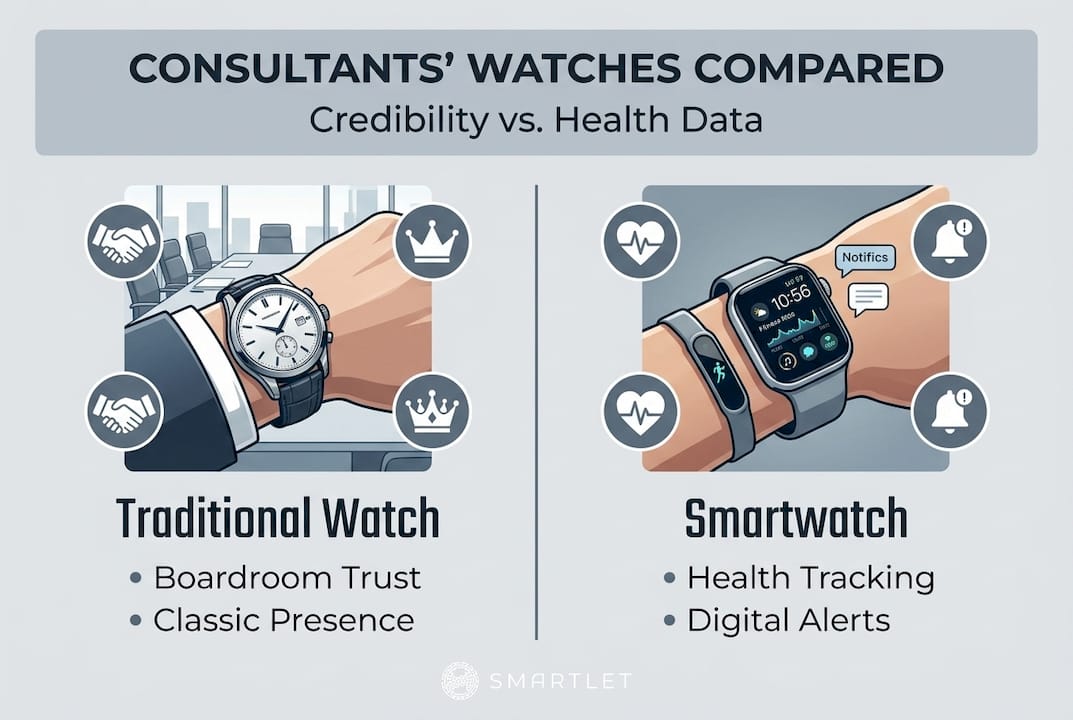
"Los relojes tradicionales señalan juicio atemporal, artesanía y presencia sin distracciones de notificaciones, a diferencia de los smartwatches que parecen casuales y fragmentan la atención."
Esta percepción tiene consecuencias reales. La capacidad de un consultor para comandar confianza en una sesión de estrategia puede depender de estas señales sutiles y no verbales. Echar un vistazo a un Apple Watch a mitad de una presentación comunica impaciencia. Revisar un Rolex Submariner o un JLC Reverso se lee completamente diferente.
En reuniones con clientes, el reloj mecánico no es solo una preferencia estética. Es parte del desempeño. Y hay razones históricas profundas por las que los relojes mecánicos continúan prosperando incluso en la era de los dispositivos conectados: llevan un significado que las herramientas digitales no pueden fabricar.clásico versus smartwatchlos relojes mecánicos continúan prosperando
Smartwatches y datos de salud: equilibrando necesidades modernas
Ahora considera lo que el cuerpo de un consultor experimenta durante un día de cliente de 12 horas. Vuelos tempranos, talleres consecutivos, un almuerzo de trabajo que es apenas una pausa, una sesión informativa nocturna durante la cena. Las demandas físicas y cognitivas son significativas. Los picos de estrés, la calidad del sueño se deteriora durante las semanas de viaje, y el desempeño sostenido depende cada vez más de la autoconciencia sobre las métricas de salud personal.

Para un consultor que gestiona un compromiso de 4 meses con sueño mínimo y presión alta, una vista en tiempo real de tendencias de VFC o frecuencia cardíaca en reposo no es un lujo. Es inteligencia de desempeño.
Los beneficios son concretos:
- Monitoreo continuo de frecuencia cardíaca detecta signos tempranos de agotamiento o escalada de estrés antes de que afecten el desempeño.
- Seguimiento de la calidad del sueño ayuda a los consultores a optimizar la recuperación durante sprints de proyectos intensos.
- Conteos de pasos y recordatorios de actividad contrarrestan la naturaleza sedentaria de las largas reuniones con clientes y viajes.
- Indicadores de estrés señalan cuándo se necesitan estrategias de recuperación, ejercicios de respiración o un paseo corto durante el día.
- Gestión de notificaciones puede filtrar alertas urgentes sin requerir revisiones de teléfono durante momentos sensibles con clientes.
El desafío, sin embargo, es que llevar un smartwatch a una reunión de estrategia formal cambia la energía. Los clientes lo notan. Una pantalla brillante o una estética de rastreador de fitness interrumpe la gramática visual de autoridad que los consultores trabajan duro para mantener.smartwatches y entornos profesionales
Cambia a modo silencioso con la pantalla configurada en "solo despierta al levantar" con una esfera de reloj mínima. Aun así, considera si la impresión visual sirve tus objetivos profesionales en ese contexto específico.
La solución no es abandonar el monitoreo de salud. Es encontrar una manera dellevar ambos relojes sin hacer un compromiso visible.
Por qué los consultores rara vez eligen uno: el dilema de credibilidad versus datos
La verdad es que la mayoría de los consultores experimentados han resuelto silenciosamente este dilema mediante el cambio de contexto. Llevan un smartwatch durante entrenamientos y viajes, luego cambian a un reloj tradicional en el momento en que entran en entornos con clientes. Pero esta es una solución imperfecta. Cambiar relojes toma tiempo, crea fricción, y significa que durante tus momentos más exigentes física y cognitivamente, no tienes datos de salud en absoluto.
Aquí hay una comparación directa que aclara los compromisos:
| Característica | Reloj mecánico tradicional | Smartwatch |
|---|---|---|
| Credibilidad profesional | Muy alta | Baja a moderada |
| Seguimiento de datos de salud | Ninguno | Continuo y detallado |
| Riesgo de distracción en reuniones | Muy bajo | Moderado a alto |
| Percepción del cliente | Autoritario y enfocado | Casual u orientado a la tecnología |
| Durabilidad y longevidad | Décadas con servicio | Típicamente 2 a 4 años |
| Idoneidad para sala de juntas | Excelente | Situacional |
Las dos categorías de relojes son genuinamente complementarias, no competitivas. La decisión no es sobre cuál es mejor en abstracto. Es sobre cuál herramienta sirve el momento específico.
Aquí está el proceso de toma de decisiones práctico que muchos consultores senior siguen:
- Identifica el contexto principal del día. Revisa el cronograma del día para establecer si es un día completo de trabajo interno o reuniones con clientes. Esto determina qué reloj tiene prioridad en la muñeca.Identifica el contexto principal del día.
- Evalúa la relación con el cliente. Con un cliente de larga data e informal, un smartwatch puede ser aceptable. Con un nuevo contacto de C-suite, un reloj tradicional señala respeto y seriedad.Evalúa la relación con el cliente.
- Planifica ventanas de monitoreo de salud. Si los datos de salud importan, identifica momentos en el día, mañana, almuerzo, viaje, donde un dispositivo conectado puede operar sin afectar la presencia.
- Considera el formato de la reunión. Un taller de estrategia de dos horas permite menos tolerancia para distracciones de dispositivos que una sesión de trabajo informal.Considera el formato de la reunión.
- Por defecto, presencia sobre datos. En caso de duda, prioriza la señal profesional. Puedes ponerte al día con los datos de salud en tiempo de transición.Por defecto, presencia sobre datos.
El dilema deunir relojes tradicionales y conectados en una sola muñeca es uno que la industria relojera está comenzando a tomar en serio. El concepto de unapulsera de reloj dual desafía suposiciones que han gobernado cómo los profesionales se visten y monitorean su salud durante décadas.
Marcos y soluciones: llevar ambos sin compromisos
La mayoría de los consejos sobre este tema son anecdóticos. No hay puntos de referencia empíricos específicos sobre los hábitos de uso de relojes de los consultores. Las preferencias que observamos provienen de la cultura profesional, la escritura de etiqueta empresarial y la experiencia vivida de personas dentro de estas firmas.
Lo que sí tenemos es innovación que cierra la brecha entre los dos mundos de relojes. Los marcos más prácticos que los consultores pueden usar hoy incluyen:
- Cambio situacional con un sistema: mantén ambos relojes accesibles y construye el hábito de cambiar según la revisión del calendario de la mañana. Esto toma aproximadamente 30 segundos y preserva ambos objetivos.Cambio situacional con un sistema.
- Soluciones de doble uso. Los conectores de propósito específico permiten que un reloj tradicional y un smartwatch compartan la misma muñeca simultáneamente, cada uno manteniendo su función completa sin modificar ninguno de los dispositivos.
- Esferas de smartwatch mínimas: configura tu reloj conectado para mostrar solo esferas de estilo analógico y desactiva todas las notificaciones visibles. Esto reduce significativamente el contraste entre las dos estéticas.Esferas de smartwatch mínimas.
- Alternativas de anillo inteligente: para algunos consultores, un anillo inteligente ofrece funciones de monitoreo de salud sin impacto visual en la presencia profesional.Alternativas de anillo inteligente.
Aquí hay una vista práctica de cuándo se aplica cada enfoque:
| Situación | ¿Es apropiado el smartwatch? | ¿Funciona la solución de doble uso? |
|---|---|---|
| Presentación de junta directiva de C-suite | No | Sí, discretamente |
| Taller de equipo interno | Situacional | Sí |
| Cena con cliente | No | Sí |
| Aeropuerto o viaje | Sí | Sí |
| Entrenamiento matutino | Sí | Sí |
| Vuelo de larga distancia | Sí | Sí |
Posiciona la esfera del reloj tradicional hacia afuera hacia la sala. El lado del sensor del smartwatch se sienta contra tu muñeca, recopilando datos continuamente sin transmitir su presencia.
Para aquellos que coleccionan relojes finos, el atractivo de llevar relojes vintage y smartwatches juntos es particularmente fuerte. Un Omega vintage o Cartier Tank lleva historia y carácter, mientras que el dispositivo conectado debajo rastrea las biométricas de las que depende tu desempeño.llevar relojes vintage y smartwatches juntos
Una perspectiva contraria: por qué la presencia sigue siendo superior a los datos en la sala de juntas
Aquí está la verdad incómoda que la mayoría de los consejos enfocados en productividad evita: en una sala de juntas de alto riesgo, tus datos de salud no cierran tratos. Tu presencia sí.
En el contexto específico de una reunión de estrategia con un CFO escéptico o un CEO recién nombrado, lo que realmente mueve la aguja es cómo haces que esa persona se sienta sobre tu criterio y tu disciplina.
Un reloj tradicional comunica ambos silenciosamente. Dice: 'Presto atención a la artesanía. Tomo decisiones consideradas. No estoy distraído.' La mayoría de los profesionales se enfoca en los resultados visibles de la presencia sin reconocer que la base se construye sobre señales sutiles y consistentes a lo largo de meses y años.
La pregunta clásica o smartwatch no es, por lo tanto, realmente sobre relojes. Es sobre entender tu audiencia, gestionar el contexto y elegir la señal que sirve el momento. En la sala de juntas, la presencia gana. Fuera de ella, los datos ganan. La verdadera innovación es construir un kit de herramientas profesional que no te obligue a elegir entre los dos.
Próximos pasos: haz que tu reloj funcione para ti
Para los consultores que quieren dejar de elegir entre credibilidad y datos de salud, la solución adecuada ya existe. La correa modular Smartlet, en acero SS316L cepillado y titanio grado 2, le permite llevar su reloj tradicional y su dispositivo conectado en la misma muñeca, al mismo tiempo. Sin modificar ninguno de los relojes. Sin fricción. Sin comprometer su imagen.
Consulte la guía de compatibilidad de relojes para confirmar que sus relojes encajan y luego descubra el Smartlet Classic para encontrar la versión adecuada a su configuración. Si lleva un Rolex Submariner, una configuración específica muestra exactamente cómo se combina un smartwatch con un Submariner sin alterar el reloj en absoluto. Tres versiones disponibles: Classic (299 EUR), Shadow (399 EUR) y Titanium (549 EUR). No elija. Componga.
Recomendado
- Equilibrando ECG de Apple Watch y prestigio mecánico
- Combina estilo Cartier Tank con seguimiento de salud de Apple Watch
- Smartwatch versus anillo conectado: por qué las pantallas y los sensores importan
- Cómo el monitoreo cardíaco del smartwatch salva vidas: datos globales
- Cómo llevar un reloj vintage y smartwatch juntos
Artículos destacados
No people found
We couldn’t find anything with that term. Please try again.


